ADVERTISEMENT

Morocco looks outward

Published Aug 17, 2026 11:18 am
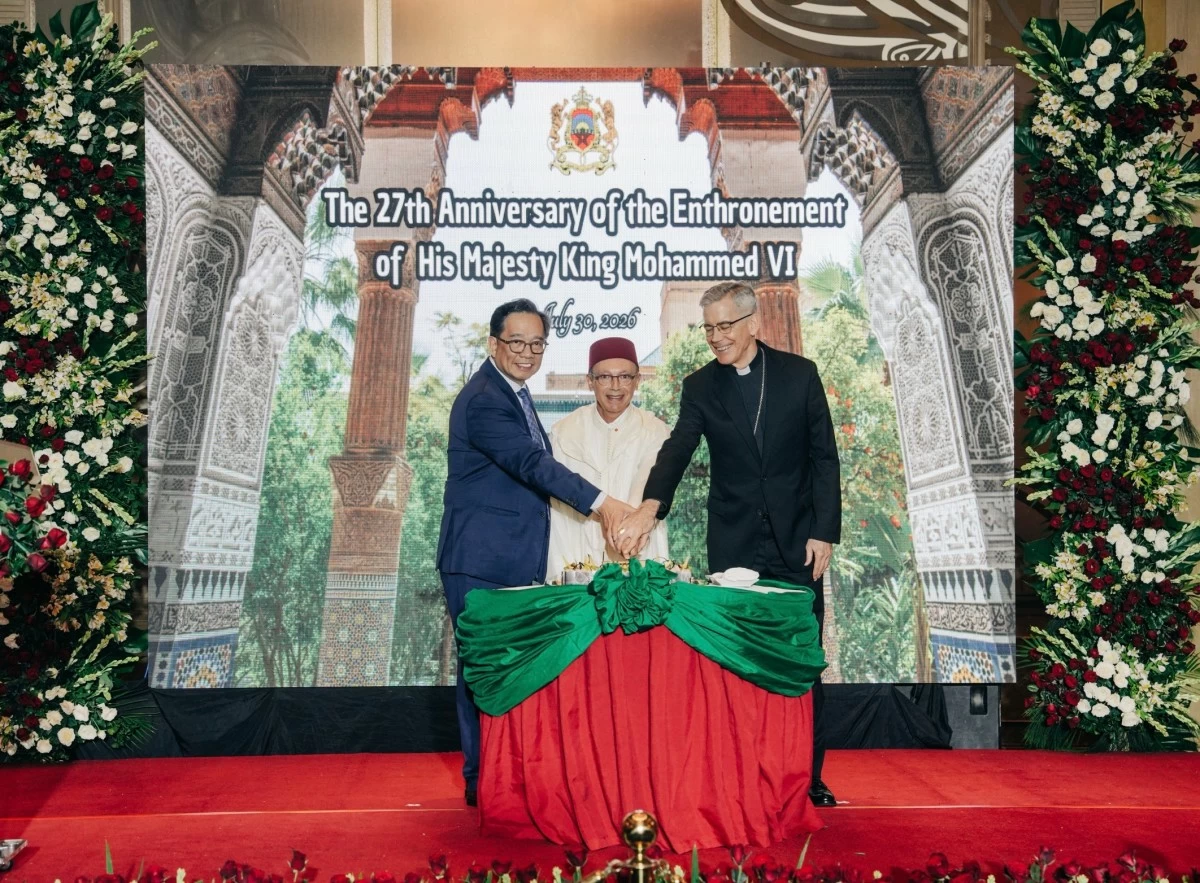
DFA Undersecretary Leo Herrera-Lim, Moroccan Ambassador Mohammed Rida El Fassi, and Dean of the Diplomatic Corps Rev. Charles Brown lead the celebrations for the 27th Anniversary of the Enthronement of King Mohamed VI. (Photo: Embassy of Morocco)
Twenty-seven years on the throne can change a country.
For Morocco, the reign of King Mohammed VI has coincided with an ambitious period of modernization that has reshaped its infrastructure, economy and international outlook, while strengthening the Kingdom’s position as a bridge between Africa, Europe and an increasingly wider circle of partners. That transformation provided much of the context when Morocco marked the 27th anniversary of the King’s enthronement in Manila on July 30.
Held at Dusit Thani Manila, the reception brought together members of the diplomatic corps, Philippine government officials, business leaders and friends of Morocco for Throne Day, one of the most important occasions on the Moroccan calendar.
There was also a bit of humor from Moroccan Ambassador Mohammed Rida El Fassi, who opened his remarks by recalling that he had confidently told guests at last year’s celebration that it would be his final Enthronement Day in the Philippines. “What I thought was a farewell speech should have been a ‘See you next year’ speech,” he joked.
A year later, he was back at the podium—and with considerably more to talk about. “Throne Day is a moment of national pride for all Moroccans,” El Fassi said. “It offers an opportunity to reflect on the remarkable transformation of Morocco under the leadership of His Majesty King Mohammed VI.”
Over the past 27 years, he noted, the Kingdom has pursued political, economic and social reforms aimed at promoting inclusive development, strengthening democratic institutions, advancing human rights and improving living conditions. Perhaps the most visible side of that transformation has been Morocco’s modernization drive.
Investments in infrastructure, renewable energy, industry and social development have helped position the country as a strategic hub connecting Africa with Europe and the wider world. Geography certainly helps: Morocco sits at the northwestern edge of Africa, just across the Strait of Gibraltar from Europe. But its ambitions increasingly stretch farther into the African continent.
El Fassi pointed to the Nigeria-Morocco African Atlantic Gas Pipeline as an example. The initiative envisions connecting Nigeria with Morocco along the Atlantic coast of West Africa, with the broader ambition of strengthening energy security and regional economic integration. For the ambassador, it reflects Morocco’s larger approach to development: using its own growth to create stronger connections across the continent.
That outward-looking approach also defines Moroccan diplomacy. Under King Mohammed VI, El Fassi said, Morocco has remained committed to “peace, stability, sustainable development and effective multilateralism,” while pursuing South-South cooperation and expanding partnerships across Africa, Asia, Latin America and the Pacific.
The Philippines increasingly fits into that picture. Manila and Rabat celebrated 50 years of diplomatic relations in 2025. What began as a relationship separated by considerable geography has gradually expanded into cooperation in trade, tourism, renewable energy, education and culture.
The two countries also work together in multilateral institutions, including on issues affecting middle-income countries—an area where nations separated by continents can nevertheless find themselves confronting remarkably similar development challenges.
Morocco’s location and connectivity offer Filipino businesses a potential gateway into African and European markets, while the Philippines gives Moroccan companies access to one of Southeast Asia’s largest consumer markets and a country positioned at the center of an increasingly consequential region. That makes the presence of Rustan’s and SSI Group Inc. as partners in this year’s celebration particularly fitting. Diplomatic relations ultimately deepen when government engagement is complemented by business, tourism, education and ordinary encounters between people.
Morocco has also become increasingly adept at using culture as part of that international introduction. For many Filipinos, the country is immediately recognizable through images of Marrakech, Casablanca, desert landscapes, intricate architecture and Moroccan cuisine. But behind that familiar visual identity is a country making a deliberate effort to present itself as a modern economy, an investment destination and a diplomatic actor with interests extending well beyond its immediate neighborhood.
Morocco and the Philippines may sit on opposite sides of continents, but both occupy interesting geographical positions: one looking toward Africa, Europe and the Atlantic, the other at the crossroads of Southeast Asia and the Indo-Pacific. There is opportunity in connecting those worlds.
Throne Day is ultimately a celebration of Morocco and the relationship between its monarch and its people. But this year’s reception in Manila also offered a glimpse of how Morocco increasingly sees its place beyond its borders. Twenty-seven years into the reign of King Mohammed VI, the Kingdom is not simply looking at how far it has come. It is looking at where—and with whom—it wants to go next.

Related Tags

Morocco
ADVERTISEMENT
.most-popular .layout-ratio{ padding-bottom: 79.13%; } @media (min-width: 768px) and (max-width: 1024px) { .widget-title { font-size: 15px !important; } }

{{ articles_filter_1561_widget.title }}

.most-popular .layout-ratio{ padding-bottom: 79.13%; } @media (min-width: 768px) and (max-width: 1024px) { .widget-title { font-size: 15px !important; } }

{{ static_articles_1562_widget.title }}

.most-popular .layout-ratio{ padding-bottom: 79.13%; } @media (min-width: 768px) and (max-width: 1024px) { .widget-title { font-size: 15px !important; } }

{{ articles_filter_1563_widget.title }}

{{ articles_filter_1564_widget.title }}

.mb-article-details { position: relative; } .mb-article-details .article-body-preview, .mb-article-details .article-body-summary{ font-size: 17px; line-height: 30px; font-family: "Libre Caslon Text", serif; color: #000; } .mb-article-details .article-body-preview iframe , .mb-article-details .article-body-summary iframe{ width: 100%; margin: auto; } .read-more-background { background: linear-gradient(180deg, color(display-p3 1.000 1.000 1.000 / 0) 13.75%, color(display-p3 1.000 1.000 1.000 / 0.8) 30.79%, color(display-p3 1.000 1.000 1.000) 72.5%); position: absolute; height: 200px; width: 100%; bottom: 0; display: flex; justify-content: center; align-items: center; padding: 0; } .read-more-background a{ color: #000; } .read-more-btn { padding: 17px 45px; font-family: Inter; font-weight: 700; font-size: 18px; line-height: 16px; text-align: center; vertical-align: middle; border: 1px solid black; background-color: white; } .hidden { display: none; }
function initializeAllSwipers() { // Get all hidden inputs with cms_article_id document.querySelectorAll('[id^="cms_article_id_"]').forEach(function (input) { const cmsArticleId = input.value; const articleSelector = '#article-' + cmsArticleId + ' .body_images'; const swiperElement = document.querySelector(articleSelector); if (swiperElement && !swiperElement.classList.contains('swiper-initialized')) { new Swiper(articleSelector, { loop: true, pagination: false, navigation: { nextEl: '#article-' + cmsArticleId + ' .swiper-button-next', prevEl: '#article-' + cmsArticleId + ' .swiper-button-prev', }, }); } }); } setTimeout(initializeAllSwipers, 3000); const intersectionObserver = new IntersectionObserver( (entries) => { entries.forEach((entry) => { if (entry.isIntersecting) { const newUrl = entry.target.getAttribute("data-url"); if (newUrl) { history.pushState(null, null, newUrl); let article = entry.target; // Extract metadata const author = article.querySelector('.author-section').textContent.replace('By', '').trim(); const section = article.querySelector('.section-info ').textContent.replace(' ', ' '); const title = article.querySelector('.article-title h1').textContent; // Parse URL for Chartbeat path format const parsedUrl = new URL(newUrl, window.location.origin); const cleanUrl = parsedUrl.host + parsedUrl.pathname; // Update Chartbeat configuration if (typeof window._sf_async_config !== 'undefined') { window._sf_async_config.path = cleanUrl; window._sf_async_config.sections = section; window._sf_async_config.authors = author; } // Track virtual page view with Chartbeat if (typeof pSUPERFLY !== 'undefined' && typeof pSUPERFLY.virtualPage === 'function') { try { pSUPERFLY.virtualPage({ path: cleanUrl, title: title, sections: section, authors: author }); } catch (error) { console.error('ping error', error); } } // Optional: Update document title if (title && title !== document.title) { document.title = title; } } } }); }, { threshold: 0.1 } ); function showArticleBody(button) { const article = button.closest("article"); const summary = article.querySelector(".article-body-summary"); const body = article.querySelector(".article-body-preview"); const readMoreSection = article.querySelector(".read-more-background"); // Hide summary and read-more section summary.style.display = "none"; readMoreSection.style.display = "none"; // Show the full article body body.classList.remove("hidden"); } document.addEventListener("DOMContentLoaded", () => { let loadCount = 0; // Track how many times articles are loaded const offset = [1, 2, 3, 4, 5, 6, 7, 8, 9, 10]; // Offset values const currentUrl = window.location.pathname.substring(1); let isLoading = false; // Prevent multiple calls if (!currentUrl) { console.log("Current URL is invalid."); return; } const sentinel = document.getElementById("load-more-sentinel"); if (!sentinel) { console.log("Sentinel element not found."); return; } function isSentinelVisible() { const rect = sentinel.getBoundingClientRect(); return ( rect.top < window.innerHeight && rect.bottom >= 0 ); } function onScroll() { if (isLoading) return; if (isSentinelVisible()) { if (loadCount >= offset.length) { console.log("Maximum load attempts reached."); window.removeEventListener("scroll", onScroll); return; } isLoading = true; const currentOffset = offset[loadCount]; window.loadMoreItems().then(() => { let article = document.querySelector('#widget_1690 > div:nth-last-of-type(2) article'); intersectionObserver.observe(article) loadCount++; }).catch(error => { console.error("Error loading more items:", error); }).finally(() => { isLoading = false; }); } } window.addEventListener("scroll", onScroll); });

Sign up by email to receive news.