






Manila Bulletin
 Philippines
National
Moro Gulf tsunami, 50 years later: What Phivolcs says we should know
Philippines
National
Moro Gulf tsunami, 50 years later: What Phivolcs says we should know
Philippines
National
Moro Gulf tsunami, 50 years later: What Phivolcs says we should know
Moro Gulf tsunami, 50 years later: What Phivolcs says we should know
Published Aug 17, 2026 11:34 am


At A Glance
- The 1976 event remains the deadliest tsunami in Philippine history.
- The earthquake struck at 12:11 a.m. on Aug. 17, 1976, when many residents were asleep, thus it is also known as the "Midnight Killer."
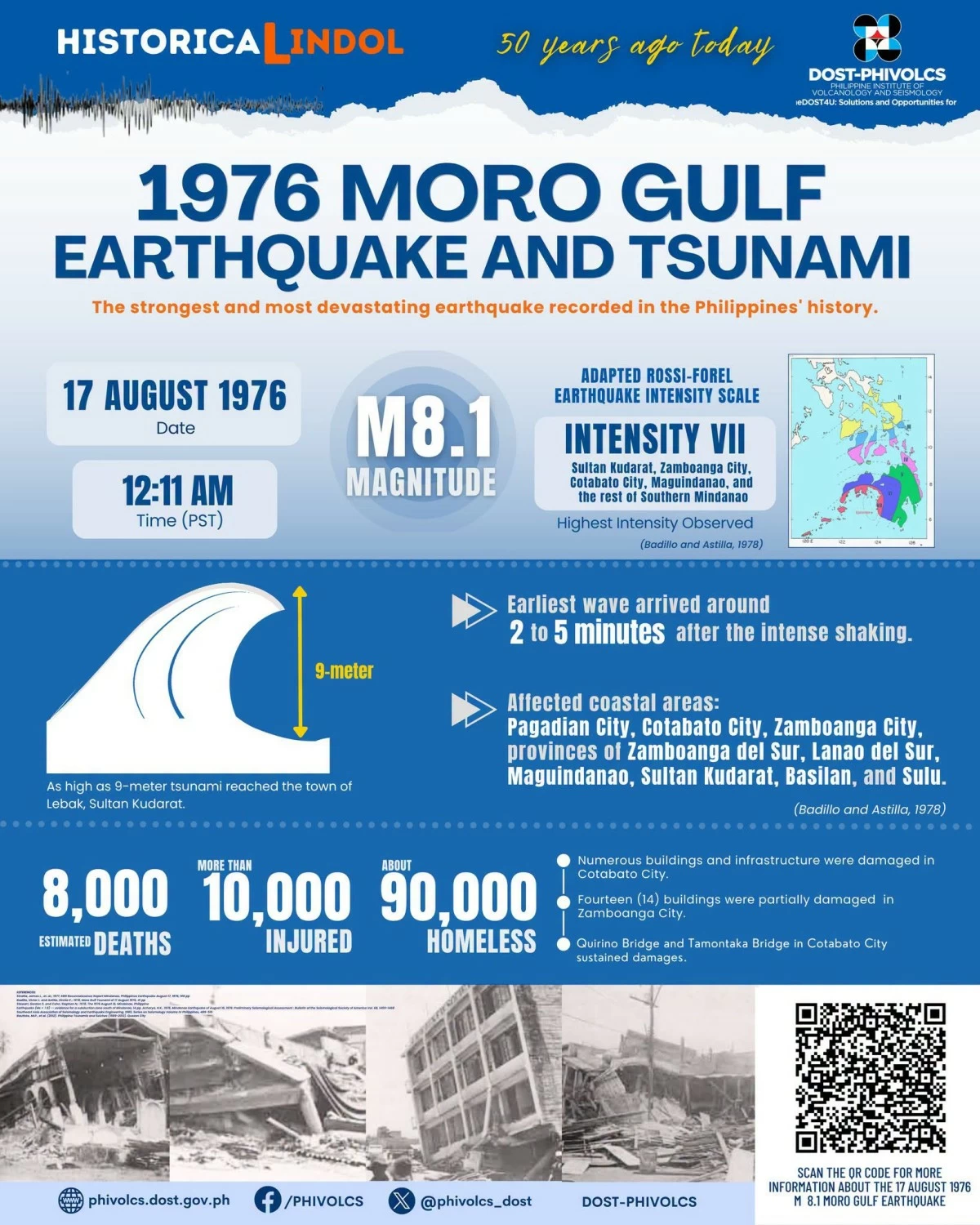
Phivolcs
Fifty years ago today, a magnitude 8.1 earthquake struck Moro Gulf, followed by a tsunami that devastated coastal communities in Sultan Kudarat and other areas around the gulf.
The earthquake struck at 12:11 a.m. on Aug. 17, 1976, when many residents were asleep, thus it is also known as the “Midnight Killer.”
In Lebak, Sultan Kudarat, tsunami waves reached as high as nine meters, about the height of a three-story building.
The tsunami also caused extensive coastal damage in Kalamansig and Palimbang, “severely affecting fishing communities and leaving widespread damage,” Phivolcs said.
About 8,000 people died in the disaster.
The 1976 event remains the deadliest tsunami in Philippine history.
Lessons from the disaster
The Philippine Institute of Volcanology and Seismology (Phivolcs) said residents in coastal areas should know the natural signs of a tsunami, particularly when an earthquake occurs near the coast.
The agency uses “Shake, Drop, Roar” to describe these signs.
“Shake” refers to strong or prolonged ground shaking, “Drop” refers to an unusual rise or fall in sea level, and “Roar” refers to an unusual sound coming from the sea.
People who feel a strong earthquake near the coast should move to higher ground or farther inland, especially if they notice unusual changes in the sea, instead of waiting for an official warning.
The same areas hit by the 1976 tsunami have faced another reminder of the hazard this year.
On June 8, a magnitude 7.8 earthquake off Sarangani prompted Phivolcs to issue a tsunami warning.
Tsunami inundation was later recorded in parts of Lebak and Kalamansig, with water reaching about 163 meters inland in Barangay Clara, Kalamansig.
The earthquake was generated by the Cotabato Trench, the same source that produced the 1976 Moro Gulf earthquake.
50th anniversary
As the country marks the 50th anniversary of the Moro Gulf earthquake and tsunami, Phivolcs and the local governments of Lebak and Sultan Kudarat are holding commemorative and preparedness activities in the area.
A commemorative marker will be unveiled on Aug. 17 at the Provincial Capitol Extension in Barangay Tibpuan, Lebak.
The marker “pays tribute to the survivors, responders, scientists, government agencies, local communities, international partners, and media organizations” involved in the response to the 1976 earthquake and tsunami, Phivolcs said.
The agency will also distribute earthquake and tsunami information materials to teachers and local disaster risk reduction and management officials.
On Aug. 18, an exhibit featuring the 1976 earthquake and interactive earthquake and tsunami preparedness activities will open at the Barangay Aurelio F. Freires Sr. Gymnasium.
Grade 7 and 8 students from Lebak and Kalamansig will also attend the “Kabataan: Handa ang May Alam” seminar on geologic hazards and preparedness.