






 Philippines
National
174 workers rescued as probe finds radioactive materials, substandard steel at Davao plant
Philippines
National
174 workers rescued as probe finds radioactive materials, substandard steel at Davao plant
174 workers rescued as probe finds radioactive materials, substandard steel at Davao plant


At A Glance
- An inter-agency operation found radioactive materials and substandard reinforcing steel at Davao Mighty Steel Corp. in Davao City.
- Authorities rescued 174 Filipino workers from an industrial environment containing radioactive-bearing materials, dust, fumes, wastes, and production residues.
- The NBI referred the case to the Department of Justice for possible violations of laws governing nuclear safety, hazardous wastes, environmental compliance, and consumer protection.
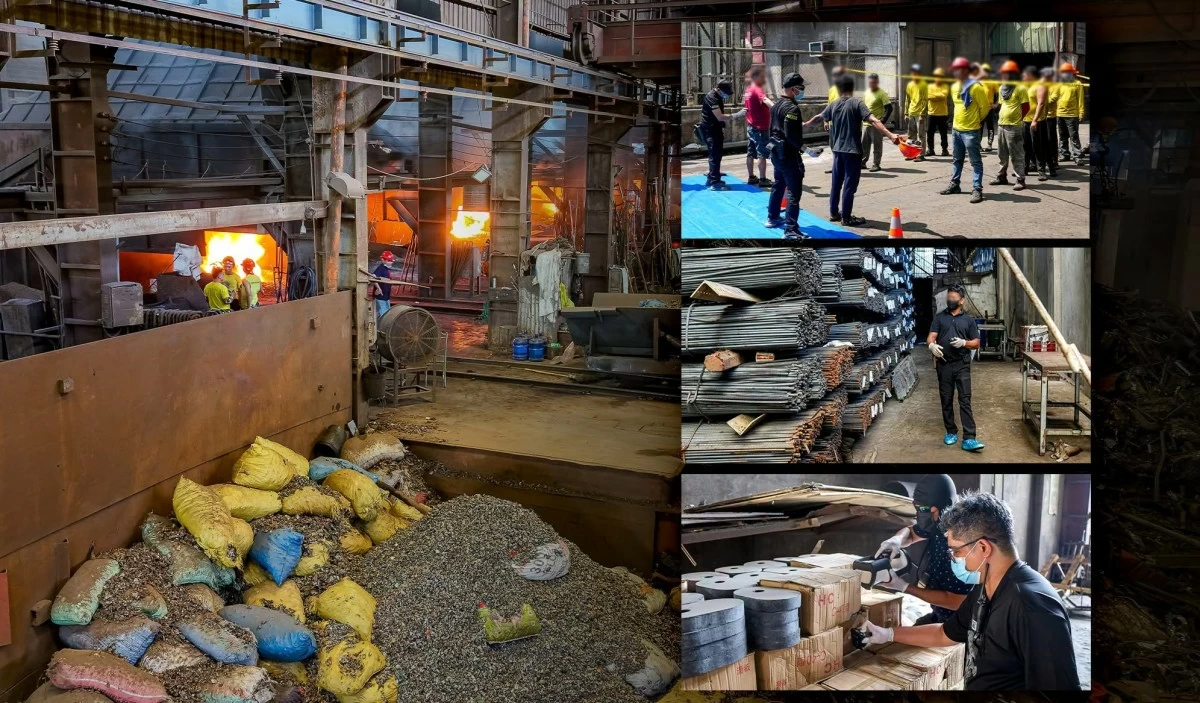
A total of 174 Filipino workers were rescued from Davao Mighty Steel Corp. in Davao City after an inter-agency operation found radioactive-bearing materials, dust, fumes, wastes, and production residues at the company's steel manufacturing facility, the Presidential Anti-Organized Crime Commission (PAOCC) said.
The PAOCC said this after the National Bureau of Investigation (NBI) and PAOCC implemented search warrants at the company's facility in Barangay Ilang, Bunawan, Davao City, on Aug. 13.
The operation resulted in the rescue of the 174 workers, who were removed from an industrial environment that authorities said contained radioactive-bearing materials and other substances that posed risks of continued occupational exposure.
In a statement, PAOCC Executive Director Undersecretary Benjamin Acorda Jr. said the government would act on evidence that steel products entering the market were substandard or contained radioactive materials.
“Malinaw ang ating layunin at ito ay ang protektahan ang buhay at kaligtasan ng bawat Pilipino (Our objective is clear, and that is to protect the lives and safety of every Filipino). We fully support the NBI as the lead law-enforcement agency, as well as all our partner agencies, in this operation,” he said.
“Kapag may ebidensiya na ang bakal na pumapasok sa ating merkado ay substandard o may radioactive materials, kailangang kumilos ang gobyerno (When there is evidence that steel entering our market is substandard or contains radioactive materials, the government must act),” he added.
According to PAOCC, the NBI, which led the operation, began investigating the company following reports that it was manufacturing and distributing substandard reinforcing steel bars.
The investigation expanded after the Philippine Nuclear Research Institute (PNRI) detected radioactive isotopes in commercially distributed DMS reinforcing steel.
Technical examinations confirmed the presence of Uranium-238, Thorium-228, Thorium-232, and Radium-226 in different stages and areas of the company's operations.
These materials were documented in finished DMS rebars, furnace-related materials, residual black sand, industrial powders, dust, wastes, wastewater, and other production and stored materials.
The PNRI also certified that the company and its identified officers and personnel did not possess the required license or authority to acquire, receive, possess, use, store, sell, transfer, import, or export nuclear or radioactive materials.
The Department of Environment and Natural Resources (DENR), meanwhile, found that the company's Environmental Compliance Certificate did not declare or authorize the presence, handling, processing, storage, or use of radioactive materials within the facility.
Substandard steel found in market
Separate from the radioactive-material findings, product-standard testing raised concerns over DMS reinforcing steel already circulating in the market.
Of eight DMS reinforcing steel samples purchased from commercial hardware establishments across Mindanao, four, or 50 percent, failed the mandatory mass-variation requirement under PNS 49:2020.
The NBI also documented DMS-marked reinforcing steel bars in the rubble of structures that collapsed following the magnitude 7.8 Mindanao earthquake on June 8, including schools, hospitals, government buildings, barangay health centers, and residences in Sarangani, Davao del Sur, and Davao Occidental.
Authorities stressed, however, that the presence of DMS rebars in the collapsed structures does not by itself establish that the steel caused the structural failures, which remain subject to appropriate engineering assessment.
Case referred to DOJ
The NBI has referred the case to the Department of Justice for appropriate proceedings involving alleged violations of the Philippine National Nuclear Energy Safety Act, the Toxic Substances and Hazardous and Nuclear Wastes Control Act, the Philippine Environmental Impact Statement System, and the Consumer Act of the Philippines.
The arrest warrants were implemented with assistance from the PNRI, Philippine Air Force, and Philippine Coast Guard CBRN units, PCG Special Operations Group, and the 10th Infantry Division of the Philippine Army.