






Manila Bulletin
 Philippines
Mindanao
DepEd Sarangani official wary of the impact of classroom shortage to learners amid quake devastation
Philippines
Mindanao
DepEd Sarangani official wary of the impact of classroom shortage to learners amid quake devastation
Philippines
Mindanao
DepEd Sarangani official wary of the impact of classroom shortage to learners amid quake devastation
DepEd Sarangani official wary of the impact of classroom shortage to learners amid quake devastation
Published Aug 14, 2026 01:53 pm


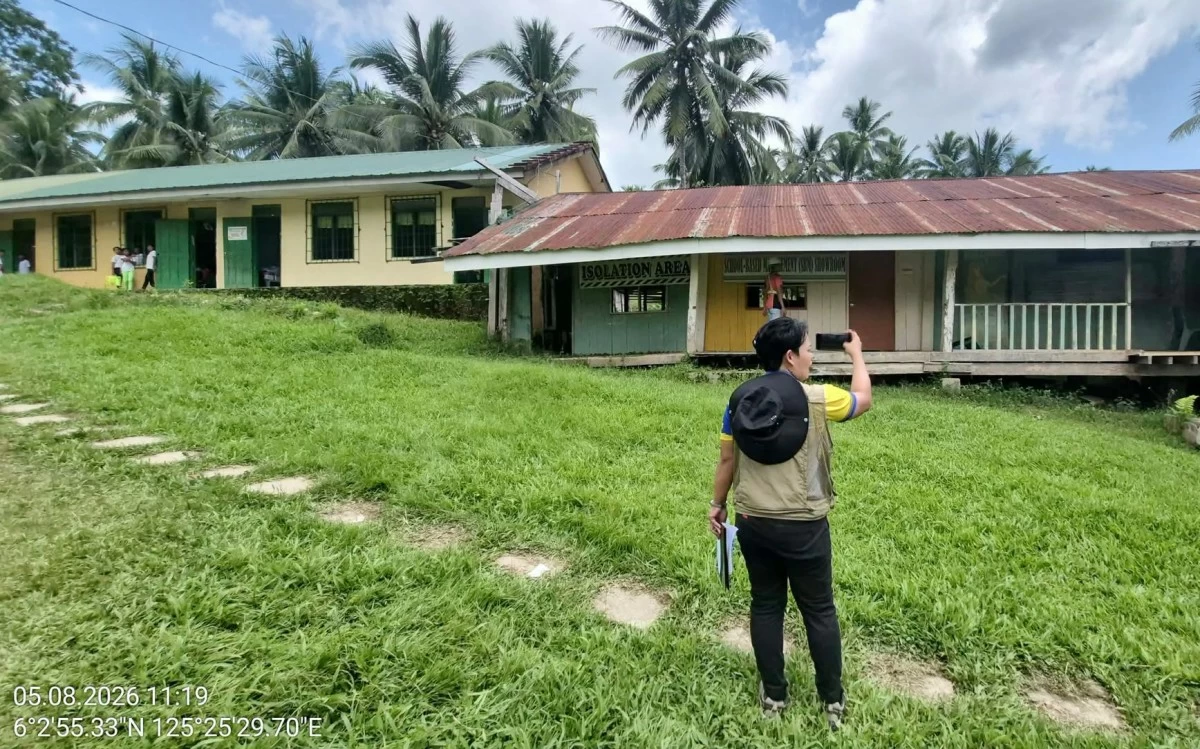
A personnel of Office of Civil Defense-12 conducts Post-Disaster Needs Assessment at a school in Malaptan ( OCD 12 Photo)
DAVAO CITY – An official of the Department of Education (DepEd) in Sarangani Province is wary of the impact of classroom shortage among learners as face-to-face classes resume in earthquake-devastated towns.
Dr. Donna Panes, curriculum implementation division chief of DepEd Sarangani Division, admitted that learners in the DepEd Sarangani Division have reeled from poor reading comprehension even before the magnitude-7.8 earthquake struck last June 8.
Thus, Panes said that the teachers are wary of the impact of the classroom shortage as many schools in severely-hit areas are implementing blended and modular learning methods after school buildings were totally damaged by the earthquakes.
"This measure is implemented due to lack of classrooms," she added.
On August 10, the provincial government of Sarangani announced that face-to-face classes in all levels will resume in both public and private schools. But it clarified that blended learning methods will be implemented in some schools that still have restricted classrooms.
Since the powerful earthquake struck on June 8, face-to-face classes in the province have been suspended several times due to continued aftershocks, heavy rains and flooding.
Of the 328 schools in the seven towns of the province, 45 are implementing blended learning, Panes said.
While modular distance learning will be implemented in some schools that are still not accessible due to landslides.
The DepEd Sarangani official disclosed that in Malapatan town, 19 schools are implementing a blended method and three are purely modular.
Seven schools are also implementing purely modular methods after the classrooms were totally damaged and the school site remains hazardous due to the powerful earthquake, she added.
In the neighboring town of Glan, 23 schools are under a blended method while four are implementing a modular method, Panes said.
These towns were the most-heavily affected by the earthquake last June.
Under the blended method, Panes said learners will attend three days of face-to-face classes and two days of modular learning.
She said that they are wary of this prolonged impact of the earthquake on the students’ learning environment. “We are facing a big challenge since our reading comprehension is already low even if we already have the classrooms. How much more now since we are facing classroom shortage?”
The DepEd Sarangani official admitted that she is saddened that many of the struggling readers are also the ones who are living in the remote areas.
Data from the DepEd Sarangani shows that out of 35,591 Grade 1 to 3 learners assessed, 59.25% were identified as struggling readers.
While intermediate level learners (Grades 4–6) show that out of 36,922 learners assessed, 86.03% in English and 79.25% in Filipino were performing below grade level (2 to 3 levels down).
It added that junior high school (Grades 7–10) shows that 87.84% in English and 82.19% in Filipino were non-proficient/frustration level readers.
The baselines assessment was conducted in July last year using the Comprehensive Rapid Literacy Assessment (CRLA) for Key Stage 1 and the Philippine Informal Reading Inventory (PHIL-IRI) for Key Stages 2 and 3.
Moreover, Panes also said the geographic barriers, resulting in physical fatigue, has also affected the performance of the learners since hundreds of learners walk over five kilometers daily to reach school.
This has resulted in chronic absenteeism and exhaustion, the report added.
“The profile of our struggling readers are the ones living in the most remote areas. They are the poorest of the poor here and they are the ones who have to walk to the schools. Unfortunately, they are the ones too who are severely affected by the earthquake and the landslides,” Panes emphasized.
Following the impact of the devastating earthquake last June, Panes acknowledged that there’s still a need to build more temporary classrooms known as Learning Continuity Spaces (LCS).
LCS are prefabricated, disaster-resilient classrooms, to address immediate classroom needs in disaster-affected areas designed prevent prolonged class disruptions during typhoons, earthquakes, and other calamities
According to Panes, the provincial government has allocated P170,000 worth of construction materials for each of the 117 LCS.
While the ng DepEd has allocated P62 million for clean up and cleaning operations and minor repairs in the province, she added.
Across the province, Panes said there are 778 totally damaged classrooms. “These are all for replacement, we needed to build new classrooms. That’s why we needed the LCS to continue classes. This shortage has resulted in the implementation of blended learning because we have a shortage of classrooms.”