







Stocks tumble as MSCI rebalancing, weak peso drag PSEi
Published Aug 13, 2026 04:58 pm


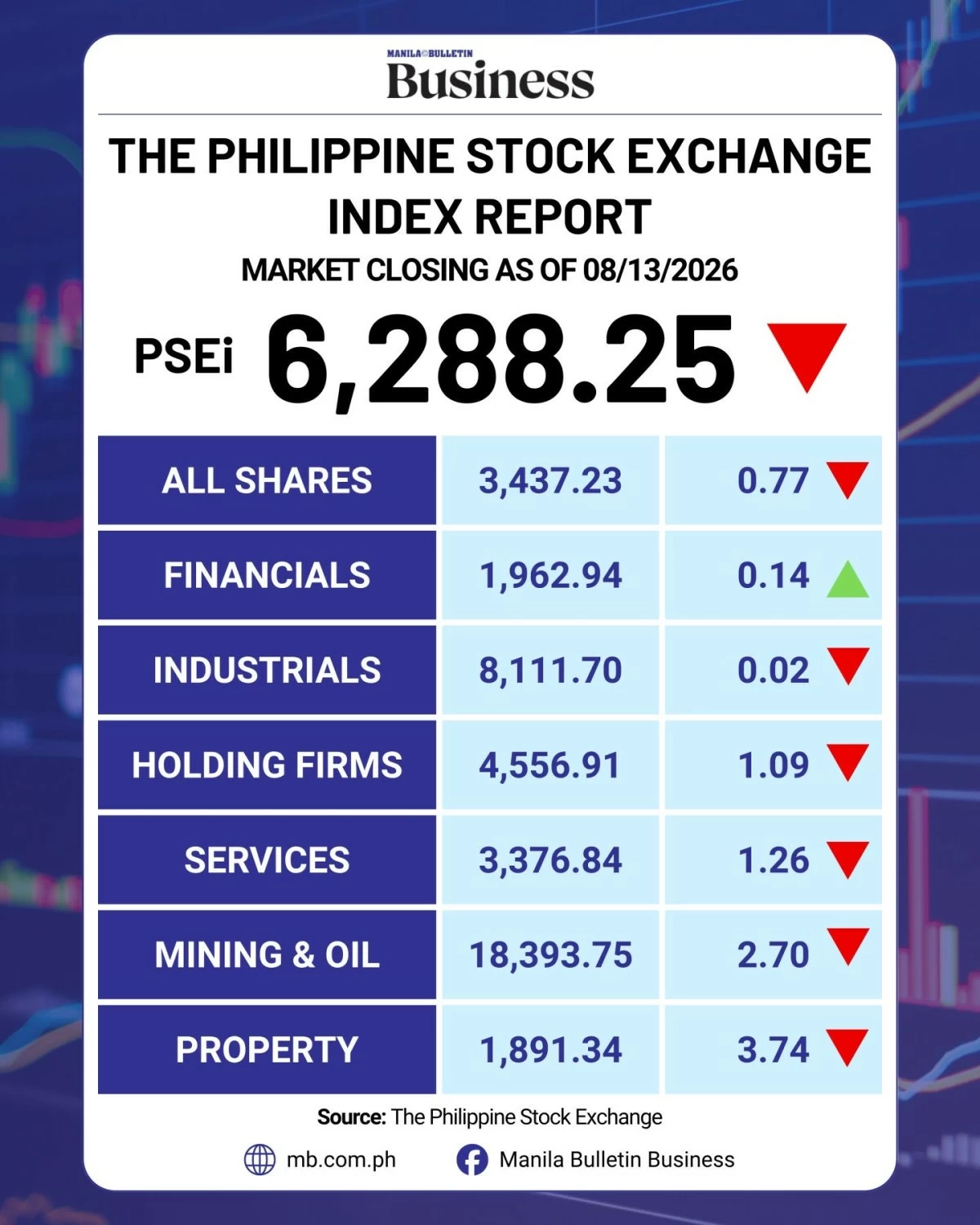
Local equities market retreated as the onset of the traditional “Ghost Month” coincided with portfolio shifts triggered by MSCI Inc.’s quarterly benchmark review and persistent local currency weakness, pushing the country’s main stock index to a one-week low.
The Philippine Stock Exchange index (PSEi) dropped 78.39 points, or 1.23 percent, to close at 6,288.25 on Wednesday, Aug. 13, with real estate developers leading sector-wide declines while commercial banks managed to hold their ground.
Trading activity surged alongside index adjustment flows, with total turnover reaching 1.34 billion shares valued at ₱14.25 billion. Market breadth leaned negative as decliners outnumbered gainers 96 to 89, while 63 issues closed unchanged.
Property heavyweights bore the brunt of the session's selling pressure, anchored by a steep decline in Ayala Land Inc.
Shares of the real estate developer dropped 5.67 percent to end at ₱14.98 apiece amid selling by international funds following the company's exclusion from the MSCI Philippine Standard Index due to reduced market capitalization footprint.
“The local index ended lower as investors reacted to the MSCI Philippine Index’s latest review, which triggered selling pressure on select names,” said Luis Limlingan, managing director at Regina Capital Development Corp.
“The peso’s depreciation against the US dollar further weighed on sentiment, prompting a more cautious stance among market participants,” he added.
Beyond benchmark reclassification dynamics, broader macroeconomic concerns and international geopolitical friction dampened appetite for domestic equities.
Investors opted to lock in gains following a brief two-day rally on the back of growing caution over escalating global tensions and the broader economic outlook.
“The local market declined as investors took profits after a two-day rise, reflecting cautiousness amid uncertainties in the Middle East and worries over the general economic outlook,” said Japhet Tantiangco, research manager at Philstocks Financial Inc.
Fiscal adjustments by domestic policy planners further strained market sentiment. The government recently revised downward its medium-term infrastructure spending program covering 2026 through 2029, raising concerns that reduced public capital expenditure could temper domestic economic expansion over the coming years.
“The PSEi dropped to a one-week low after the downward revision of the government’s infrastructure spending program from 2026 to 2029, which could fundamentally slow down economic growth in the coming years at the start of the Ghost Month,” said Michael Ricafort, chief economist at Rizal Commercial Banking Corp.