

ADVERTISEMENT

'Maawa naman tayo': De Lima files twin bills to cut electricity costs

Published Aug 12, 2026 12:55 pm  |  Updated Aug 12, 2026 01:10 pm

At A Glance

  • Rep. Leila de Lima files House Bill No. 10677 to prohibit non‑technical system loss charges on electric bills and limit ERC's authority to technical loss only.
  • She also files House Bill No. 10676 to exempt the system loss component charged to residential consumers from VAT, adopting Senator Kiko Pangilinan's Senate Bill No. 2124.
  • De Lima stresses that unjust charges burden Filipinos, urging reforms to ensure fair electricity pricing and reliable service.
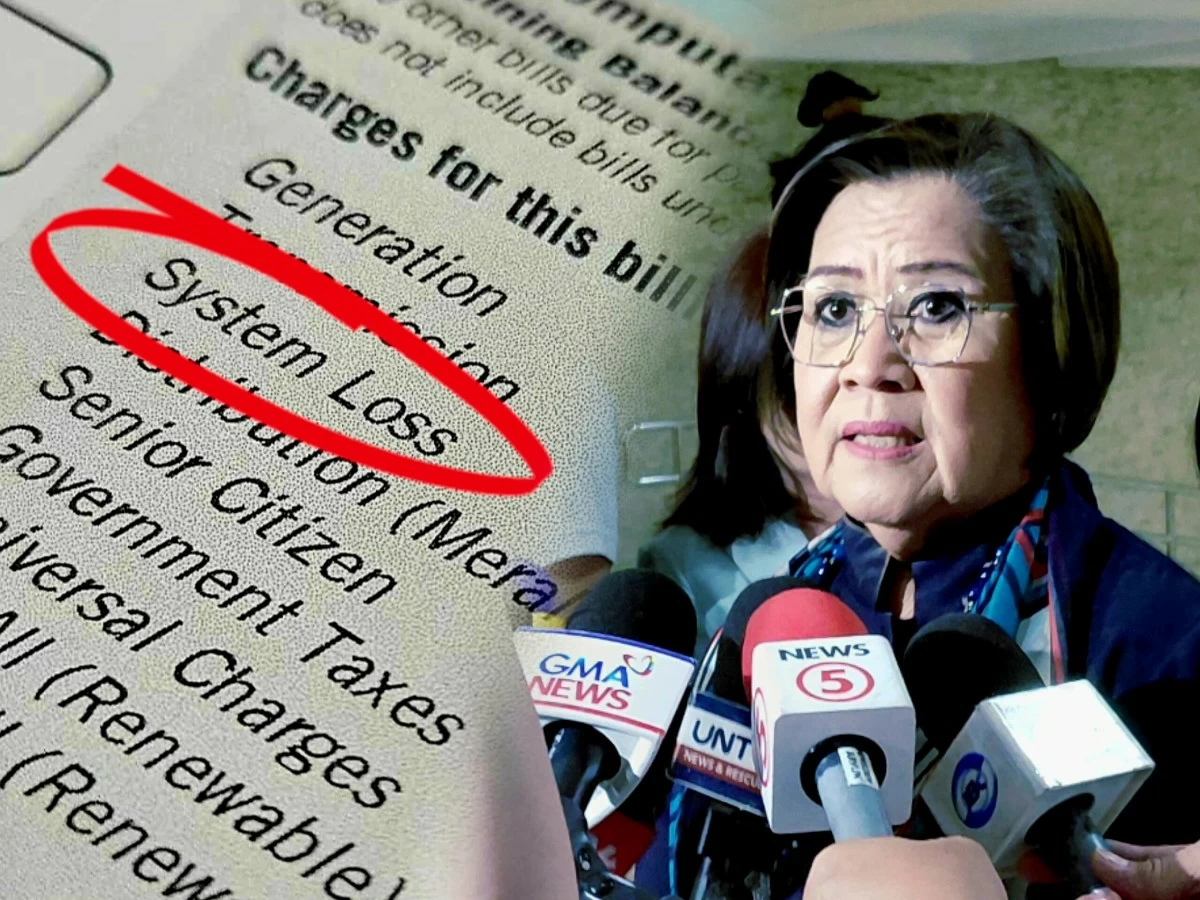
System loss charge from an electricity bill (left), Mamamayang Liberal (ML) Party-list Rep. Leila de Lima (Ellson Quismorio/ MANILA BULLETIN)


Mamamayang Liberal (ML) Party-list Rep. Leila de Lima has filed two measures seeking to reduce electricity costs by prohibiting non-technical system loss charges on electric bills and exempting system loss from value-added tax (VAT). 
In filing House Bill No. 10677 or the "Non-Technical System Loss Charge Prohibition Act", De Lima aims to amend Section 43(f) of Republic Act (RA) No. 9136 or the “Electric Power Industry Reform Act” (EPIRA) to limit the Energy Regulation Commission’s (ERC) rate- and cap-setting authority to technical loss alone.
Under this measure, distribution utilities (DUs) are prohibited from imposing or recovering from consumers any cost attributable to non-technical loss, whether through system loss rate or any other charge, fee, or cross-subsidy mechanism.
“Malaking bahagi ng gastos ng pamilya ang napakamahal at nagmamahal pang kuryente. Hindi naman tumataas ang sahod kaya nauuwi ito sa pagtitipid sa konsumo at pagkaltas ng budget para sa iba pang pangunahing pangangailangan," said De Lima, the House senior deputy minority leader.
(A large part of family expenses is the very expensive and still rising electricity. Salaries are not increasing, so this ends up in cutting consumption and reducing the budget for other basic needs.)
"Kaya sobrang kalabisan kung papasanin pa ng mga Pilipino pati yung hindi naman nila napakinabangang serbisyo,” she stressed.
(That's why it is excessive if Filipinos still have to bear services that they did not even benefit from.)
"Maawa naman tayo sa ating mga kababayan. Binubuwisan na nga sila sa sandamakmak na ghost flood control projects, binubuwisan pa rin sila para sa guni-guning kuryente,” De Lima lamented.
(Let us have pity on our fellow citizens. They are already being taxed for countless ghost flood control projects, and yet they are still being taxed for imaginary electricity.)
The ex-senator said additional burdens and unjust charges on electricity bills such as non‑technical system loss should be removed. "When the very lifeline that powers every Filipino home is priced fairly, only then can the promise of affordable and reliable electricity be truly fulfilled."
Under the 2017 Edition of the Philippine Distribution Code, technical loss is the inherent and unavoidable loss of electricity in its physical transmission and distribution through wires, transformers, and other equipment. On the other hand, non-technical loss results from pilferage, meter tampering, erroneous meter readings, and other human actions, whether intentional or negligent.
To ensure faithful implementation, the bill requires distribution utilities to segregate and report their Technical and Non-Technical Losses to the ERC, with corresponding administrative penalties imposed on DUs and responsible officials who fail to comply.
According to the Bicol congresswoman, this mechanism could create a direct financial incentive for distribution utilities to invest in anti-pilferage measures, meter security, and collection efficiency.
VAT exemption 
Meanwhile, De Lima also filed HB No.10676, which fully adopts Senator Kiko Pangilinan’s Senate Bill (SB) No. 2124, to exempt the system loss component charged to residential consumers from VAT by amending Article 109 of the National Internal Revenue Code (NIRC), as amended.
To prevent circumvention of the exemption, HB 10676 or the "VAT Exemption on System Loss Act for Residential Household Consumers", requires the ERC to ensure that the resulting reduction in tax liability is not passed on to consumers through distribution wheeling charges or other pass-through mechanisms.
De Lima says Filipinos deserve quality service, and the electricity sector is no exception.
“We must put an end to the injustice suffered by our countrymen by removing the tax burden on electricity that never reaches their households,” she added.

Related Tags

Electricity bills system loss charge Leila de Lima VAT
ADVERTISEMENT
.most-popular .layout-ratio{ padding-bottom: 79.13%; } @media (min-width: 768px) and (max-width: 1024px) { .widget-title { font-size: 15px !important; } }

{{ articles_filter_1561_widget.title }}

.most-popular .layout-ratio{ padding-bottom: 79.13%; } @media (min-width: 768px) and (max-width: 1024px) { .widget-title { font-size: 15px !important; } }

{{ static_articles_1562_widget.title }}

.most-popular .layout-ratio{ padding-bottom: 79.13%; } @media (min-width: 768px) and (max-width: 1024px) { .widget-title { font-size: 15px !important; } }

{{ articles_filter_1563_widget.title }}

{{ articles_filter_1564_widget.title }}

.mb-article-details { position: relative; } .mb-article-details .article-body-preview, .mb-article-details .article-body-summary{ font-size: 17px; line-height: 30px; font-family: "Libre Caslon Text", serif; color: #000; } .mb-article-details .article-body-preview iframe , .mb-article-details .article-body-summary iframe{ width: 100%; margin: auto; } .read-more-background { background: linear-gradient(180deg, color(display-p3 1.000 1.000 1.000 / 0) 13.75%, color(display-p3 1.000 1.000 1.000 / 0.8) 30.79%, color(display-p3 1.000 1.000 1.000) 72.5%); position: absolute; height: 200px; width: 100%; bottom: 0; display: flex; justify-content: center; align-items: center; padding: 0; } .read-more-background a{ color: #000; } .read-more-btn { padding: 17px 45px; font-family: Inter; font-weight: 700; font-size: 18px; line-height: 16px; text-align: center; vertical-align: middle; border: 1px solid black; background-color: white; } .hidden { display: none; }
function initializeAllSwipers() { // Get all hidden inputs with cms_article_id document.querySelectorAll('[id^="cms_article_id_"]').forEach(function (input) { const cmsArticleId = input.value; const articleSelector = '#article-' + cmsArticleId + ' .body_images'; const swiperElement = document.querySelector(articleSelector); if (swiperElement && !swiperElement.classList.contains('swiper-initialized')) { new Swiper(articleSelector, { loop: true, pagination: false, navigation: { nextEl: '#article-' + cmsArticleId + ' .swiper-button-next', prevEl: '#article-' + cmsArticleId + ' .swiper-button-prev', }, }); } }); } setTimeout(initializeAllSwipers, 3000); const intersectionObserver = new IntersectionObserver( (entries) => { entries.forEach((entry) => { if (entry.isIntersecting) { const newUrl = entry.target.getAttribute("data-url"); if (newUrl) { history.pushState(null, null, newUrl); let article = entry.target; // Extract metadata const author = article.querySelector('.author-section').textContent.replace('By', '').trim(); const section = article.querySelector('.section-info ').textContent.replace(' ', ' '); const title = article.querySelector('.article-title h1').textContent; // Parse URL for Chartbeat path format const parsedUrl = new URL(newUrl, window.location.origin); const cleanUrl = parsedUrl.host + parsedUrl.pathname; // Update Chartbeat configuration if (typeof window._sf_async_config !== 'undefined') { window._sf_async_config.path = cleanUrl; window._sf_async_config.sections = section; window._sf_async_config.authors = author; } // Track virtual page view with Chartbeat if (typeof pSUPERFLY !== 'undefined' && typeof pSUPERFLY.virtualPage === 'function') { try { pSUPERFLY.virtualPage({ path: cleanUrl, title: title, sections: section, authors: author }); } catch (error) { console.error('ping error', error); } } // Optional: Update document title if (title && title !== document.title) { document.title = title; } } } }); }, { threshold: 0.1 } ); function showArticleBody(button) { const article = button.closest("article"); const summary = article.querySelector(".article-body-summary"); const body = article.querySelector(".article-body-preview"); const readMoreSection = article.querySelector(".read-more-background"); // Hide summary and read-more section summary.style.display = "none"; readMoreSection.style.display = "none"; // Show the full article body body.classList.remove("hidden"); } document.addEventListener("DOMContentLoaded", () => { let loadCount = 0; // Track how many times articles are loaded const offset = [1, 2, 3, 4, 5, 6, 7, 8, 9, 10]; // Offset values const currentUrl = window.location.pathname.substring(1); let isLoading = false; // Prevent multiple calls if (!currentUrl) { console.log("Current URL is invalid."); return; } const sentinel = document.getElementById("load-more-sentinel"); if (!sentinel) { console.log("Sentinel element not found."); return; } function isSentinelVisible() { const rect = sentinel.getBoundingClientRect(); return ( rect.top < window.innerHeight && rect.bottom >= 0 ); } function onScroll() { if (isLoading) return; if (isSentinelVisible()) { if (loadCount >= offset.length) { console.log("Maximum load attempts reached."); window.removeEventListener("scroll", onScroll); return; } isLoading = true; const currentOffset = offset[loadCount]; window.loadMoreItems().then(() => { let article = document.querySelector('#widget_1690 > div:nth-last-of-type(2) article'); intersectionObserver.observe(article) loadCount++; }).catch(error => { console.error("Error loading more items:", error); }).finally(() => { isLoading = false; }); } } window.addEventListener("scroll", onScroll); });

Sign up by email to receive news.