







EDC highlights Mt. Apo plant's role in PH renewable energy
By Ivy Tejano


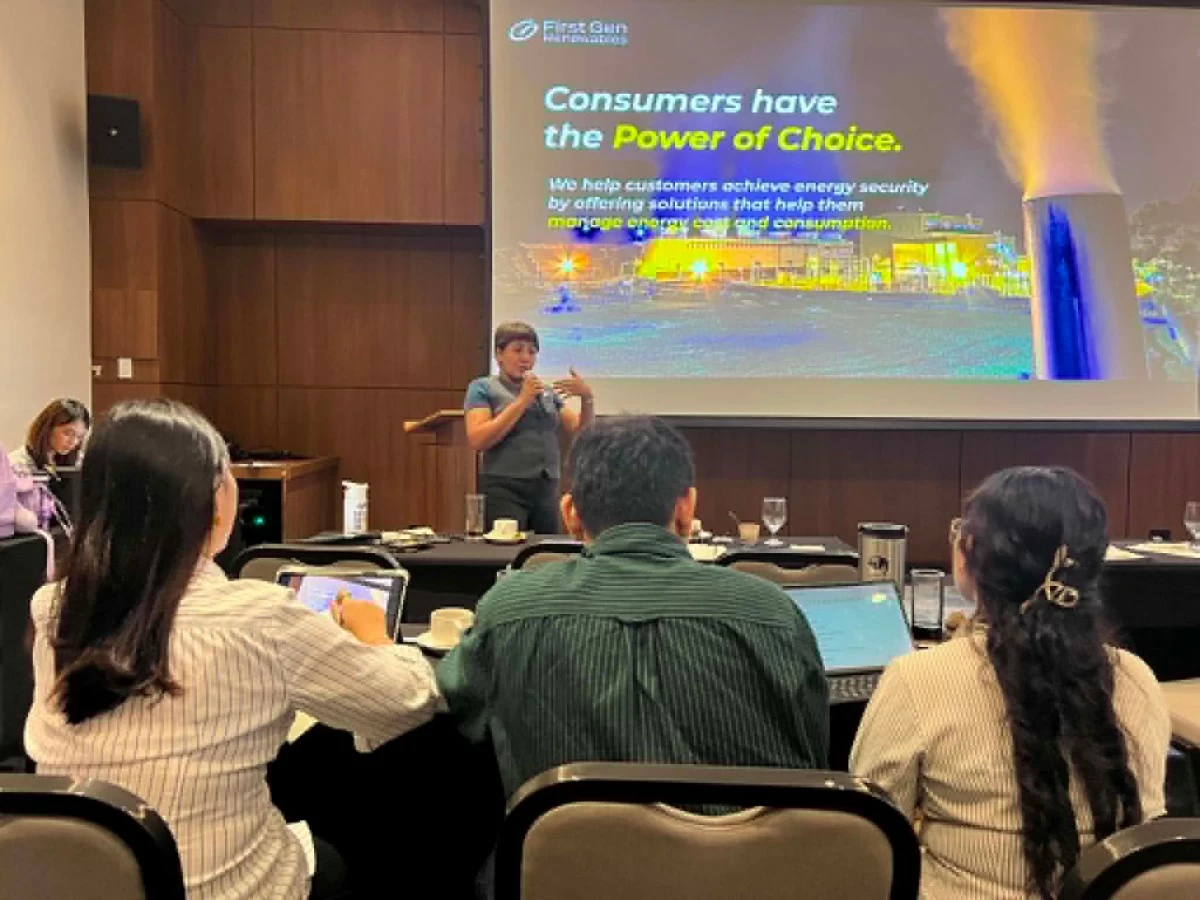
DAVAO CITY – The Energy Development Corporation (EDC) highlighted the continuing role of its Mt. Apo Geothermal Facility in the Philippines' renewable energy supply while outlining new investments, environmental programs, and community initiatives under the First Gen Renewables brand.
EDC company officials said the Mt. Apo Geothermal Complex in Kidapawan City, North Cotabato, has operated for nearly 30 years and remains an important part of EDC's five-decade geothermal development program.
Romy Kee, head of the EDC's Mt. Apo facility, said the company organized a media session to deepen public understanding of geothermal energy, the people behind its operations, and the role of renewable power in building a more sustainable energy system.
"EDC hopes to strengthen its partnership with the media practitioners to explain how clean, renewable, and reliable electricity is generated and supplied to communities and customers," Kee said, adding that the event aims to raise awareness on clean and renewable energy in Mindanao.
Frances Ariola, EDC corporate communications head, said the company has adopted First Gen Renewables as the unified public brand for the First Gen group's renewable-energy portfolio. She clarified that EDC's name and its legal identity remain unchanged.
During the discussion, Ariola said the First Gen Renewables brand covers the group's geothermal, hydro, wind, and solar assets, while First Gen Energy Solutions focuses on services that help customers improve energy efficiency and reduce carbon emissions.
The company said the unified branding is intended to clarify the relationship between First Gen and EDC for customers and the public. EDC, which was formerly a government-owned corporation, was acquired by the First Gen group in 2007.
According to the company's presentation, the First Gen group operates 31 renewable energy facilities with a combined installed capacity of 1,764.2 megawatts. These include 16 geothermal power plants, four hydro facilities, one wind farm, and 10 solar installations.
The company reported a renewable-energy generation output of 8,319.9 gigawatt-hours and said it accounts for about 30 percent of the country's renewable-energy production.
EDC itself has an installed renewable capacity of 1,597.57 megawatts, including 1,302.70 megawatts from geothermal facilities. The company said it produces about 56 percent of the Philippines' geothermal capacity.
The Philippines remains the world's third-largest geothermal producer after the United States and Indonesia, according to the presentation.
"Geothermal energy is especially important because, unlike intermittent renewable sources such as solar and wind, geothermal plants can operate continuously, providing baseload power around the clock," Ariola said.
Ariola said the Philippines has significant untapped renewable energy potential because of its location along the Pacific Ring of Fire and its geothermal, hydro, wind, and solar resources.
The company officials also discussed how large electricity consumers may directly contract power from licensed suppliers under the Electric Power Industry Reform Act.
According to the presentation, qualified customers with sufficient demand may participate in retail competition, retail aggregation, or the Green Energy Option Program.
Under retail aggregation, neighboring customers or tenants in a building may combine their electricity demand to meet the required threshold and negotiate with a power supplier. This arrangement may offer potential cost savings because electricity can be purchased on a wholesale basis.
First Gen also offers energy-efficiency services such as remote energy monitoring, transformer solutions, energy audits, and on-site solar installations. These services are designed to help businesses identify waste, improve operations, and reduce power costs.
Rosario Lagamon, deputy head of corporate communications at First Gen Corporation, said the company is also helping businesses develop decarbonization plans through the Net Zero Carbon Alliance.
Lagamon said the alliance was established in 2021 and had 47 partner organizations as of May 2026.
"Members are guided through a framework that includes making a public net-zero commitment, measuring emissions, preparing a roadmap, implementing reduction programs, tracking progress, and obtaining third-party validation," Lagamon added.
She said reducing the carbon intensity of the power grid is an important part of addressing climate change because much of the country's electricity is still generated from fossil fuels.
Lagamon explained that the use of renewable energy does not directly eliminate a community's exposure to storms, floods, or other climate hazards. However, replacing fossil-fuel generation with cleaner sources reduces greenhouse gas emissions that contribute to global warming.
"Geothermal development also depends on healthy forests and watersheds that help recharge underground resources," she said. "For this reason, EDC combines its power operations with forest protection, restoration, and biodiversity conservation."
Kay Abarrientos, head of corporate relations for EDC's Mt. Apo operations, emphasized that the facility is located within an ancestral domain in Kidapawan City; therefore, the company works closely with Indigenous communities, families, farmers, and local government units.
Among the groups supported by the Mt. Apo facilities are the Manobo Apo Descendants Ancestral Domain of Mount Apo, the Sudsuhayan Tribal Farmers Association, the 701 Tribal Farmers and Service Owners Association, and the Mount Apo Foundation Inc.
She said EDC's community programs are organized under three major areas: environmental protection through the BINHI program, education through the SIKAT program, and support for local needs and livelihoods.
BINHI, launched in 2008, covers forest protection, forest restoration, biodiversity conservation, and the propagation of native Philippine trees.
Across its program areas, Abarrientos said, EDC has mainstreamed 145 native tree species, established 44 arboreta and 163 tree parks, and conserved 1,474 endemic and near-endemic species, according to the company presentation.
Indigenous forest guards deputized by the Department of Environment and Natural Resources conduct regular patrols, remove wildlife traps, and report violations at the Mt. Apo site.
EDC also maintains a 25-kilometer fire line intended to help prevent forest fires from spreading across the mountain.
Abarrientos said that the company has reforested more than 10,260 hectares and has propagated 6.9 million native tree seedlings in partnership with 88 forest communities.
EDC has documented 549 wildlife species across its operating sites, including 304 found in Mt. Apo. The facility's flagship species include the Almaciga tree and the Apo Myna.
Under the SIKAT education program, EDC has supported 54 graduates, 57 percent of whom came from Indigenous communities. It currently supports 23 SIKAT scholars and 46 additional Indigenous and community scholars.
"The company provides more than financial assistance. Graduates receive mentoring, resume preparation, mock interviews, job-readiness training, and, when applicable, one-time support for board examinations or bar review," Abarrientos said.
EDC also supports school-supply programs, Brigada Eskwela, laptops for scholars, and the donation of adjustable tables and chairs to schools.
One of the company's cultural initiatives is the School of Indigenous Knowledge in the towns of Magpet and Makilala, which teaches the Manobo language, traditions, and cultural practices to younger community members.
Abarrientos said the program was established to help preserve Indigenous identity at a time when many young people are increasingly exposed to mainstream media and no longer speak their ancestral language fluently.
The Mt. Apo facility also supports local enterprises, including the Sundawa Coffee Farmers Association, as the company helped Manobo coffee farmers with production training, processing equipment, and barista skills, leading to the development of the Apo's Brew coffee brand.
"Other supported community enterprises have developed into contractors that now compete for EDC workforce, construction, and catering requirements," Abarrientos said.
According to the presentation, the company also complies with the Department of Energy's Energy Regulations 1-94 program, which provides financial benefits to host regions, provinces, cities, barangays, Indigenous communities, and resettled communities.
The benefit rate increased from one centavo to three centavos per kilowatt-hour, effective in 2026. Funds may be used for development and livelihood projects, watershed and environmental programs, and electrification.
Projects financed through the program have included an excavator and a dump truck for landslide response in Barangay Ilomavis, barangay facilities, market buildings, solar lighting, equipment, sanitary landfill support, and quarantine facilities.
The company officials also disclosed plans for additional hydroelectric facilities in Mindanao. One small run-of-river plant in Bukidnon is already operating, while the proposed San Isidro and Bubunawan projects remain in the development pipeline.
San Isidro, located near the Bukidnon-Cagayan de Oro boundary, is planned at 39 megawatts and is targeted for commissioning in 2030. Bubunawan is planned at 32 megawatts and is targeted for 2031. Another project, Puyo, remains in the regulatory-compliance stage.
Officials said the new facilities could add about 113 megawatts of hydroelectric capacity in Mindanao. However, the power may be sold through the grid depending on contracts with electric cooperatives and other buyers.