






Manila Bulletin
 Philippines
National
US tells PH, Asian allies to shoulder more defense burden as it deepens regional presence
Philippines
National
US tells PH, Asian allies to shoulder more defense burden as it deepens regional presence
Philippines
National
US tells PH, Asian allies to shoulder more defense burden as it deepens regional presence
US tells PH, Asian allies to shoulder more defense burden as it deepens regional presence
Published Aug 10, 2026 03:56 pm


At A Glance
- United States Undersecretary of War for Policy Elbridge Colby said stronger allied capabilities would help sustain US alliances and strengthen deterrence in the Indo-Pacific.
- Colby rejected concerns over a possible US pullback, saying Washington is "not leaving" and is instead expanding its military posture while replacing symbolic engagement with a more resource-backed approach.
- Colby praised Manila for strengthening its military and coast guard capabilities, and cited the alliance's "historic modernization," including expanded EDCA cooperation and the rotational deployment of four US fast response cutters to support Philippine maritime security.
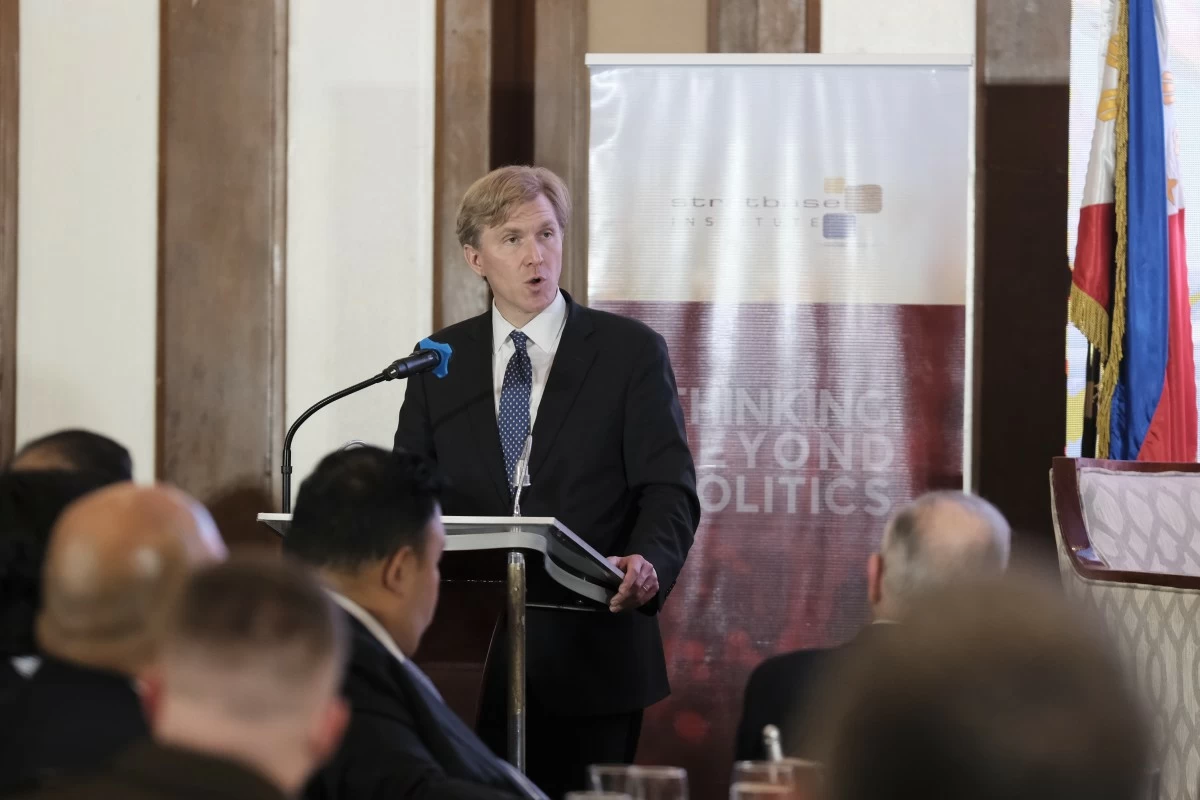
US Undersecretary of War for Policy Elbridge Colby delivers a speech during a forum organized by think tank Stratbase Group in Makati City on Aug. 10, 2026. (Photo: Stratbase Group)
The United States (US) on Monday, Aug. 10, asked its allies and partners in Asia to invest more heavily in their own defense as Washington expands its military posture in the Indo-Pacific region, saying stronger allies would make the US alliance network more sustainable and deterrence against aggression more credible.
In his keynote speech during a forum organized by the independent think tank Stratbase Group in Makati City, US Undersecretary of War for Policy Elbridge Colby assured that the United States remained a “willing partner” amid a perceived shift in US President Donald Trump’s foreign policy, underscoring that their new approach is to “build strength in ways that are durable and achieve their intended effect, of genuine peace through strength rather than rhetorical pressurization without adequate material strength and resolve.”
Colby said that Washington was not withdrawing from the Indo-Pacific, instead, the administration of President Trump was seeking to replace symbolic engagement with a more focused military presence backed by greater contributions from allies.
“America is definitely not disengaging from Asia – to the contrary. Our vital national interests dictate our enduring presence here,” Colby said.
“What the commentariat frequently misinterprets as ‘disengagement’ or ‘retrenchment’ is, in reality, a disciplined and necessary strategic prioritization,” he added.
The reassurance came amid continuing debate over the reliability of the US security commitment under President Trump as analysts have questioned whether Washington's demands for greater defense spending from allies and its shifting strategic priorities could weaken its role in the Indo-Pacific.
However, Colby said the United States was “replacing the hollow, merely symbolic engagement of previous decades with a formidable, resource-backed posture calibrated to actual structural realities.”
“We are not leaving. In fact, we are digging in, to ensure a favorable balance of power where it matters most,” he said.
Colby’s visit to Manila marked his first official trip to Southeast Asia as undersecretary under the Trump administration. He is scheduled to travel from Manila to Jakarta, Indonesia; Bangkok, Thailand; and Phnom Penh, Cambodia.
Meanwhile, Stratbase Institute President Victor Andres Manhit said Colby’s visit was also timely given that the Philippine-U.S. alliance “carried greater weight than [at] any point in recent memory.”
“The United States consistently ranks first among the countries they want the Philippine government to work with in defending our seas, especially in defending the West Philippine Sea (WPS) and advancing our economic security. Today, that is precisely what we hope to explore, how this trust can be translated into a stronger, more capable, and more resilient alliance that responds to present challenges and contributes to a free and open rules-based Indo-Pacific,” he said.
Philippines as ‘model ally’
After calling for its allies to invest in defense, Colby cited the Philippines as an example of the kind of ally Washington wants to work with. He praised Manila for strengthening its own military and coast guard capabilities while deepening operational cooperation with the United States amid China’s aggression in the WPS.
“That is exactly what we have here in Manila, under the leadership of President Marcos, Secretary of National Defense [Gilberto] Teodoro, and other key leaders,” Colby said.
“We see and respect a resolute and proud nation that is determined to strengthen its own capabilities to better defend itself and its interests. A model ally,” he added.
He said the Washington and Manila were undergoing a “historic modernization” as the two countries co-invest in resilient infrastructure, conduct training on advanced capabilities, and operationalize sites covered by the Enhanced Defense Cooperation Agreement (EDCA).
“This is not a one-sided partnership. The Philippines is stepping up, taking the lead to defend itself, and investing more to modernize its military and coast guard,” Colby said.
Washington is also providing concrete support to Manila, including the rotational deployment of four fast response cutters to work with the Philippine Coast Guard (PCG) in patrolling and securing the country’s exclusive economic zone (EEZ).
“By strengthening our joint posture, we are ensuring that both our nations possess the hard capabilities required to deter aggression,” Colby said.