






Manila Bulletin
 Philippines
National
OCD: 13 dead, 1.3M individuals affected by 'habagat,' tropical cyclones
Philippines
National
OCD: 13 dead, 1.3M individuals affected by 'habagat,' tropical cyclones
Philippines
National
OCD: 13 dead, 1.3M individuals affected by 'habagat,' tropical cyclones
OCD: 13 dead, 1.3M individuals affected by 'habagat,' tropical cyclones
Published Aug 10, 2026 12:18 pm
|
Updated Aug 10, 2026 03:18 pm


At A Glance
- At least 13 people have died, 14 were injured, and nine remain missing as the enhanced southwest monsoon or "habagat" and tropical cyclones "Luis" and "Maymay" continue to affect parts of the country.
- More than 1.3 million people have been affected, with 384,520 families impacted across 10 regions. A total of 624 evacuation centers are sheltering about 58,650 people while 39,290 others are receiving assistance outside temporary shelters.
- Disaster response operations remain underway with the PCG evacuating 7,887 residents and the AFP, PCG, PNP and BFP deployed for search, rescue and retrieval operations. The OCD said prepositioned resources remain sufficient and no local government has requested national augmentation.
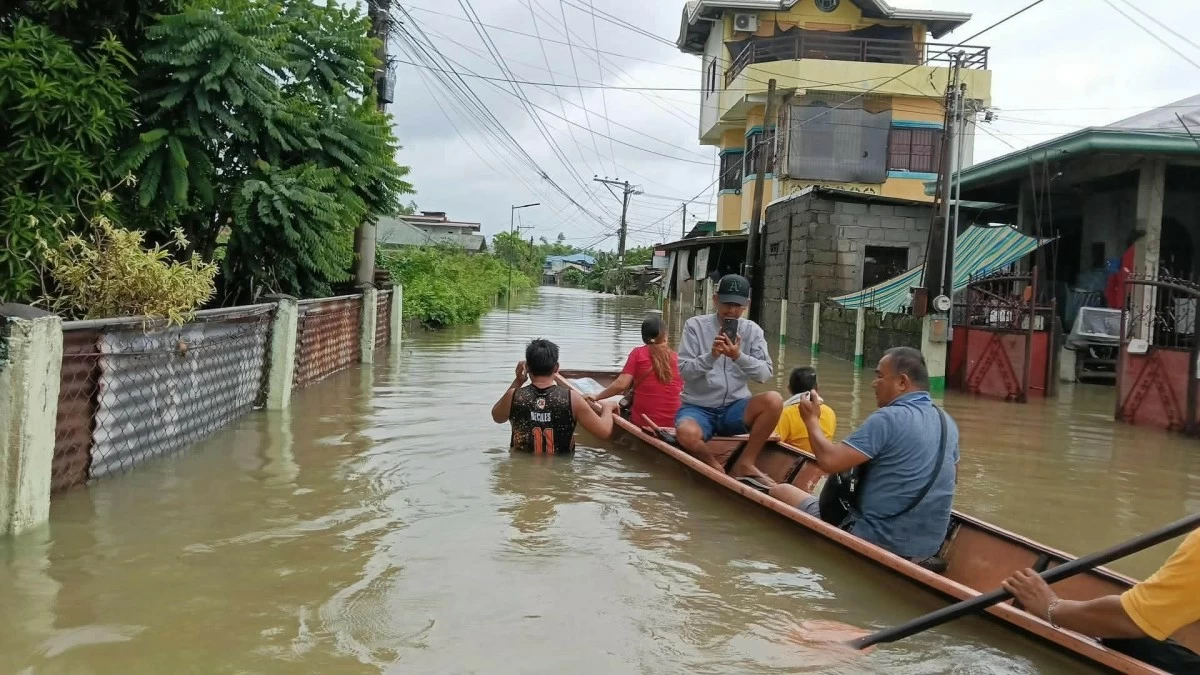
FLOOD swamps Dagupan City due to the enhanced 'habagat.' (Mayor Belen Fernandez FB)
(UPDATED STORY)
At least 13 people have died while more than 1.3 million others have been affected by the combined effects of the enhanced southwest monsoon (habagat) and the previous tropical cyclones “Luis” and “Maymay,” the Office of Civil Defense (OCD) said Monday, Aug. 10.
The latest figures as of 10 a.m. showed 384,520 families or 1,310,000 people were affected across 10 regions namely National Capital Region (NCR), Cordillera Administrative Region (CAR), Ilocos (Region 1), Cagayan Valley (Region 2), Central Luzon (Region 3), Calabarzon Region 4A), Mimaropa (Region 4B), Bicol (Region 5), Western Visayas (Region 6), and Zamboanga Peninsula (Region 9).
Benguet recorded the most number of fatalities with seven due to three separate landslides in La Trinidad where two persons died, Baguio where four people were killed, and Atok where one person perished.
In Baguio City, police said 13 people were buried when a landslide struck three houses in Riverside, Guisad Surong, on Sunday, Aug. 9.
As of 5:35 a.m. Monday, seven people had been extracted from the site: three were rescued and taken to a hospital while four were declared dead. The reported fatalities were a 17-year-old female student, two nine-year-old students, and a 56-year-old man. Six people remained missing, according to police.
Two persons also died in a rockslide in Rodriguez, Rizal; one was struck to death by a fallen tree in Antipolo; one died in Lipa, Batangas due to electrocution; another was killed in Santa Teresita, Batangas due to a landslide; and one died in Batangas City due to drowning.
OCD Deputy Administrator for Operations, Assistant Secretary Laurence E. Mina said the reported casualties were still undergoing "ongoing validation."
The OCD also recorded 14 injured individuals: 12 were due to landslides in various areas in Benguet, one in Rizal due to strong currents, and one in Cavite due to a vehicular accident.
Meanwhile, nine persons were missing: eight in Benguet due to landslides and one in Batangas.
The OCD added that 624 evacuation centers were operating, with about 16,130 families or 58,650 people staying in them, and an additional 11,360 families or 39,290 individuals were being served outside the temporary shelters.
Despite the scale of the affected population, OCD spokesperson Junie Castillo said authorities had not yet seen a need for additional national resources.
“For our fellow Filipinos in evacuation centers, the good thing is that our local governments, as well as national government agencies, have prepositioned food and non-food items. We have not seen any shortage,” Castillo said.
“As of the latest report, no local government has requested national intervention because the regional resources that have been prepositioned are still sufficient,” he added.
The weather disturbances also damaged a total of 367 houses. Of these, 340 were partially damaged and 27 were totally destroyed.
Infrastructure damage was estimated at P1.12 billion while agricultural losses stood at P3.53 million.
The government has provided P33.94 million in assistance to the affected communities.
Flooding concerns
Castillo said flooding remained a concern in several areas although government response teams had already been deployed to communities requesting assistance.
“Regarding the flooded areas, there were still reported flooding incidents as of last night. For our fellow Filipinos requesting rescue, we have already deployed teams,” he said.
The Search, Rescue and Retrieval (SRR) cluster of the National Disaster Risk Reduction and Management Council (NDRRMC) has deployed personnel from the Armed Forces of the Philippines (AFP), Philippine Coast Guard (PCG), Philippine National Police (PNP), and Bureau of Fire Protection (BFP) for the intensified operations.
The PCG said it had evacuated 7,887 residents from affected communities in Romblon, Batangas, Cavite, Rizal, Laguna and Pampanga over the weekend.
PCG spokesperson Commodore Noemie Cayabyab said the agency had deployed response teams before conditions worsened.
“Almost 7,887 evacuated individuals were assisted by the PCG over the weekend. The PCG remains on heightened alert, together with its deployable response groups and floating assets,” Cayabyab said.
The PCG also provided free rides to stranded commuters in Batangas and Cavite. It assisted the Department of Social Welfare and Development (DSWD) and local governments in distributing family food packs and helped clear roads of fallen debris.
Cayabyab said the early evacuations helped prevent residents from being caught in the worst conditions.
“We had no problems with the evacuation efforts. Our fellow Filipinos cooperated, and our operations were swift,” she said.
“What was good was that there was no report of search and rescue, because that is what the PCG wants to avoid. We do not want to evacuate our fellow Filipinos only when the bad weather is already at its peak,” she added.
The PCG said flooding in Cavite was particularly severe, reaching almost chest level in some areas.
Narrow roads also hampered the movement of response teams and equipment, including rubber boats, into some communities.
Stranded in ports
The PCG also continued monitoring maritime facilities as habagat disrupted sea travel. As of 4 a.m. Monday, 20 ports were being monitored across Western Visayas, Bicol, Southern Tagalog, and Central Visayas, where 472 passengers, truck drivers, and cargo helpers were stranded, and 86 rolling cargoes were affected.
Twenty-four vessels, 531 motorbancas, and three tugboats were also taking shelter because of the weather.
“We advise our fellow Filipinos who intend to travel to contact the vessel company first before going to the port so they will not be stranded,” Cayabyab said.
She also warned fishermen and motorbanca operators against going out to sea during dangerous conditions.
“To our fellow fishermen and motorbanca operators, please do not go out to sea if there is a gale warning or bad weather in your area. Your safety is our top priority,” Cayabyab said.
Funds sufficient
Meanwhile, the OCD said government agencies remained prepared to respond to further weather disturbances, with more tropical cyclones possible in August.
“We have not seen any indication that our funds will be insufficient, including the Quick Response Fund and budget for food and non-food items. Our response agencies also have personnel and equipment ready,” Castillo said.
“In fact, heavy equipment, personnel, and other resources of our response agencies are currently on standby,” he added.
President Ferdinand Marcos Jr. has directed government agencies and local governments to address the needs of affected communities.
Castillo said the OCD, NDRRMC, and other agencies would provide the President with an update on the situation.
“To our fellow Filipinos, especially those in low-lying areas, first, listen to the advisories of PAGASA and local authorities. They are the ones who can tell you what needs to be done. Follow them immediately because this is for your safety,” he said.