







Schoeman, Van Coevorde defy odds to conquer IRONMAN 70.3 Lapu-Lapu


At A Glance
- LAPU-LAPU CITY – Henri Schoeman rediscovered his winning form in Cebu, overcoming punishing heat, a choppy swim and a blustery bike course before fighting through cramps in the closing run to reclaim the men's professional crown at the IRONMAN 70.3 Lapu-Lapu here on Sunday, Aug. 9.
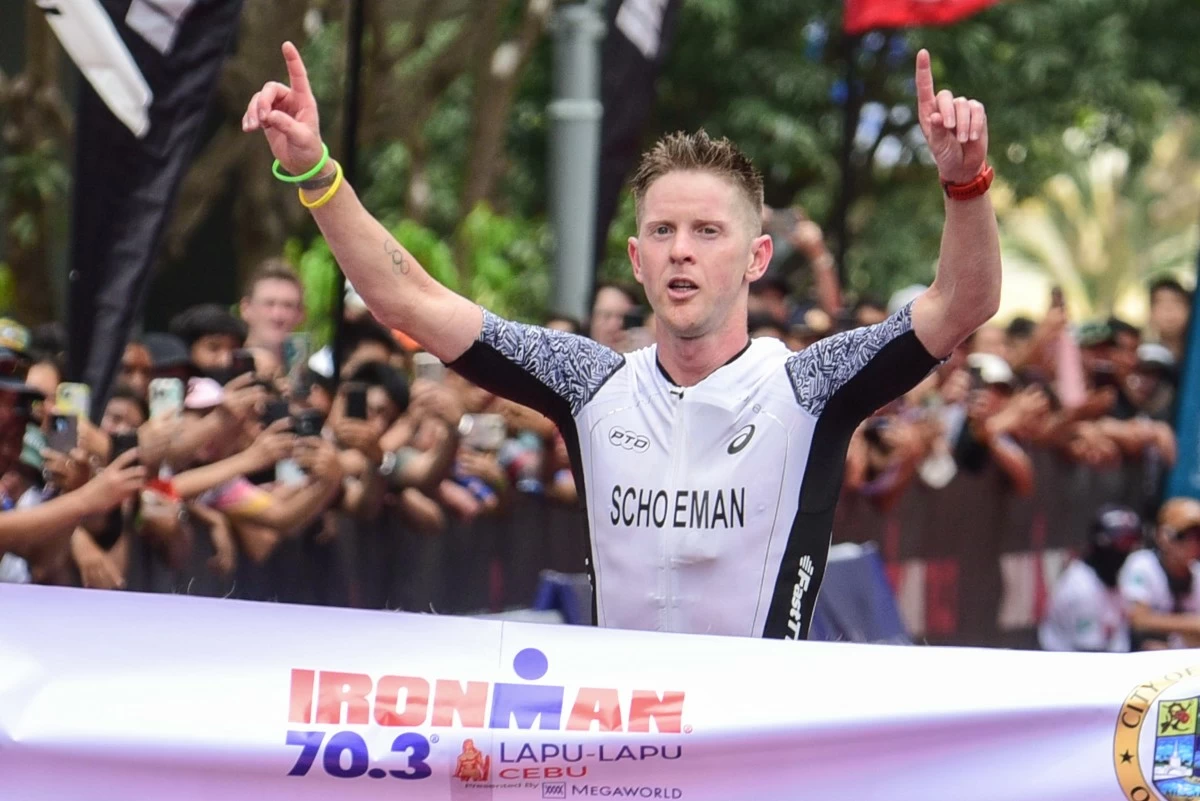
LAPU-LAPU CITY – Henri Schoeman rediscovered his winning form in Cebu, overcoming punishing heat, a choppy swim and a blustery bike course before fighting through cramps in the closing run to reclaim the men’s professional crown at the IRONMAN 70.3 Lapu-Lapu here on Sunday, Aug. 9.
The 34-year-old South African clocked 4:08:52 over the demanding 1.9-km swim, 90-km bike and 21-km run course, returning to the top two years after his breakthrough triumph in the same race presented by Megaworld. He won his first Lapu-Lapu 70.3 in 2024 in 4:02:31, beating another deep international field.
But this victory carried far more weight for Schoeman, who has endured two difficult years trying to regain the form that once made him one of the world’s elite triathletes.
“This win means so much, you know. I've had a really tough two years, struggling to find my form,” said Schoeman, who described the victory as a major confidence boost and a sign that there is still more to come.
Schoeman said the race largely unfolded according to plan, with the swim setting up his decisive move on the bike. He pushed hard in the opening leg before creating the gap he needed on the 90-km ride, which again featured the imposing Cebu-Cordova Link Expressway (CCLEX).
The bike, however, was no easy ride even for the world-class professionals. Strong winds swept across the course and made the exposed sections particularly demanding, with the CCLEX bridge providing one of the race’s biggest physical and tactical tests.
Schoeman managed to hold his advantage through the bike and carried that cushion into the half-marathon, where the tropical heat turned the final leg into a test of patience and survival.
“I just wanted to make sure that I get to the finish line, because I know it gets really hot on the run,” he said.
Schoeman, who had split times of 27:23 (swim)-2:10:09 (bike)-1:26:15 (run), revealed that cramps forced him to ease off his pace, opting to race conservatively rather than risk losing the victory in the closing kilometers.
He held off Austrian Sebastian Fuchs and Ben Hamilton of New Zealand, who clocked 4:12:51 (35:33-2:09:36-1:22:19) and 4:14:34 (32:34-2:10:01-1:27:06), respectively.
While Schoeman celebrated a triumphant return, Australian Olympian Natalie Van Coevorden delivered an equally impressive performance, capturing the women’s professional crown in the race organized by Sunrise Events, Inc., which drew more than 1,400 triathletes from 48 countries, with the majority competing for top honors in various age-group divisions.
The huge turnout also underscored how the IRONMAN 70.3 Lapu-Lapu has become a regular and much-anticipated part of Cebu’s sporting calendar – a race where elite international competition, challenging tropical conditions and the unmistakable energy of the Cebuano crowd come together year after year.
As in previous editions, thousands of spectators lined the course, turning the roads and finish area into a wall of sound that helped carry exhausted athletes through the most challenging portions of the race. Their boisterous support has also become one of the defining features of IRONMAN racing in Cebu.
Van Coevorden clocked 4:30:11 to dominate an all-Australian podium, finishing ahead of compatriots Charlotte McShane, who posted 4:47:33, and Paige Cranage, who crossed the finish line in 4:53:17.
Van Coevorden, who competed in both the women’s individual and mixed relay events at the 2024 Paris Olympics, admitted the conditions were among the toughest she had experienced in a 70.3 race. The heat was relentless, the wind was persistent and, for much of the day, she found herself racing alone at the front.
“I think we had probably the most challenging conditions I've ever had for a 70.3 today. It was hot, it was windy, and I had a pretty solo day by myself,” she said, visibly relieved after securing the victory.
The swim proved especially difficult, with the strong current making the return leg particularly demanding. Van Coevorden also had to contend with the wind on the bike, recalling how she feared being blown toward the water while crossing the bridge, but maintained her rhythm and stayed within herself.
McShane, who battled Van Coevorden near the front early on, said the swim took a heavy toll. A strong current helped propel the athletes outward, but the return trip became a brutal fight against the water, leaving her depleted before she even reached the bike.
“I felt pretty terrible straight away on the bike,” said McShane, describing the remainder of the race as survival. The wind added another layer of difficulty, while the heat made the run equally unforgiving as the professionals battled simply to keep moving toward the finish.
Austria’s 24-year-old rising star Fuchs, meanwhile, turned in the biggest result of his young career with a strong runner-up finish, drawing strength from a deeply personal motivation. “Four years ago my dad died and this is for him,” he said, dedicating the performance to his father.
Fuchs said the swim was particularly rough and choppy, while the bike demanded plenty of strength on the bridge and the uphill sections. By the run, the heat had intensified the suffering, but the massive Cebu crowd gave him and the other athletes a much-needed lift.
“The crowd was amazing and they pushed us so hard,” he said.
That boisterous support has become one of the defining features of IRONMAN racing in Cebu. As in previous editions, thousands of spectators lined the course, turning the roads and finish area into a wall of sound that helped carry exhausted athletes through the most painful portions of the race.