ADVERTISEMENT

Guardians of public trust: CPAs in the Duterte impeachment trial

Published Aug 8, 2026 12:01 am  |  Updated Aug 7, 2026 09:43 am
In the high-stakes crucible of the Senate Impeachment Court, where political rhetoric often threatens to obscure constitutional substance, the ultimate weight of truth relies on verifiable facts, rigorous documentation, and forensic integrity.
As the impeachment trial of Vice President Sara Z. Duterte unfolds, a defining feature of the prosecution’s case has been the pivotal role played by Certified Public Accountants (CPAs). Beyond their traditional domain of ledgers and financial statements, CPAs have emerged as front-line defenders of the national interest, proving that financial accountability is the bedrock of democratic governance.
The strength of an impeachment proceeding rests on the quality of its evidence. In establishing allegations surrounding the handling and disbursement of state resources, the prosecution panel has relied heavily on the testimony of key technical experts whose accounting credentials provide unimpeachable objectivity.
Roderick Wamil, CPA, serving under the Commission on Audit’s (COA) Intelligence and Confidential Funds Audit Office (ICFAO), provided authoritative testimony regarding audit processes, Audit Observation Memorandums (AOMs), and the liquidation standards governing confidential and intelligence funds under the Office of the Vice President (OVP) and the Department of Education (DepEd).
Xylene Del Ocampo, CPA, also hailing from COA-ICFAO, delivered critical forensic testimony evaluating disbursement records, liquidation documents, and acknowledgment receipts—demystifying complex financial mechanisms and translating routine audit findings into actionable legal evidence before the Senator-Judges.
Senior Agent John Mark Calilung, CPA, combining his foundational training as a CPA with advanced digital forensic expertise at the National Bureau of Investigation (NBI), stood as the very first witness called by the prosecution. His meticulous authentication of digital media evidence and press conference transcripts demonstrated how accounting discipline—characterized by chain-of-custody tracking, objective verification, and methodical inquiry—is essential in modern investigative work across state security and cybercrime enforcement.
The prominent inclusion of these CPA witnesses underscores a broader institutional reality: the accounting profession serves as a primary firewall against administrative opacity. In every public office, from municipal councils to the highest executive branches, the integrity of governance depends on transparent record-keeping and strict adherence to statutory spending limits.
When CPAs evaluate public expenditures, they do not merely audit figures; they enforce the constitutional principle that public office is a public trust. By ensuring that every peso spent aligns with legislative appropriations and executive guidelines, state accountants protect public resources from misuse, safeguard the national treasury, and ensure that government programs deliver their intended benefits to the Filipino people.
The ongoing impeachment trial highlights a modern evolution in the role of accountants within government service. CPAs are no longer passive record-keepers operating in the background of bureaucracy. Today, they occupy leadership positions at the intersection of law, public policy, digital forensics, and national security. Whether auditing sensitive government operations or guiding policy formulation in oversight bodies like COA, accountants are taking a decisive lead in shaping public administration. Their unwavering commitment to professional ethics, objectivity, and statutory compliance reinforces the rule of law and rebuilds citizen confidence in state institutions.
As the trial progresses, the technical clarity provided by CPAs Wamil, Del Ocampo, and Calilung serves as a powerful reminder of the profession's higher calling. In the pursuit of justice and institutional integrity, the accountant’s work remains one of the most potent instruments for securing public accountability and preserving the strength of democratic institutions.
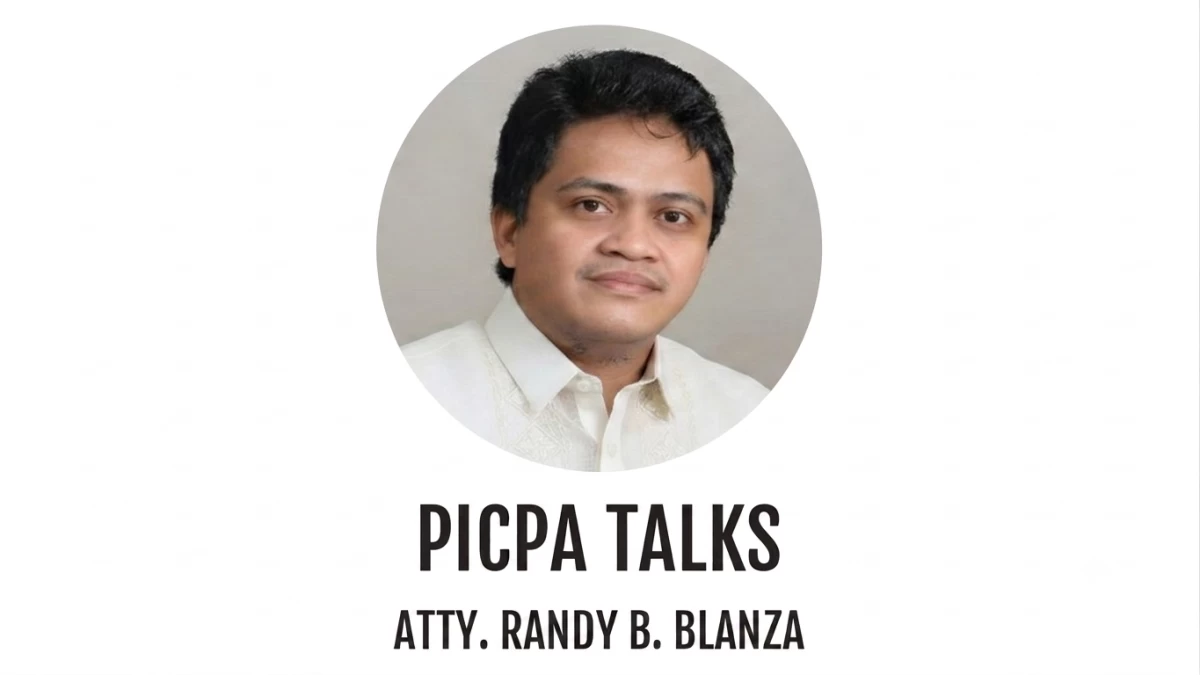
Atty. Randy Bisa Blanza, CPA, is a Past National President of the Philippine Institute of Certified Public Accountants (PICPA) and a co-founder of the Albay Bar Association (ABA).

Related Tags

Philippine Institute of Certified Accountants (PICPA) Vice President Sara Duterte impeachment trial Certified Public Accountant (CPA)
ADVERTISEMENT
.most-popular .layout-ratio{ padding-bottom: 79.13%; } @media (min-width: 768px) and (max-width: 1024px) { .widget-title { font-size: 15px !important; } }

{{ articles_filter_1561_widget.title }}

.most-popular .layout-ratio{ padding-bottom: 79.13%; } @media (min-width: 768px) and (max-width: 1024px) { .widget-title { font-size: 15px !important; } }

{{ static_articles_1562_widget.title }}

.most-popular .layout-ratio{ padding-bottom: 79.13%; } @media (min-width: 768px) and (max-width: 1024px) { .widget-title { font-size: 15px !important; } }

{{ articles_filter_1563_widget.title }}

{{ articles_filter_1564_widget.title }}

.mb-article-details { position: relative; } .mb-article-details .article-body-preview, .mb-article-details .article-body-summary{ font-size: 17px; line-height: 30px; font-family: "Libre Caslon Text", serif; color: #000; } .mb-article-details .article-body-preview iframe , .mb-article-details .article-body-summary iframe{ width: 100%; margin: auto; } .read-more-background { background: linear-gradient(180deg, color(display-p3 1.000 1.000 1.000 / 0) 13.75%, color(display-p3 1.000 1.000 1.000 / 0.8) 30.79%, color(display-p3 1.000 1.000 1.000) 72.5%); position: absolute; height: 200px; width: 100%; bottom: 0; display: flex; justify-content: center; align-items: center; padding: 0; } .read-more-background a{ color: #000; } .read-more-btn { padding: 17px 45px; font-family: Inter; font-weight: 700; font-size: 18px; line-height: 16px; text-align: center; vertical-align: middle; border: 1px solid black; background-color: white; } .hidden { display: none; }
function initializeAllSwipers() { // Get all hidden inputs with cms_article_id document.querySelectorAll('[id^="cms_article_id_"]').forEach(function (input) { const cmsArticleId = input.value; const articleSelector = '#article-' + cmsArticleId + ' .body_images'; const swiperElement = document.querySelector(articleSelector); if (swiperElement && !swiperElement.classList.contains('swiper-initialized')) { new Swiper(articleSelector, { loop: true, pagination: false, navigation: { nextEl: '#article-' + cmsArticleId + ' .swiper-button-next', prevEl: '#article-' + cmsArticleId + ' .swiper-button-prev', }, }); } }); } setTimeout(initializeAllSwipers, 3000); const intersectionObserver = new IntersectionObserver( (entries) => { entries.forEach((entry) => { if (entry.isIntersecting) { const newUrl = entry.target.getAttribute("data-url"); if (newUrl) { history.pushState(null, null, newUrl); let article = entry.target; // Extract metadata const author = article.querySelector('.author-section').textContent.replace('By', '').trim(); const section = article.querySelector('.section-info ').textContent.replace(' ', ' '); const title = article.querySelector('.article-title h1').textContent; // Parse URL for Chartbeat path format const parsedUrl = new URL(newUrl, window.location.origin); const cleanUrl = parsedUrl.host + parsedUrl.pathname; // Update Chartbeat configuration if (typeof window._sf_async_config !== 'undefined') { window._sf_async_config.path = cleanUrl; window._sf_async_config.sections = section; window._sf_async_config.authors = author; } // Track virtual page view with Chartbeat if (typeof pSUPERFLY !== 'undefined' && typeof pSUPERFLY.virtualPage === 'function') { try { pSUPERFLY.virtualPage({ path: cleanUrl, title: title, sections: section, authors: author }); } catch (error) { console.error('ping error', error); } } // Optional: Update document title if (title && title !== document.title) { document.title = title; } } } }); }, { threshold: 0.1 } ); function showArticleBody(button) { const article = button.closest("article"); const summary = article.querySelector(".article-body-summary"); const body = article.querySelector(".article-body-preview"); const readMoreSection = article.querySelector(".read-more-background"); // Hide summary and read-more section summary.style.display = "none"; readMoreSection.style.display = "none"; // Show the full article body body.classList.remove("hidden"); } document.addEventListener("DOMContentLoaded", () => { let loadCount = 0; // Track how many times articles are loaded const offset = [1, 2, 3, 4, 5, 6, 7, 8, 9, 10]; // Offset values const currentUrl = window.location.pathname.substring(1); let isLoading = false; // Prevent multiple calls if (!currentUrl) { console.log("Current URL is invalid."); return; } const sentinel = document.getElementById("load-more-sentinel"); if (!sentinel) { console.log("Sentinel element not found."); return; } function isSentinelVisible() { const rect = sentinel.getBoundingClientRect(); return ( rect.top < window.innerHeight && rect.bottom >= 0 ); } function onScroll() { if (isLoading) return; if (isSentinelVisible()) { if (loadCount >= offset.length) { console.log("Maximum load attempts reached."); window.removeEventListener("scroll", onScroll); return; } isLoading = true; const currentOffset = offset[loadCount]; window.loadMoreItems().then(() => { let article = document.querySelector('#widget_1690 > div:nth-last-of-type(2) article'); intersectionObserver.observe(article) loadCount++; }).catch(error => { console.error("Error loading more items:", error); }).finally(() => { isLoading = false; }); } } window.addEventListener("scroll", onScroll); });

Sign up by email to receive news.