ADVERTISEMENT

Hiroshima mayor urges world leaders to work for nuclear abolition

Published Aug 6, 2026 12:53 pm  |  Updated Aug 6, 2026 03:12 pm
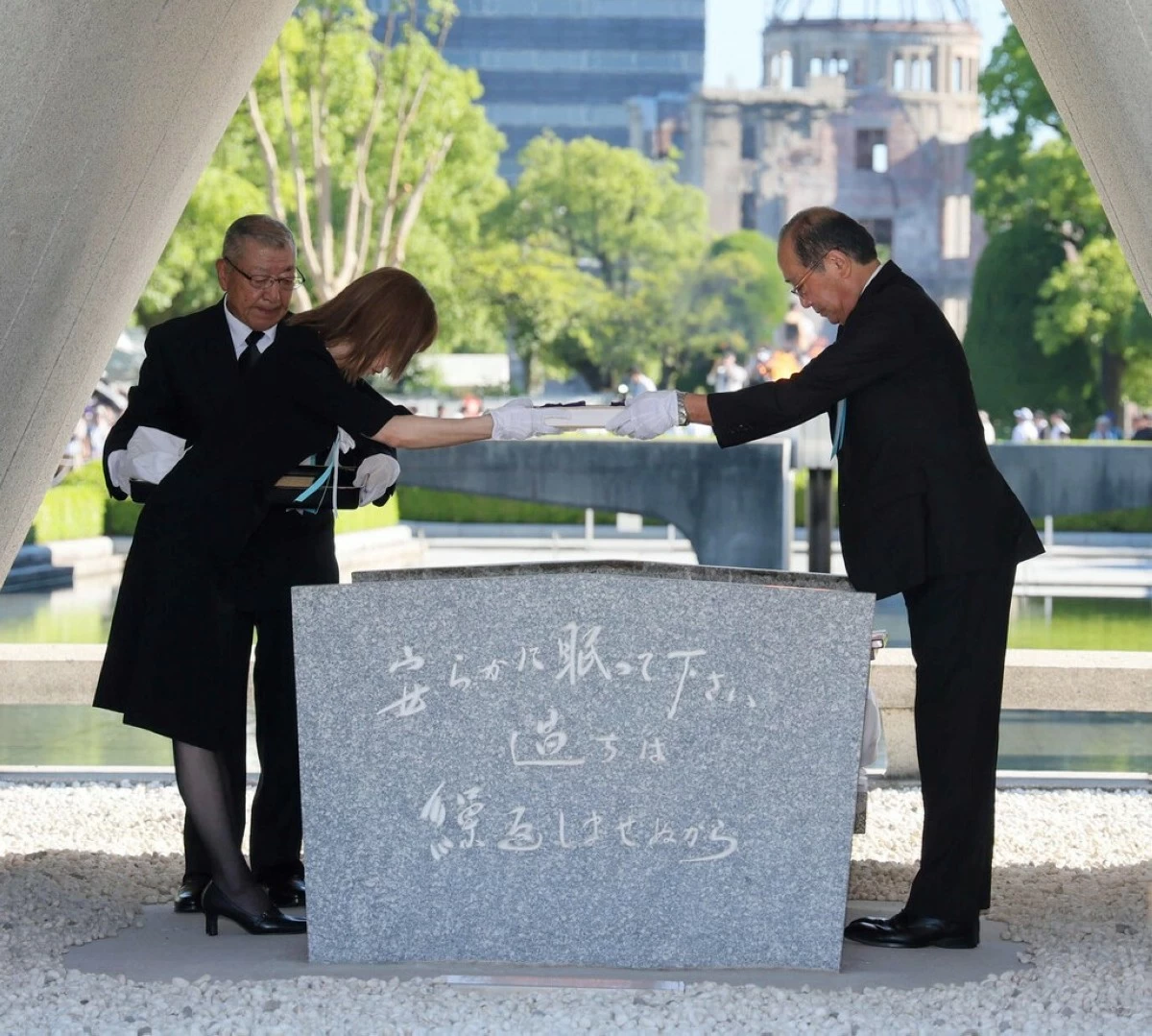
Hiroshima Mayor Kazumi Matsui (right) and a victim's relative place a list of victims of the Aug. 6, 1945, U.S. atomic bombing of the western Japan city in the cenotaph at Hiroshima Peace Memorial Park during the city's annual memorial ceremony Thursday.
HIROSHIMA, Aug. 6 (Jiji Press) -- Hiroshima Mayor Kazumi Matsui called on policymakers around the world to show determination and implement policies for nuclear abolition, in an annual peace declaration Thursday, the 81st anniversary of the U.S. atomic bombing of the western Japan city.
Noting that "we still see military invasions using nuclear weapons as tools of intimidation as well as other imperious actions by major powers in violation of international law," Matsui said, "Civil society demands the immediate abolition of nuclear weapons."
The mayor read out the declaration at the city's annual peace ceremony at Hiroshima Peace Memorial Park, which brought together about 50,000 people including hibakusha atomic bomb survivors, bereaved relatives of victims of the bombing and Prime Minister Sanae Takaichi.
Among the attendees were representatives from a record 121 countries and regions, and the European Union. China and Russia did not attend the ceremony, while the United States was represented by the deputy chief of mission at its embassy in Tokyo, not by the country's ambassador to Japan.
At 8:15 a.m., the time when the atomic bomb was dropped on Hiroshima on Aug. 6, 1945, in the closing days of World War II, the participants offered one-minute silent prayers as the Peace Bell at the park was rung.
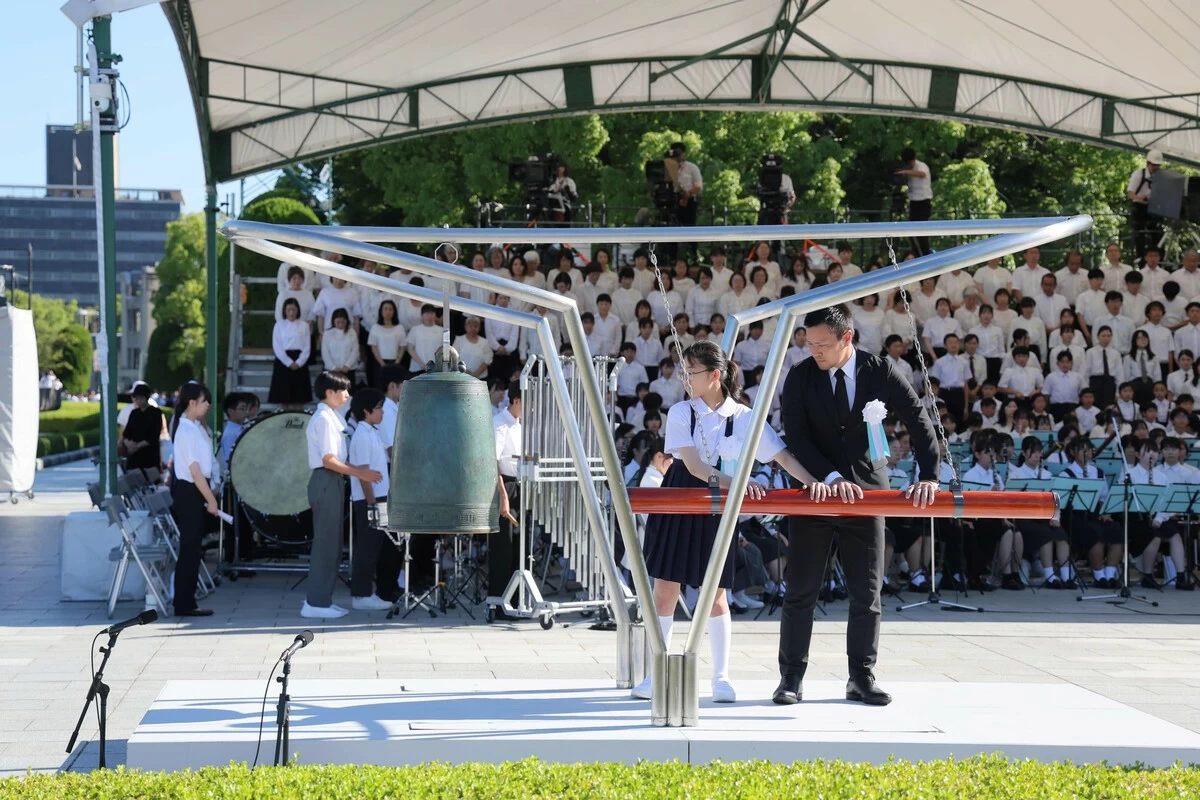
The Peace Bell at Hiroshima Peace Memorial Park is rung during the western Japan city's annual memorial ceremony Thursday to console the souls of the victims of the Aug. 6, 1945, U.S. atomic bombing of the city and pray for permanent peace.
In the declaration, Matsui introduced the experiences of three hibakusha, including witnessing a tragic fate of a relative and spending time fearing the risk of developing radiation-related illnesses.
Expressing a sense of crisis over the fading memory of the war and the possibility of nuclear weapons being used again, he called on people, especially young generations, to take action for peace in order to "make the ideal of nuclear abolition a reality."
Matsui also referred to the failure to adopt an outcome document at a Nuclear Non-Proliferation Treaty review conference earlier this year, asking world leaders, "How much longer do you intend to disappoint us?"
The mayor urged the Japanese government to participate in a review conference for the Treaty on the Prohibition of Nuclear Weapons, slated for November, and enhance support measures for hibakusha.
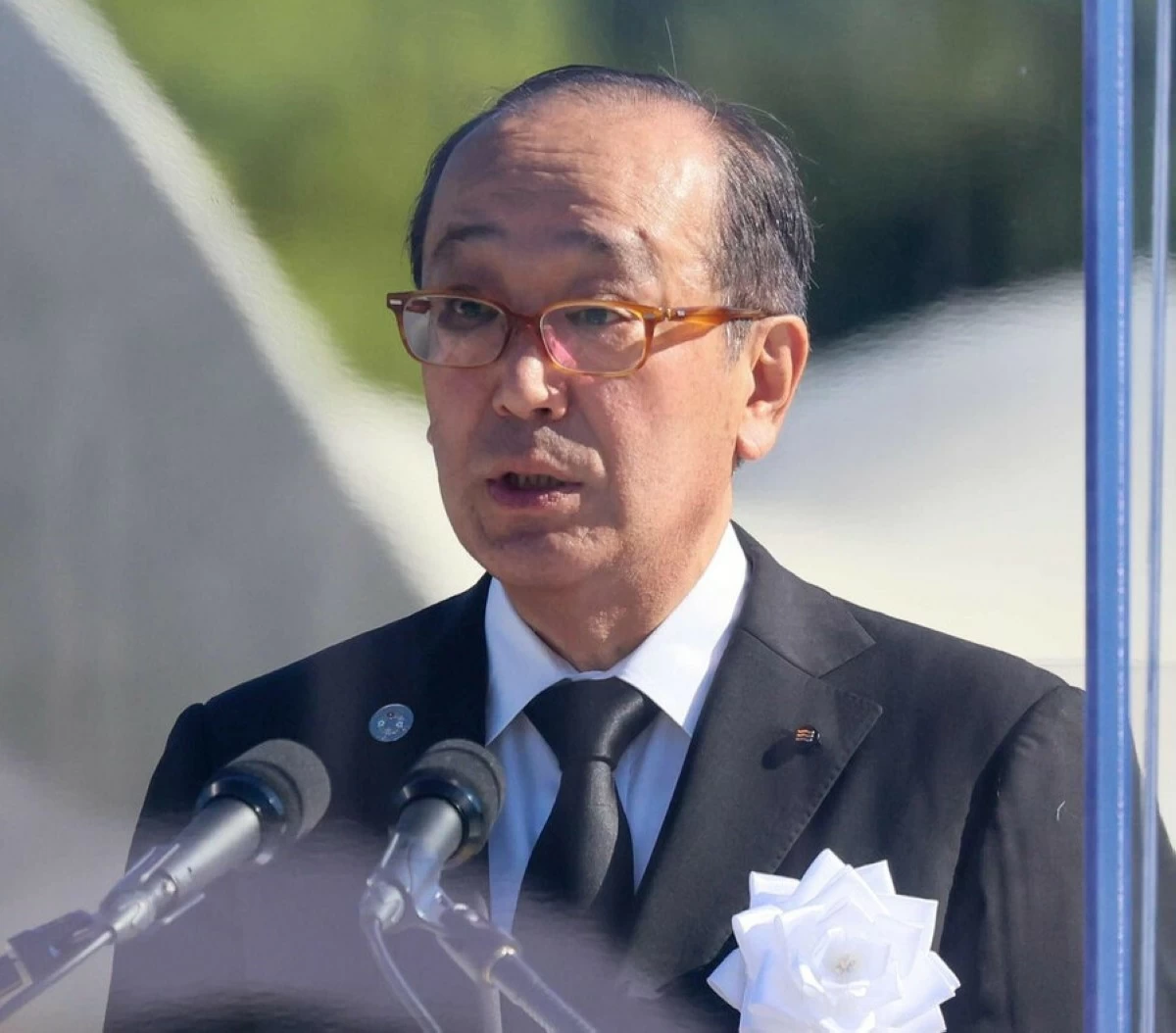
Hiroshima Mayor Kazumi Matsui reads out a peace declaration at an annual memorial ceremony at Hiroshima Peace Memorial Park on Thursday, paying tribute to the victims of the Aug. 6, 1945, U.S. atomic bombing of the western Japan city.
In her address at the ceremony, Takaichi said Japan, as the only nation attacked with a nuclear weapon, has a mission to make constant efforts to realize a world without nuclear weapons, stressing that she firmly upholds Japan's three nonnuclear principles of not possessing nuclear weapons, not producing them and not allowing them into the country.
Conveying the reality of the atomic bombing is important as the starting point of all efforts toward nuclear disarmament, the prime minister said, pledging to do her best to realize lasting peace.
At the ceremony, a name list of 4,393 survivors of the Hiroshima atomic bombing who were confirmed to have died in the past year was placed in the cenotaph for atomic bomb victims. Including those on the new list, the official count of deaths among those who suffered the atomic bomb attack on Hiroshima reached 353,639.
According to the welfare ministry, the number of survivors with a hibakusha health handbook totaled 91,105 at the end of March. Their average age was 86.66, up 0.53 from a year before.


Related Tags

world news Hiroshima bombing
ADVERTISEMENT
.most-popular .layout-ratio{ padding-bottom: 79.13%; } @media (min-width: 768px) and (max-width: 1024px) { .widget-title { font-size: 15px !important; } }

{{ articles_filter_1561_widget.title }}

.most-popular .layout-ratio{ padding-bottom: 79.13%; } @media (min-width: 768px) and (max-width: 1024px) { .widget-title { font-size: 15px !important; } }

{{ static_articles_1562_widget.title }}

.most-popular .layout-ratio{ padding-bottom: 79.13%; } @media (min-width: 768px) and (max-width: 1024px) { .widget-title { font-size: 15px !important; } }

{{ articles_filter_1563_widget.title }}

{{ articles_filter_1564_widget.title }}

.mb-article-details { position: relative; } .mb-article-details .article-body-preview, .mb-article-details .article-body-summary{ font-size: 17px; line-height: 30px; font-family: "Libre Caslon Text", serif; color: #000; } .mb-article-details .article-body-preview iframe , .mb-article-details .article-body-summary iframe{ width: 100%; margin: auto; } .read-more-background { background: linear-gradient(180deg, color(display-p3 1.000 1.000 1.000 / 0) 13.75%, color(display-p3 1.000 1.000 1.000 / 0.8) 30.79%, color(display-p3 1.000 1.000 1.000) 72.5%); position: absolute; height: 200px; width: 100%; bottom: 0; display: flex; justify-content: center; align-items: center; padding: 0; } .read-more-background a{ color: #000; } .read-more-btn { padding: 17px 45px; font-family: Inter; font-weight: 700; font-size: 18px; line-height: 16px; text-align: center; vertical-align: middle; border: 1px solid black; background-color: white; } .hidden { display: none; }
function initializeAllSwipers() { // Get all hidden inputs with cms_article_id document.querySelectorAll('[id^="cms_article_id_"]').forEach(function (input) { const cmsArticleId = input.value; const articleSelector = '#article-' + cmsArticleId + ' .body_images'; const swiperElement = document.querySelector(articleSelector); if (swiperElement && !swiperElement.classList.contains('swiper-initialized')) { new Swiper(articleSelector, { loop: true, pagination: false, navigation: { nextEl: '#article-' + cmsArticleId + ' .swiper-button-next', prevEl: '#article-' + cmsArticleId + ' .swiper-button-prev', }, }); } }); } setTimeout(initializeAllSwipers, 3000); const intersectionObserver = new IntersectionObserver( (entries) => { entries.forEach((entry) => { if (entry.isIntersecting) { const newUrl = entry.target.getAttribute("data-url"); if (newUrl) { history.pushState(null, null, newUrl); let article = entry.target; // Extract metadata const author = article.querySelector('.author-section').textContent.replace('By', '').trim(); const section = article.querySelector('.section-info ').textContent.replace(' ', ' '); const title = article.querySelector('.article-title h1').textContent; // Parse URL for Chartbeat path format const parsedUrl = new URL(newUrl, window.location.origin); const cleanUrl = parsedUrl.host + parsedUrl.pathname; // Update Chartbeat configuration if (typeof window._sf_async_config !== 'undefined') { window._sf_async_config.path = cleanUrl; window._sf_async_config.sections = section; window._sf_async_config.authors = author; } // Track virtual page view with Chartbeat if (typeof pSUPERFLY !== 'undefined' && typeof pSUPERFLY.virtualPage === 'function') { try { pSUPERFLY.virtualPage({ path: cleanUrl, title: title, sections: section, authors: author }); } catch (error) { console.error('ping error', error); } } // Optional: Update document title if (title && title !== document.title) { document.title = title; } } } }); }, { threshold: 0.1 } ); function showArticleBody(button) { const article = button.closest("article"); const summary = article.querySelector(".article-body-summary"); const body = article.querySelector(".article-body-preview"); const readMoreSection = article.querySelector(".read-more-background"); // Hide summary and read-more section summary.style.display = "none"; readMoreSection.style.display = "none"; // Show the full article body body.classList.remove("hidden"); } document.addEventListener("DOMContentLoaded", () => { let loadCount = 0; // Track how many times articles are loaded const offset = [1, 2, 3, 4, 5, 6, 7, 8, 9, 10]; // Offset values const currentUrl = window.location.pathname.substring(1); let isLoading = false; // Prevent multiple calls if (!currentUrl) { console.log("Current URL is invalid."); return; } const sentinel = document.getElementById("load-more-sentinel"); if (!sentinel) { console.log("Sentinel element not found."); return; } function isSentinelVisible() { const rect = sentinel.getBoundingClientRect(); return ( rect.top < window.innerHeight && rect.bottom >= 0 ); } function onScroll() { if (isLoading) return; if (isSentinelVisible()) { if (loadCount >= offset.length) { console.log("Maximum load attempts reached."); window.removeEventListener("scroll", onScroll); return; } isLoading = true; const currentOffset = offset[loadCount]; window.loadMoreItems().then(() => { let article = document.querySelector('#widget_1690 > div:nth-last-of-type(2) article'); intersectionObserver.observe(article) loadCount++; }).catch(error => { console.error("Error loading more items:", error); }).finally(() => { isLoading = false; }); } } window.addEventListener("scroll", onScroll); });

Sign up by email to receive news.