






 Business
The Economy
Fresh graduates struggle as June unemployment rises to 2.59 million
Business
The Economy
Fresh graduates struggle as June unemployment rises to 2.59 million
Fresh graduates struggle as June unemployment rises to 2.59 million


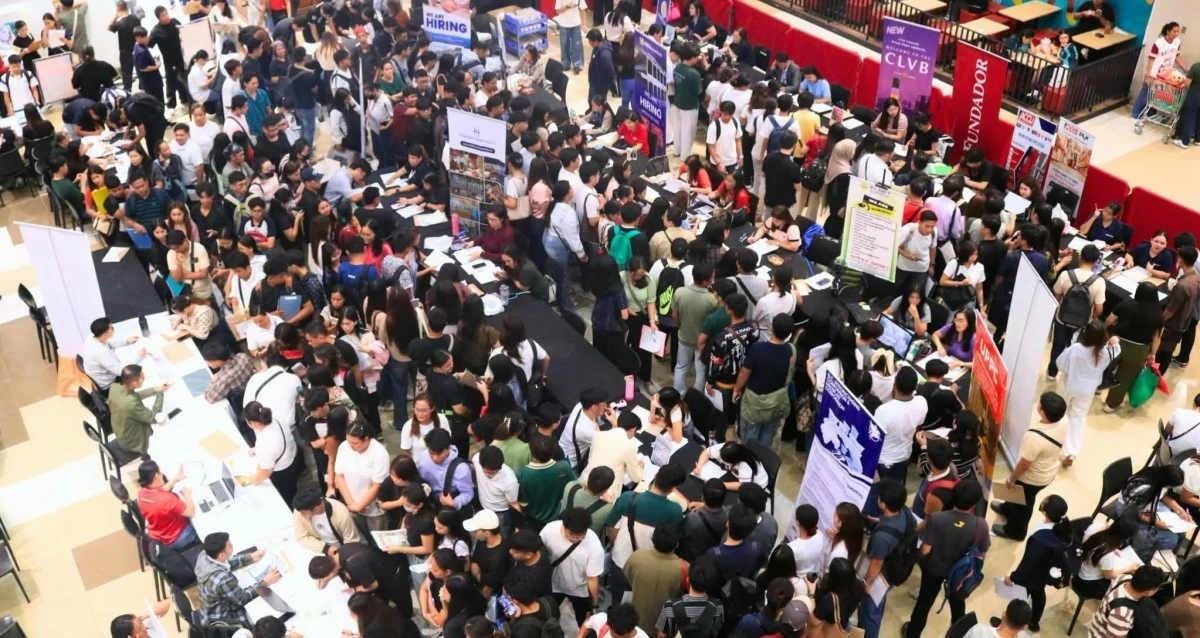
Many fresh graduates struggled to find jobs in June as the country’s unemployment rate worsened from both a month and a year ago, with the labor market unable to absorb a surge in new entrants despite continued job creation.
The Philippine Statistics Authority’s (PSA) latest labor force survey (LFS) showed the unemployment rate rose to 4.9 percent in June from 4.8 percent in May and 3.7 percent in June 2025. The number of unemployed Filipinos likewise increased to 2.59 million from 2.5 million a month ago and 1.95 million a year ago.
The labor force expanded to 53.25 million in June from 52.13 million in May and 52.42 million in June 2025, pushing the labor force participation rate up to 65.1 percent from 63.8 percent in the previous month, although it remained slightly below the 65.7 percent recorded a year ago.
In a press briefing on Thursday, Aug. 6, National Statistician Claire Dennis S. Mapa said the higher unemployment rate was primarily driven by a sharp increase in labor force participation, particularly among fresh graduates entering the job market.
Compared with a year ago, the labor force grew by about 822,000 individuals, but only around 184,000 of them were absorbed into employment. As a result, roughly 639,000 of the additional labor force participants remained unemployed.
Mapa said the increase was concentrated among Filipinos aged 15 to 24, whose labor force expanded by about 600,000 over the year. Of these, only around 246,000 found jobs, while about 354,000 remained unemployed.
The PSA’s youth labor indicators reflected the same trend. The labor force participation rate among those aged 15 to 24 rose to 33.7 percent in June from 32.3 percent in May and 33.1 percent in June 2025. However, the youth employment rate slipped to 86.5 percent from 87.6 percent a month ago and 90.6 percent a year ago. Youth unemployment likewise climbed to 978,000 from 866,000 in May and 623,000 in June 2025.
Despite the increase in unemployment, total employment rose to 50.66 million in June from 49.63 million in May and 50.47 million a year ago. However, the employment rate eased to 95.1 percent from 95.2 percent in May and 96.3 percent in June 2025 as job creation failed to keep pace with the influx of new job seekers.
Mapa said accommodation and food service activities generated the largest number of new jobs over the past year, adding 481,000 positions, almost all of which came from restaurants and mobile food service activities.
Administrative and support service activities followed with 456,000 additional jobs, largely driven by call center operations, which accounted for about 430,000 new positions. Public administration and defense, including social security, added 362,000 jobs, while the education sector also expanded as schools reopened for the academic year.
On the other hand, wholesale and retail trade recorded the biggest employment decline, shedding about 903,000 jobs from a year ago. Mapa said much of the reduction came from retail trade, suggesting that elevated inflation may have dampened consumer spending.
Fishing and aquaculture also lost around 467,000 jobs, particularly in freshwater fishing, fish pond and cage operations, and marine fishing. According to Mapa, higher diesel prices may have discouraged fishing activities by raising operating costs for fisherfolk.
Meanwhile, financial and insurance activities recorded a decline of about 195,000 jobs.
The services sector remained the country's largest employer, accounting for 62.7 percent of total employment, followed by agriculture at 20 percent and industry at 17.3 percent. Wholesale and retail trade, agriculture and forestry, and construction continued to employ the largest number of Filipinos.
Meanwhile, 6.11 million employed Filipinos were underemployed in June, translating to an underemployment rate of 12.1 percent. While slightly lower than the 12.2 percent recorded in May, it was higher than the 11.4 percent posted a year ago. The underemployed are those expressing an interest to work more hours in their current job, secure another job, or transition to a new job with longer hours.
Rizal Commercial Banking Corp. (RCBC) chief economist Michael L. Ricafort said the weaker labor market likely reflected the lingering effects of the Middle East conflict, which drove up global oil prices, inflation, and interest rates, weighing on consumer spending, business investment, and hiring.
He also said slower government infrastructure spending since late 2025, amid the review of anomalous flood-control projects, had dampened job creation. According to Ricafort, catch-up infrastructure spending under stronger governance standards should generate more employment in construction and related supply chains.
Ricafort added that the risk of a strong El Niño from late 2026 to early 2027 could also adversely affect agricultural employment in the coming months.
Jonathan L. Ravelas, senior adviser at Reyes Tacandong & Co., said fresh graduates are entering the labor market at a particularly difficult time.
“The data suggests that fresh graduates are finding it tougher to land jobs. They are faced by geopolitical risks which creates challenges in salaries and business opportunities, the threat of artificial intelligence (AI) and a slowing economy,” he said.
“The labor force is growing, particularly among the 15-to-24 age group, but job creation is not keeping pace with the influx of new entrants. This highlights a school-to-work transition challenge rather than a lack of economic activity.”
Ravelas said policymakers should focus on creating more entry-level opportunities in services, tourism, technology, and other youth-intensive sectors.
The PSA conducted its June LFS from June 8 to 27, covering 11,164 sample households and 31,334 individuals aged 15 years and over.