






Manila Bulletin
 Lifestyle
Schools and Universities
UST's 160 year-old tradition set to spotlight Indigenous Filipino Philosophy through inaugural lecture
Lifestyle
Schools and Universities
UST's 160 year-old tradition set to spotlight Indigenous Filipino Philosophy through inaugural lecture
Lifestyle
Schools and Universities
UST's 160 year-old tradition set to spotlight Indigenous Filipino Philosophy through inaugural lecture
UST's 160 year-old tradition set to spotlight Indigenous Filipino Philosophy through inaugural lecture
By MBrand
Published Aug 5, 2026 09:42 am


UST
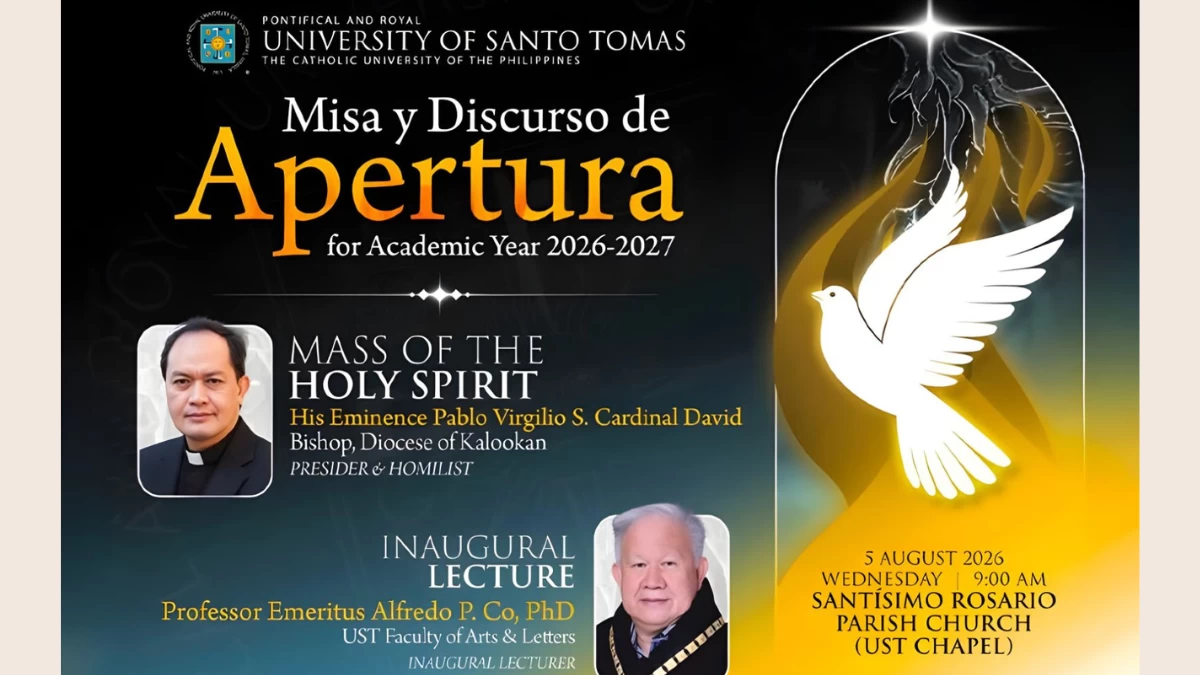
When the Thomasian community gathers at the Santísimo Rosario Parish Church on the morning of Aug. 5, 2026, they will once again participate in a sixteen-decade scholarly tradition that has opened every academic year at the University of Santo Tomas (UST) for generations.
This year's Discurso de Apertura, UST’s inaugural academic lecture, will be delivered by professor Emeritus Alfredo P. Co, Ph.D., one of the country's eminent philosophers and sinologists. His lecture, "Indigenous Filipino Philosophy: From Excavation to Void to Presencing," will bring the Thomasian community along a thoughtful exploration of Filipino philosophical consciousness, inviting reflection on ideas that have shaped the nation's identity and continue to influence its future.
The Discurso de Apertura has long served as the intellectual compass of each new academic year. The tradition draws inspiration from the opening exercises of medieval European universities. At UST, it evolved from the practice of the Lectio Prima, the "first lecture" at the Order of Preachers’ houses of study, which was incorporated into the University's statutes drafted by then-Rector Fr. Juan Amador, O.P., in 1785. Today, every inaugural lecture becomes part of what is considered the University's longest-running serial publication: the collection of inaugural addresses delivered at the beginning of each academic year since 1866.
In recent years, these inaugural lectures have reflected the changing concerns of society while remaining faithful to the University's mission of serving the Church, the nation, and the global community.
In 2019, former president of the Philippine Medical Association and UST Faculty of Medicine and Surgery professor Maria Minerva P. Calimag, M.D., Ph.D., challenged the Thomasian community to see the inseparable relationship between personal and planetary health. In her Discurso titled, "Research and the Social Agenda: The Tale of Two Rivers," she argued that health can only be sustained when individuals, communities, and the natural world flourish together.
The unprecedented disruption brought about by the Covid-19 pandemic the following year soon reshaped the conversation. Faculty of Medicine and Surgery dean Dr. Ma. Lourdes D. Maglinao's 2021 inaugural lecture, "Leading Change in a 150-year-old Medical School: Overcoming the Challenges of a VUCA World amidst the Twenty-first-Century Pandemic," documented the realities of educating future physicians during one of the most difficult periods in modern history. Her address underscored the University's determination to preserve academic excellence while protecting the health and well-being of students, academic staff, and healthcare workers.
As institutions gradually adapted to the new educational landscape, assistant to the Rector for Planning and Quality Management prof. Clarita D.L. Carillo, Ph.D., proposed that resilience itself must evolve. In her 2022 lecture, "Quality Assurance and the 3Cs of Resiliency as Philippine Academic Institutions Move Forward," she introduced the framework of Cope, Control, and Construct, describing how higher education institutions move beyond surviving crises toward building stronger and more innovative academic communities. Drawing from UST's own transition to the Enriched Virtual Mode (EVM) of instruction, she illustrated how the University quietly became a benchmark for other Philippine higher education institutions navigating uncertainty.
The following year, assistant to the Rector for UST General Santos prof. Maribel G. Nonato, Ph.D., turned the University's attention toward growth and innovation. Her lecture, "C.A.R.E. in the 21st Century Academic Institution," in August 2023 coincided with preparations for the University's General Santos campus, which was inaugurated in April 2024. She emphasized leadership that is Cutting-edge, Assertive, Resourceful, and Enterprising (CARE). Beyond infrastructure, her lecture focused on creating educational institutions that remain relevant, responsive, and deeply engaged with the needs of contemporary society.
History itself became the focal point of the 2024 Discurso de Apertura. Faculty of Arts and Letters Dean prof. Melanie D. Turingan, Ph.D., retraced the University's remarkable journey in "Imbued with Unending Grace: A History and Legacy of the University of Santo Tomas." Beginning with the vision of Archbishop Miguel de Benavides, O.P., and the founding of what was originally called the Colegio de Nuestra Señora del Santísimo Rosario in 1611, she recounted UST's transformation into Asia's oldest existing university while highlighting its continuing expansion through campuses in Santa Rosa and General Santos.
In 2025, UST-AMV College of Accountancy Dean and Global Accounting Hall of Fame inductee prof. Patricia M. Empleo, Ph.D., shifted the discussion toward institutional governance. Her lecture, "Internal Control: Key to Effective Enterprise Risk Management," emphasized that organizations become resilient not simply by reacting to crises but by establishing systems that anticipate risks and strengthen accountability.
Viewed together, these recent lectures forming the Discurso de Apertura series are an intellectual progression. They speak of sustainability, resilience, innovation, institutional memory, and responsible governance, each responding to the needs of its particular historical moment while reinforcing UST's enduring commitment to social transformation and Veritas in Caritate (Eph 4:15), or truth in love.
This year's Discurso de Apertura adds another important dimension to that continuing conversation. Professor Emeritus Alfredo P. Co, Ph.D. invites the Thomasian community to reflect on how philosophy can deepen our understanding of who we are as a people and illuminate the Filipino experience, particularly during a time where the humanities tend to be given less focus by a society undergoing rapid technological advancement.
A bona fide Thomasian, Dr. Co earned his bachelor's (1972), master's, and doctoral degrees (1976) in Philosophy from UST, completing his doctorate at just twenty-six years old. He later pursued postdoctoral studies in Classical Chinese Philosophy at the Chinese University of Hong Kong and Comparative Philosophy at the Sorbonne University in Paris, where St. Thomas Aquinas himself once studied. He further broadened his scholarship through intercultural studies in Taiwan and India.
Internationally recognized as an eminent sinologist and Filipino philosopher, Dr. Co became the first Asian scholar to deliver a plenary lecture at the 2008 Conférence Mondiale des Institutions Universitaires Catholiques de Philosophie (COMIUCAP), joining some of the world's most respected contemporary philosophers. He later served as convenor of the same conference when it was hosted by UST in 2022.
For more than five decades, Prof. Dr. Co, fondly known by the community as “The Venerable Master”, has helped shape philosophical scholarship in the Philippines through his teaching, research, and leadership. He founded the University-wide Department of Philosophy, has authored more than fifty scholarly articles, and continues to serve various scholarly publications, most notably as the editor-in-chief of Karunungan: A Journal of Philosophy, the official journal of the Philippine Academy of Philosophical Research. He continues to teach Chinese philosophy and comparative philosophy at UST.
His scholarly contributions have likewise been celebrated through the publication of the seven-volume festschrift titled “Across the Philosophical Silk Road: A Festschrift in Honor of Alfredo P. Co”, a rare tribute bestowed upon Filipino academics. He became the first UST professor to receive such an honor.
For more than a century and a half, the Discurso de Apertura has chronicled the University's dialogue with the wider world, from responding to crises and embracing innovation to preserving history and strengthening institutions. This year, through the voice of Professor Emeritus Alfredo P. Co, Thomasians will begin the academic year with a dialogue that turns toward the philosophical foundations of Filipino thought.
The Discurso de Apertura will immediately follow the Misa de Apertura, the traditional Mass of the Holy Spirit that officially opens the academic year and allows Thomasians onsite, online, and within different campuses to entrust the new academic year to the Lord’s will. For 2026, His Eminence Pablo Virgilio Cardinal David, D.D., Bishop of Kalookan and vice president of the Federation of Asian Bishops' Conferences, will preside over the Eucharistic Celebration and formally declare the academic year open.
One UST community
Both the Misa and Discurso de Apertura will be livestreamed through the official UST Facebook page (/UST1611official).
UST Vice Rector Rev. Fr. Isaias Tiongco, O.P., J.C.D., will lead the onsite Eucharistic Celebration at UST General Santos Main Building, and the Tomasinong Mindanaoan community will join the Discurso virtually.
The onboarding season continues on Aug. 6, 2026, with a hallmark tradition called the Thomasian Welcome Walk. Thomasian freshmen are welcomed through the same threshold used by multiple generations of Thomasians since the 1600s: the National Cultural Treasure named the Arch of the Centuries. For 2026, over 9,000 collegiate freshmen and more than 2,000 new basic education students are expected to enter the Arch and begin the cycle that will end in a few years at their Baccalaureate Mass, when they will exit through the Arch.
Serving as a reminder of the University’s rich history, these entry and exit traditions connect Thomasians across 415 years of excellence, since the Arch was the original gateway of the University back in its original Intramuros campus, where it operated for over 300 years before moving to its present 21.5-hectare site at España Boulevard in the late 1920s. The Arch was taken from the old Intramuros building and reassembled piece by piece in the Sampaloc campus after World War II.
Regular classes across UST’s campuses will begin on Aug. 7, 2026, after a series of hybrid and onsite onboarding activities including virtual and in-person ROARientations, Triduum Masses for St. Dominic de Guzmán, and the Thomasian welcome party, among others.