







Japan and Southeast Asia: Trust and Strengthening People-to-People Exchanges
The Shared Future of Asia and Japan
By JIJI PRESS
Published Aug 5, 2026 12:15 pm


By YUSUKE UMEZAKI
Relations between Japan and Southeast Asia are growing ever closer. People-to-people exchanges, including tourism, are becoming increasingly active, while interest in each other’s cultures continues to grow. Through post World War II reconciliation and decades of cooperation, Japan and Southeast Asia have steadily deepened mutual trust, and their ties are now entering a new phase.
Southeast Asia festivals draw large crowds
More than 280,000 people attended Thai Festival Tokyo 2026, held over two days in May at Yoyogi Park in Shibuya Ward, Tokyo.First held in 2000, the festival celebrated its 26th edition this year. Visitors enjoyed authentic Thai cuisine, including hoy tod (Thai-style oyster omelet) and pad thai, as well as the opportunity to experience muay thai and watch traditional dance performances.
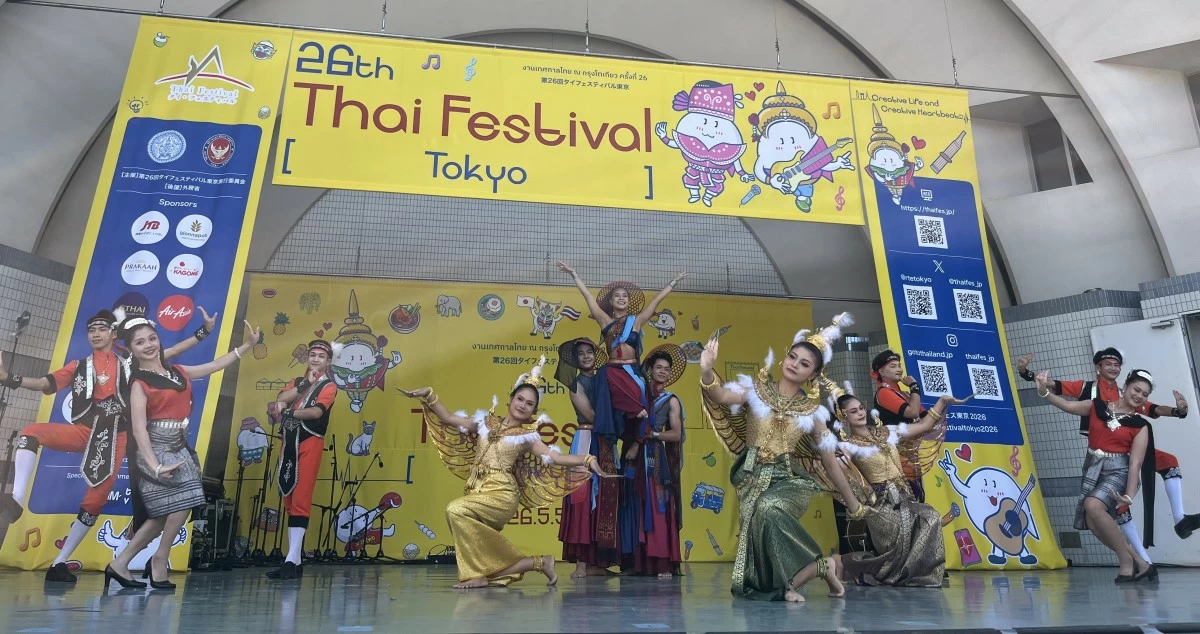
Thai Festival 2026
One of the festival’s biggest attractions was a T-pop stage featuring popular Thai artists and actors, which drew such large crowds that entry had to be temporarily restricted. Some fans even traveled from as far as Osaka, western Japan, to see the popular actor duo TayNew.
Vorapong Vadhanasindhu, Counsellor at the Royal Thai Embassy in Tokyo, noted that a growing number of Japanese people are becoming interested in Thai entertainment, including T-pop and television dramas. With the 140th anniversary of the establishment of diplomatic relations between Japan and Thailand approaching in 2027, he expressed hope for further strengthening ties between the two countries.
At Laos Festival 2026, also held at Yoyogi Park in May, Japan's Princess Aiko, the eldest daughter of Emperor Naruhito and Empress Masako, attended the opening ceremony. Dressed in a light green traditional Lao costume presented by the Lao side, she watched a welcoming dance performed by the Laotian National Dance and Music Troupe on the park’s outdoor stage before joining Lao Deputy Prime Minister and Foreign Minister Thongsavan Phomvihane and other dignitaries for the ribbon-cutting ceremony.
Similar festivals celebrating countries across Southeast Asia, including the Philippines, Indonesia, and Vietnam, are held in Tokyo each year, and all draw large crowds.
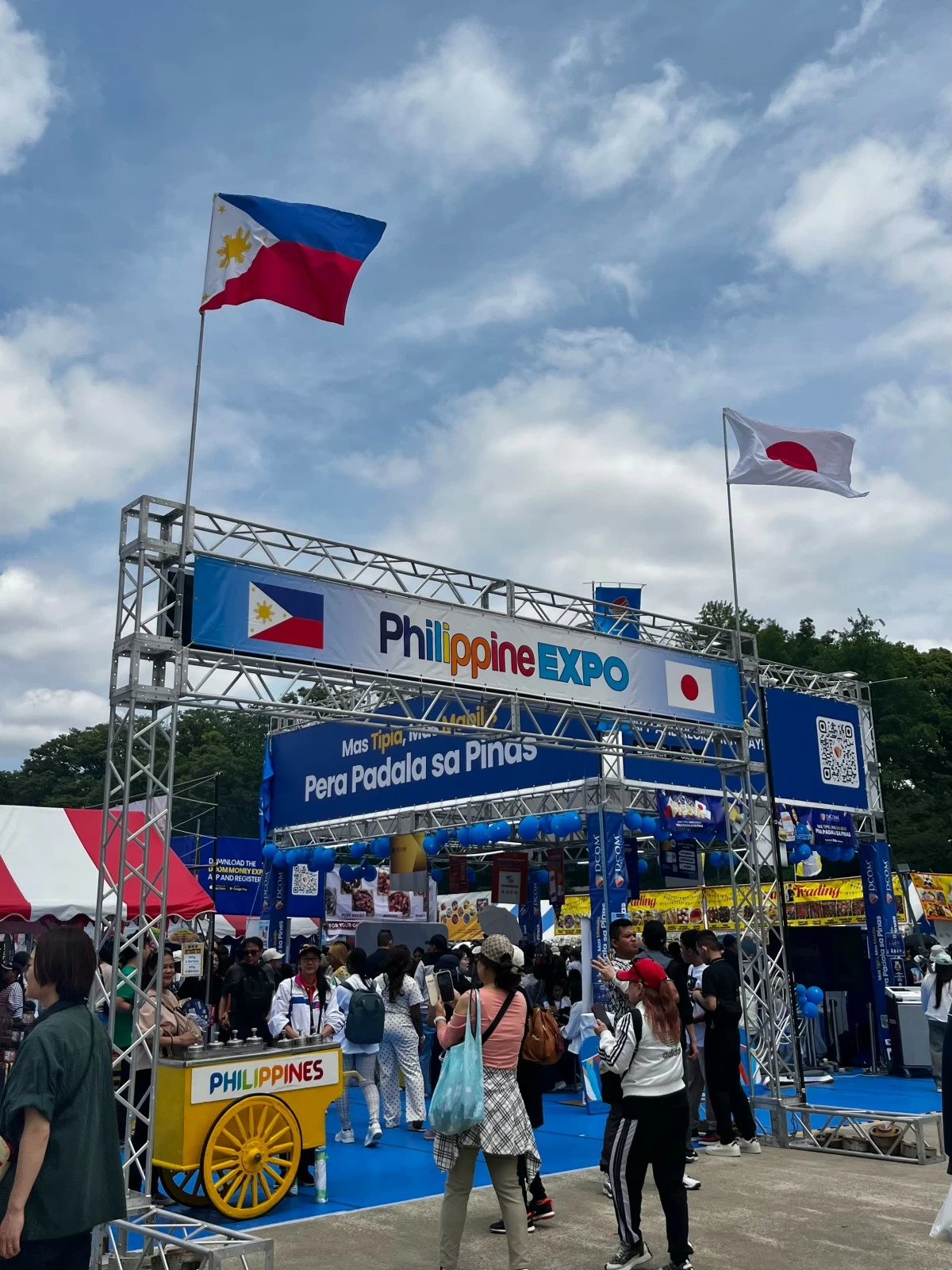
The entrance to the Philippine Expo 2026 at Ueno Park in Tokyo on June 6, 2026.
Visitors to Japan increase tenfold
The number of visitors from Southeast Asia to Japan is also on the rise. According to the Japan National Tourism Organization (JNTO), 42,683,837 foreign visitors traveled to Japan in 2025. Of these, 4,800,123 came from six major member states of the Association of Southeast Asian Nations (ASEAN)--Thailand, Singapore, Indonesia, Malaysia, the Philippines and Vietnam--accounting for 11.2% of the total. Compared with the 441,602 visitors recorded in 2003, when the Japanese government launched the Visit Japan campaign, the number has increased more than tenfold in just over two decades.
According to a 2026 survey conducted across ASEAN by the Singapore-based think tank ISEAS – Yusof Ishak Institute, Japan ranked first among respondents’ preferred holiday destinations, with 32.5% selecting Japan. This was well ahead of ASEAN member states (13.4%), European Union (EU) member states (9.7%), and Australia (9.4%), demonstrating Japan’s overwhelming popularity as a holiday destination.
High levels of trust
In the same survey, 65.6% of respondents said they trusted Japan, making it the most trusted among the five countries and regions surveyed—Japan, the United States, China, India, and the European Union (EU)—for the eighth consecutive year. By comparison, the figures for the United States and China were 44.0% and 39.8%, respectively.
When asked why they trusted Japan, 41.4% of respondents cited its status as ”a responsible stakeholder that respects and champions international law.” An additional 22.7% pointed to its "vast economic resources and the political will to provide global leadership." Meanwhile, only 15.7% said they did not trust Japan, the lowest percentage among the five countries and regions surveyed.
Friendship over division
Japan has not always enjoyed a positive image in Southeast Asia. During World War II, Japan invaded countries across Asia. Even after the war, anti-Japanese sentiment remained strong in the region. Against this backdrop, Japan worked to rebuild its relationships through war reparations, economic cooperation, and other efforts.
“There have been times in the past when our relationship has faced arduous time,” Emperor Naruhito noted at a state banquet held in late May in honor of Philippine President Ferdinand Marcos Jr. during the president’s state visit to Japan. He went on to say that “since the normalization of diplomatic relations in 1956, Japan and the Philippines have moved forward hand in hand, strengthening our relationship one step at a time to establish the firm friendship we enjoy today.”
In his response, President Marcos said that the ties between the two countries had been built by “generations of Filipinos and Japanese who chose understanding over difference, friendship over division, and partnership over isolation.”
As Japan and the Philippines marked the 70th anniversary of the normalization of diplomatic relations in July, President Marcos described the current state of bilateral ties as being in a “platinum age” during talks with Japanese Prime Minister Sanae Takaichi in Tokyo. The term took the “golden age” that President Marcos had used during then Japanese Prime Minister Shigeru Ishiba’s visit to Manila in April 2025 a step further. Today, the two countries’ ties have been elevated to a Comprehensive Strategic Partnership.
A pledge made half a century ago
The turning point in relations between Japan and Southeast Asia can be traced back to the Fukuda Doctrine, a diplomatic policy announced half a century ago. In August 1977, then Japanese Prime Minister Takeo Fukuda toured Southeast Asia, visiting Malaysia, Indonesia, and other countries. At the final stop on his tour in Manila, he delivered a speech on relations between Japan and Southeast Asia. At the time, the president of the Philippines was Ferdinand Marcos Sr., the father of the current president, Ferdinand Marcos Jr.
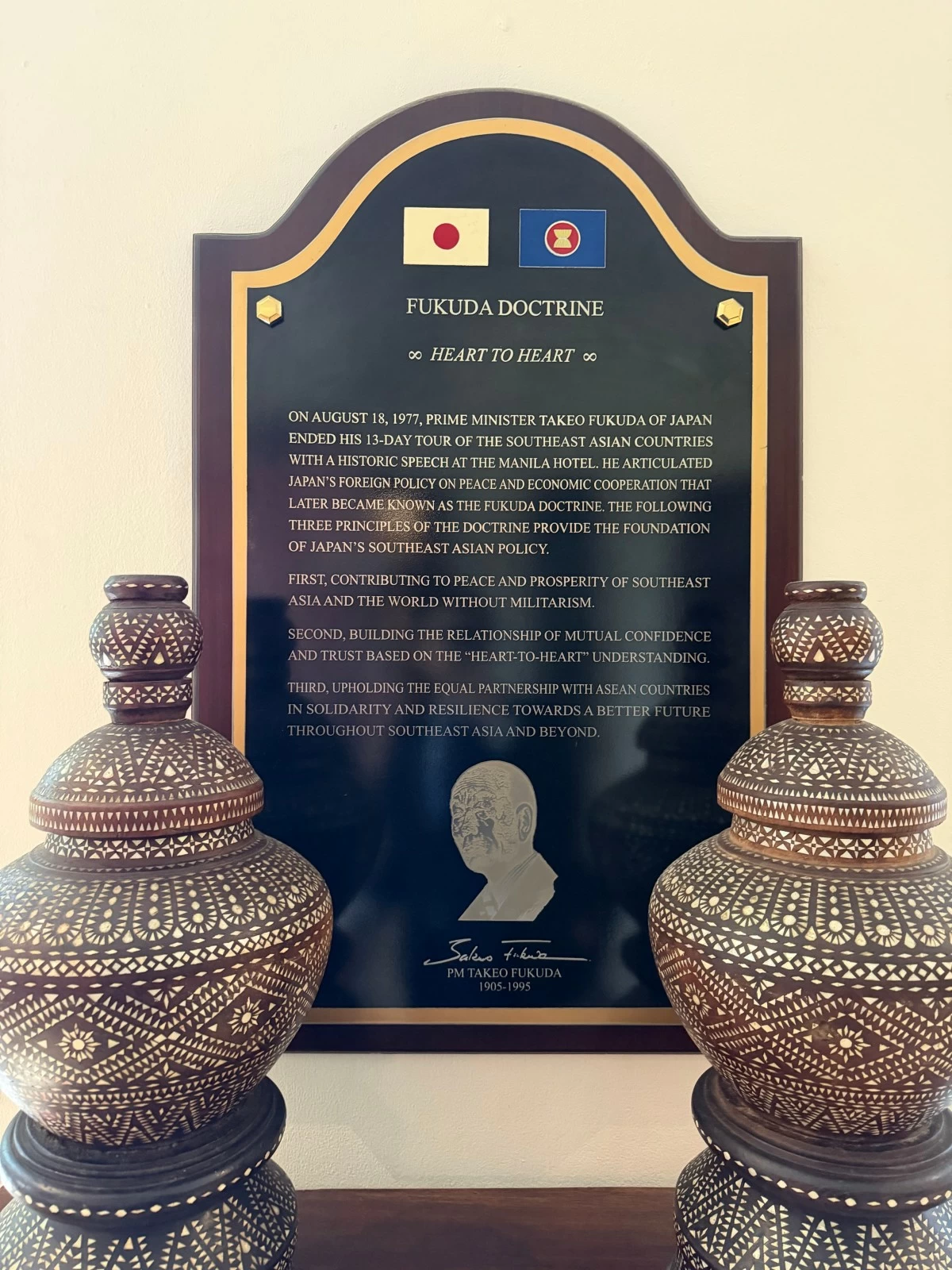
The Fukuda Doctrine plaque at The Manila Hotel
Fukuda rejected a return to Japanese militarism while positioning Japan as “an equal partner” of Southeast Asia. He also stressed that “it is not enough for our relationship to be based solely on mutual material and economic benefit,” adding that “heart-to-heart” understanding between the two sides were essential.
The principles of the Fukuda Doctrine continue to guide relations between Japan and Southeast Asia. In 2027, the doctrine will mark the 50th anniversary. As the international landscape continues to evolve, there is hope that Japan and Southeast Asia will further deepen people-to-people exchanges and carry the doctrine’s principles into the next generation.