






 Philippines
National
Impeachment Court orders Duterte camp to review confidential fund documents submitted by prosecution
Philippines
National
Impeachment Court orders Duterte camp to review confidential fund documents submitted by prosecution
Impeachment Court orders Duterte camp to review confidential fund documents submitted by prosecution


At A Glance
- Senate Impeachment Court presiding officer Francis "Chiz" Escudero on Wednesday, August 5, ordered the defense panel of Vice President Sara Duterte to again review the documents submitted by the House prosecution panel pertaining to her alleged misuse of confidential funds.
Senate Impeachment Court presiding officer Francis “Chiz” Escudero on Wednesday, August 5, ordered the defense panel of Vice President Sara Duterte to again review the documents submitted by the House prosecution panel pertaining to her alleged misuse of confidential funds.
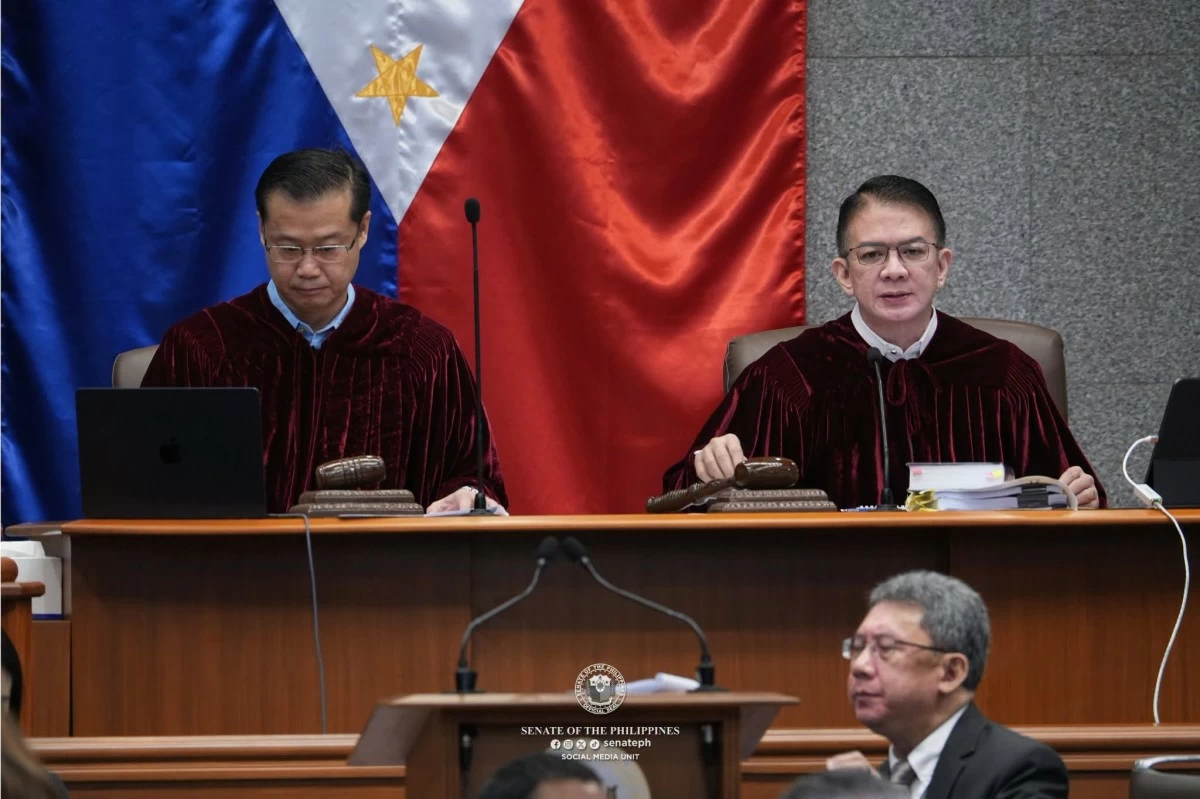
This, after the defense panel refused to stipulate the 4,492 acknowledgement receipts (ARs) that the Office of the Vice President (OVP) and the Department of Education (DepEd) submitted to the Commission on Audit (COA)-Intelligence and Confidential Funds Audit Office (ICFAO) and which was about to be identified by COA-ICFAO auditor Xylene del Campo, another witness during Day 13 of the trial.
Atty. Lorna Kapunan, counsel for the House prosecution, had started her direct examination of del Campo, and asked her to identify the ARs and compare it to the tabulation of her predecessor and first witness, Roderick Wamil.
But due to the sheer volume of the documents, Del Ocampo had difficulty finishing the identification.
Defense counsel Atty. Kristine Ferrer, then pointed out that Del Campo was “merely flipping the pages without comparing the ARs to the list to check whether the ARs are the same as what was listed by Mr. Wamil.”
To this, Kapunan retorted that the tedious identification of the over 4,000 documents is due to defense’s “own doing,” since they refused to stipulate the ARs during the pre-trial conference. She then moved that the witness be allowed to identify all the documents before both panels “out of court” before Monday, next week.
But Ferrer quickly objected to it, saying that under the rules, the witness has to identify the document in open court.
“The problem with their stipulation is that they will be having the witness identify the documents out of court. Therefore, it is no longer part of the trial and there will be a problem when it comes to their offer,” Ferrer interjected.
When Escudero offered the defense panel sufficient time to make possible stipulations in order to expedite the proceedings, the defense panel rejected the offer.
“We will not stipulate. We didn’t stipulate for the case for Wamil; the case is in the same position, and the same position is maintained for the case of this witness. Because after the ARs have been submitted to the COA, the OVP (Office of the Vice President) and DepEd (Department of Education) no longer had control over the ARs, so we do not know what the receipts are provided by COA and how many receipts were given by COA to the prosecution,” Ferrer explained.
Kapunan then amended her motion saying that the “out of court” proceedings be presided by the Clerk of Court.
Escudero again attempted to convince the defense panel to agree, clarifying that they do not need to stipulate anything during the additional period of stipulation that he suggested be held on Thursday or Friday.
To this, Ferrer conceded but on the condition that the defense “will not be forced to stipulate and that the parties agree on a time and date.”
Realizing this, Kapunan suggested that the prosecution panel simply use the defense’s marked documents “to restore a level of trust on the level of the defense.”
“Maybe we can even use their own documents. If they do not trust the prosecution’s documents or photocopies of the prosecution’s documents, then we will use their documents, because we are certain that their documents is the same as our documents,” Kapunan pointed out.
Escudero, in response, apologized pointing out that he was not yet elected as the presiding officer of the impeachment court during the pre-trial conference, hence, was not aware of what happened during the pre-trial stage.
“Apparently, the respondent, or counsel for respondent has a different purpose and/or intention with respect to the ARs from that of the prosecutor. Therefore, that’s why they refuse. A common marking on the same AR, is that correct? So they have their own set of ARs and you have your own set ARs that was marked during pre-trial. Correct, counsels?” Escudero asked.
Ferrer responded in the affirmative.
Escudero then explained that all the court is asking is for an opportunity to compare once more their respective marked copies of ARs to be able to distinguish “and find out if indeed they are the same or not regardless of whatever purpose or theory each party may have with respect to presenting the ARs given that there are common exhibits.”
“We will not touch in to that, counsel for respondent, so your concern with respect to authenticity and purpose will not be touched on. Only in so far as that it is the same AR that you received, it is the same AR that you sent to the COA that you also have a copy of that AR presented. And in so far as the ARs that you did not send to COA or did not come from you, then you can point that out to as the case may be or as may be appropriate,” he told Ferrer.
However, as of this time, both the defense counsel and the House prosecution panel have yet to agree on a date and time.