






Manila Bulletin
 Philippines
National
Over 7,700 families hit, nearly 4,000 individuals displaced due to 'Luis,' 'habagat' – OCD
Philippines
National
Over 7,700 families hit, nearly 4,000 individuals displaced due to 'Luis,' 'habagat' – OCD
Philippines
National
Over 7,700 families hit, nearly 4,000 individuals displaced due to 'Luis,' 'habagat' – OCD
Over 7,700 families hit, nearly 4,000 individuals displaced due to 'Luis,' 'habagat' – OCD
Published Aug 4, 2026 01:53 pm


At A Glance
- More than 7,700 families from 17 barangays have been affected by the combined effects of Tropical Depression Luis and the enhanced southwest monsoon while nearly 4,000 individuals are staying in evacuation centers, according to initial data from the Office of Civil Defense as of Aug. 4.
- The OCD remains under Blue Alert despite Luis weakening into a low pressure area as heavy monsoon rains continue to threaten several areas. Pangasinan is under a red rainfall warning while La Union, Benguet, Tarlac, Zambales, and Bataan are under orange rainfall warnings.
- Authorities have recorded 17 flooded areas in Regions 1, 9, and BARMM. No confirmed deaths or missing persons have been reported, although the OCD is verifying a reported drowning incident in Pangasinan.
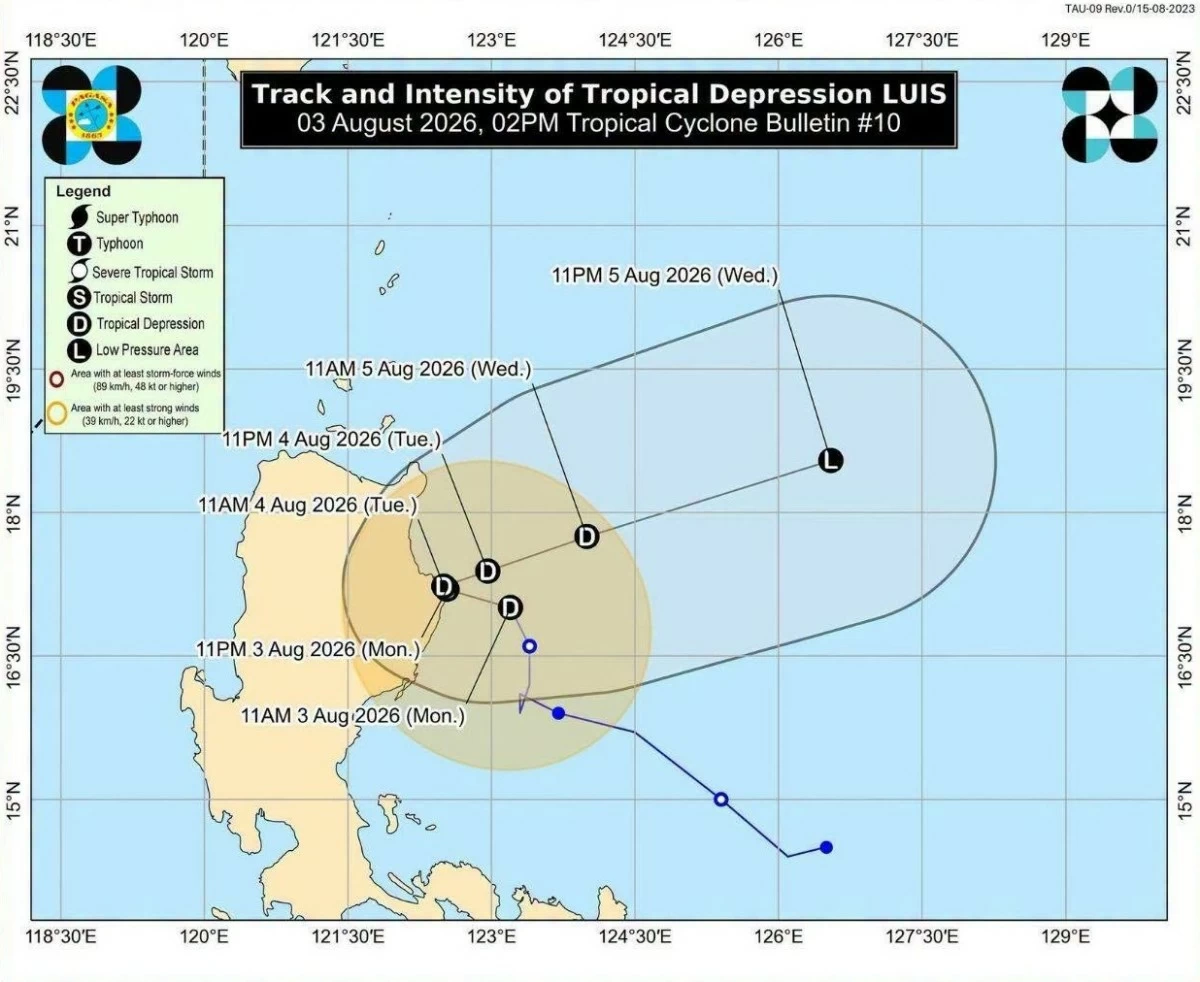
Tropical Depression Luis (Courtesy of PAGASA via Office of Civil Defense)
More than 7,700 families have been affected while nearly 4,000 people have been displaced by the combined effects of the enhanced southwest monsoon (habagat) and the remnants of Tropical Depression Luis, according to initial data released Tuesday, Aug. 4, by the Office of Civil Defense (OCD).
OCD spokesperson Junie Castillo said 7,701 families from 17 barangays have been affected by the weather disturbance. Of those, a total of 1,212 families, or 3,682 individuals, have sought shelter in evacuation centers.
“The initial data are not limited to Northern Luzon. They also include affected communities in the Bicol Region and Mindanao because these figures cover the effects of the southwest monsoon,” Castillo said.
Luis developed on Aug. 1 before making landfall over Maconacon, Isabela on Aug. 3, and eventually weakened into a low pressure area (LPA) later that day.
Although Luis has dissipated, Castillo said habagat continues to bring heavy rains over several parts of the country.
Castillo said authorities have so far recorded 18 flooded areas in Ilocos (Region 1), Zamboanga Peninsula (Region 9), and the Bangsamoro Autonomous Region in Muslim Mindanao (BARMM).
Despite Luis weakening into an LPA, the OCD has maintained the National Disaster Risk Reduction and Management Operations Center (NDRRMOC) under “Blue Alert” status.
“This means we are under heightened monitoring and different government agencies remain on standby,” Castillo said.
"This is not only at the national operations center. Even the regional disaster operations centers remain on Blue Alert status. In fact, in Region 1, different response clusters are already on standby in case our fellow Filipinos need assistance,” he added.
Castillo said Pangasinan remains under close watch because the Philippine Atmospheric, Geophysical and Astronomical Services Administration (PAGASA) continues to forecast intense rainfall.
“We are monitoring our fellow Filipinos, especially in Pangasinan, because the expected heavy rainfall will occur there due to the red rainfall warning being in effect. Residents in low-lying areas, flood-prone communities and places vulnerable to landslides should be evacuated if necessary,” he said.
Orange rainfall warnings also remain in effect over La Union, Benguet, Tarlac, Zambales and Bataan.
The OCD also cited the Mines and Geosciences Bureau (MGB), which identified about 5,000 barangays nationwide as vulnerable to landslides and flooding. These include 32 barangays in Cagayan Valley (Region 2), 345 in the Cordillera Administrative Region (CAR), and 21 in Mimaropa (Region 4B) under the 100-millimeter rainfall threshold.
No confirmed deaths or missing persons have been reported as of Tuesday, Castillo said. However, the OCD said it was verifying reports that a 21-year-old young man allegedly drowned in Lingayen, Pangasinan after attempting to bathe in a deep excavation.
“Our message to our fellow Filipinos is to listen to the advice of local authorities. Know exactly what you need to do. If you are told to evacuate, stay alert and know what is happening. While it is still daylight and you can see the conditions, prepare. Do not wait until nighttime,” Castillo said.
He added that food and non-food relief items had already been prepositioned in vulnerable areas to support affected families if conditions worsen.