ADVERTISEMENT

Top telcos join forces on $500-million archipelagic submarine cable backbone—DICT

Published Aug 3, 2026 12:00 am  |  Updated Aug 1, 2026 02:39 pm
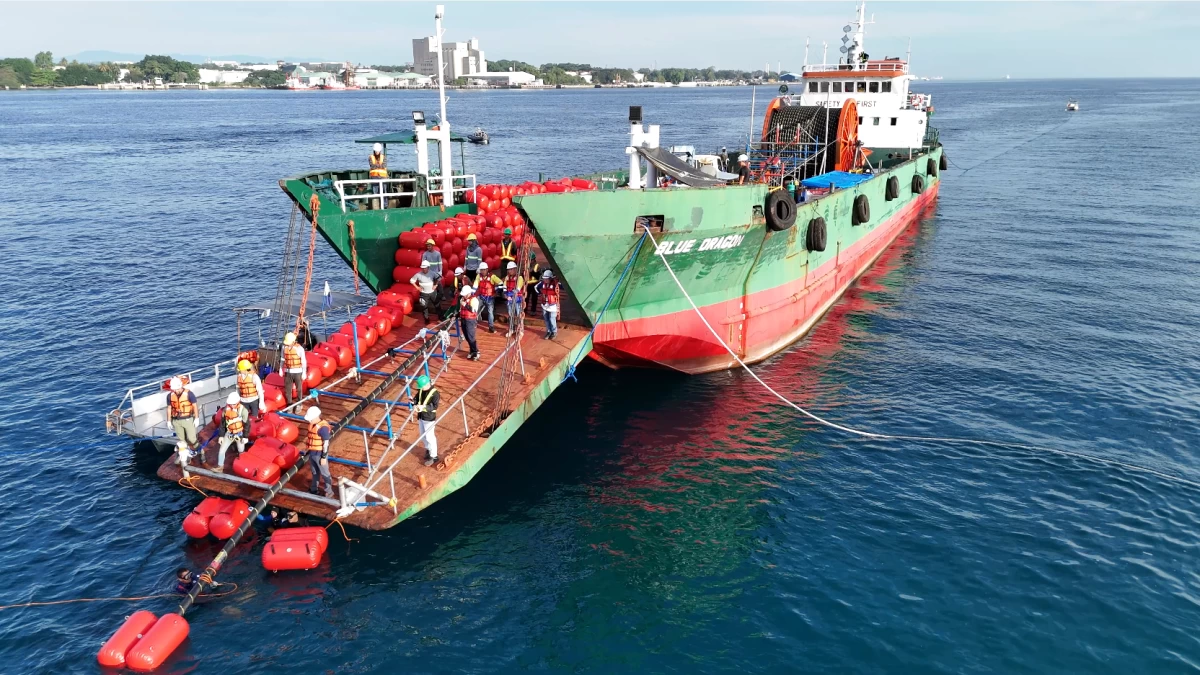
Submarine cable laying in the Pakiputan Strait. A team of technical experts and divers, led by AboitizPower’s Davao Light, initiate the long-awaited Davao-Samal power interconnection project—an initial step to Samal’s much needed integration into the mainland power grid.
The country’s three largest broadband providers are teaming up for a landmark submarine cable project aimed at closing the connectivity gap once and for all, with a potential investment pegged at $500 million, or roughly ₱30.63 billion.
Department of Information and Communications Technology (DICT) Secretary Henry Aguda told reporters that PLDT Inc., Globe Telecom Inc., and Converge ICT Solutions Inc. would form a consortium to develop a submarine cable system that covers the entire archipelago.
Based on initial plans, he said the telcos would build a cable system that would loop from Batanes down to Palawan and into the Visayas, then to Mindanao, before going straight back to Batanes along the Pacific Ocean.
The project will include investments into landing stations that will plug into 14 international submarine cables that link the Philippines to the rest of the world, ensuring redundancy and greater resilience against outages.
According to Aguda, the project would still need concurrence from the government before PLDT, Globe, and Converge can begin initial work and the actual construction.
Once approved, he said the entire subsea cable system can be completed within 24 months, potentially before President Ferdinand Marcos Jr. ends his term in June 2028.
The companies, acting as a consortium, plan to spend a combined $500 million for the project, which would cover the cable installation and support infrastructures.
"By 2028, we should no longer have any problems with connectivity,” Aguda said in an interview last week.
At present, several parts of the country are still designated as geographically isolated and disadvantaged areas (GIDAs), largely due to infrastructure gaps. A nationwide cable system is expected to help bridge these gaps by providing isolated islands with direct connectivity.
Furthermore, the system is also expected to support the growing demand for higher connectivity in the country, given the growing demand for cloud computing and artificial intelligence (AI).
The DICT chief said the project has been gaining traction within the government, especially since it is also expected to benefit security and disaster response efforts through its advanced monitoring capabilities.
In particular, the fiber optic submarine cables that would be installed would feature a digital acoustic sensing system that turns the cable into a monitoring system.
This will help the government detect seismic activity associated with potential earthquakes and tsunamis, as well as monitor vessel movements for defense purposes, among other applications.
Apart from the DICT, Aguda said the departments of national defense, environment and natural resources, science and technology, energy, and the interior and local government also plan to collaborate with three telco companies for the project.

Related Tags

Department of Information and Communications Technology (DICT) PLDT Inc. Converge ICT Solutions Inc. Globe
ADVERTISEMENT
.most-popular .layout-ratio{ padding-bottom: 79.13%; } @media (min-width: 768px) and (max-width: 1024px) { .widget-title { font-size: 15px !important; } }

{{ articles_filter_1561_widget.title }}

.most-popular .layout-ratio{ padding-bottom: 79.13%; } @media (min-width: 768px) and (max-width: 1024px) { .widget-title { font-size: 15px !important; } }

{{ static_articles_1562_widget.title }}

.most-popular .layout-ratio{ padding-bottom: 79.13%; } @media (min-width: 768px) and (max-width: 1024px) { .widget-title { font-size: 15px !important; } }

{{ articles_filter_1563_widget.title }}

{{ articles_filter_1564_widget.title }}

.mb-article-details { position: relative; } .mb-article-details .article-body-preview, .mb-article-details .article-body-summary{ font-size: 17px; line-height: 30px; font-family: "Libre Caslon Text", serif; color: #000; } .mb-article-details .article-body-preview iframe , .mb-article-details .article-body-summary iframe{ width: 100%; margin: auto; } .read-more-background { background: linear-gradient(180deg, color(display-p3 1.000 1.000 1.000 / 0) 13.75%, color(display-p3 1.000 1.000 1.000 / 0.8) 30.79%, color(display-p3 1.000 1.000 1.000) 72.5%); position: absolute; height: 200px; width: 100%; bottom: 0; display: flex; justify-content: center; align-items: center; padding: 0; } .read-more-background a{ color: #000; } .read-more-btn { padding: 17px 45px; font-family: Inter; font-weight: 700; font-size: 18px; line-height: 16px; text-align: center; vertical-align: middle; border: 1px solid black; background-color: white; } .hidden { display: none; }
function initializeAllSwipers() { // Get all hidden inputs with cms_article_id document.querySelectorAll('[id^="cms_article_id_"]').forEach(function (input) { const cmsArticleId = input.value; const articleSelector = '#article-' + cmsArticleId + ' .body_images'; const swiperElement = document.querySelector(articleSelector); if (swiperElement && !swiperElement.classList.contains('swiper-initialized')) { new Swiper(articleSelector, { loop: true, pagination: false, navigation: { nextEl: '#article-' + cmsArticleId + ' .swiper-button-next', prevEl: '#article-' + cmsArticleId + ' .swiper-button-prev', }, }); } }); } setTimeout(initializeAllSwipers, 3000); const intersectionObserver = new IntersectionObserver( (entries) => { entries.forEach((entry) => { if (entry.isIntersecting) { const newUrl = entry.target.getAttribute("data-url"); if (newUrl) { history.pushState(null, null, newUrl); let article = entry.target; // Extract metadata const author = article.querySelector('.author-section').textContent.replace('By', '').trim(); const section = article.querySelector('.section-info ').textContent.replace(' ', ' '); const title = article.querySelector('.article-title h1').textContent; // Parse URL for Chartbeat path format const parsedUrl = new URL(newUrl, window.location.origin); const cleanUrl = parsedUrl.host + parsedUrl.pathname; // Update Chartbeat configuration if (typeof window._sf_async_config !== 'undefined') { window._sf_async_config.path = cleanUrl; window._sf_async_config.sections = section; window._sf_async_config.authors = author; } // Track virtual page view with Chartbeat if (typeof pSUPERFLY !== 'undefined' && typeof pSUPERFLY.virtualPage === 'function') { try { pSUPERFLY.virtualPage({ path: cleanUrl, title: title, sections: section, authors: author }); } catch (error) { console.error('ping error', error); } } // Optional: Update document title if (title && title !== document.title) { document.title = title; } } } }); }, { threshold: 0.1 } ); function showArticleBody(button) { const article = button.closest("article"); const summary = article.querySelector(".article-body-summary"); const body = article.querySelector(".article-body-preview"); const readMoreSection = article.querySelector(".read-more-background"); // Hide summary and read-more section summary.style.display = "none"; readMoreSection.style.display = "none"; // Show the full article body body.classList.remove("hidden"); } document.addEventListener("DOMContentLoaded", () => { let loadCount = 0; // Track how many times articles are loaded const offset = [1, 2, 3, 4, 5, 6, 7, 8, 9, 10]; // Offset values const currentUrl = window.location.pathname.substring(1); let isLoading = false; // Prevent multiple calls if (!currentUrl) { console.log("Current URL is invalid."); return; } const sentinel = document.getElementById("load-more-sentinel"); if (!sentinel) { console.log("Sentinel element not found."); return; } function isSentinelVisible() { const rect = sentinel.getBoundingClientRect(); return ( rect.top < window.innerHeight && rect.bottom >= 0 ); } function onScroll() { if (isLoading) return; if (isSentinelVisible()) { if (loadCount >= offset.length) { console.log("Maximum load attempts reached."); window.removeEventListener("scroll", onScroll); return; } isLoading = true; const currentOffset = offset[loadCount]; window.loadMoreItems().then(() => { let article = document.querySelector('#widget_1690 > div:nth-last-of-type(2) article'); intersectionObserver.observe(article) loadCount++; }).catch(error => { console.error("Error loading more items:", error); }).finally(() => { isLoading = false; }); } } window.addEventListener("scroll", onScroll); });

Sign up by email to receive news.