







Idiosyncratic, peculiar, and yet so engaging
Published Aug 3, 2026 09:08 am


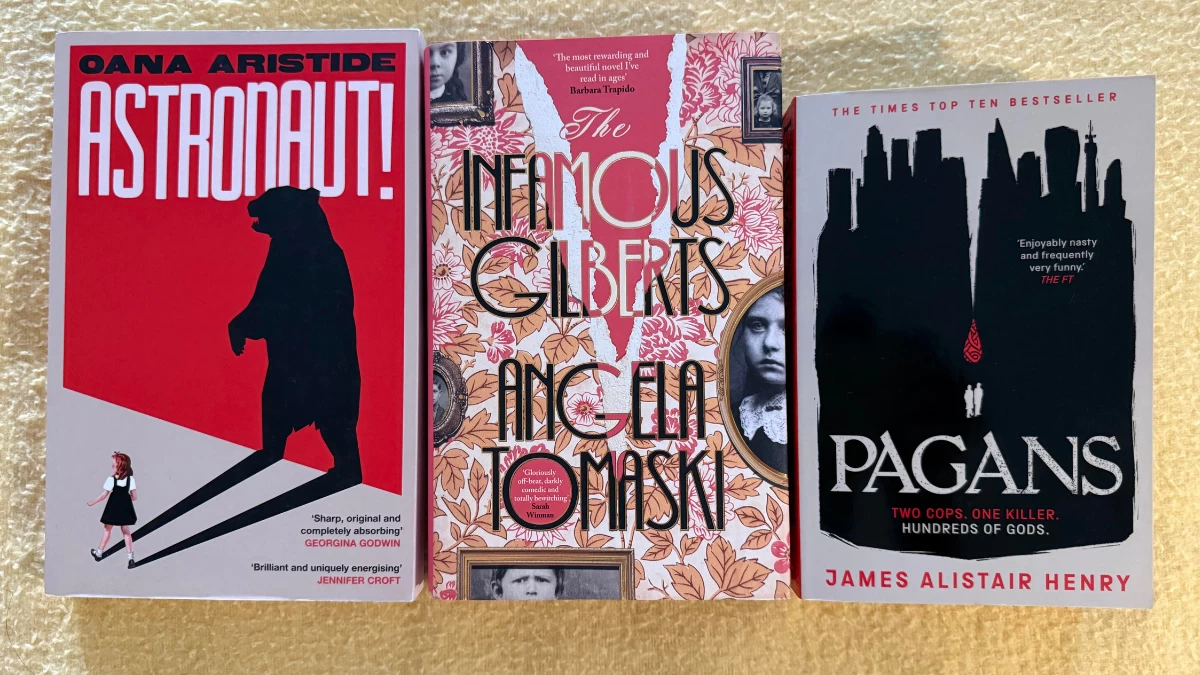
Here are three novels that exhibit strong originality, whether in structure, style, or narrative. From authors who fully deserve our kudos and applause. One combines a detective novel with a coming-of-age tale. The second is a family saga couched in a house tour, while the third conjures up an alternate Britain of today.
"Astronaut!" by Oana Aristide
Communist Romania in 1989, under the iron fist of President Ceausescu, is the setting for this story that combines a detective novel with a coming-of-age tale. On one hand, we have world-weary Constantin, possibly the last idealistic police detective in the country, and on the other hand, we have Lia, a rebellious, curious young girl who keeps getting into trouble. We first meet Lia being taken home by Comrade Blaga, who later in the story is found dead. Constantin is assigned to solve a series of mysterious, grisly murders that are happening all over the country. Serial killer? But in a country that prides itself on communism and being different from America, the report is floated that a man-eating bear is on the loose - as the country does not create serial killers. This is an era of strict rationing, of secret police informants on every corner, and of food queues that would diminish the spirit of any person.
Satirical, tense, and strangely moving, the novel juxtaposes the travails of a free-spirited eight-year-old girl with those of a ready-for-retirement detective - both up against a system that doesn’t appreciate originality of thought, or any streak of independence. Lia unknowingly falls under the influence of a neighbor, Comrade Mantea, who, on the surface, is helping her with a school art contest; but has something more insidious and outright seditious in mind. Constantin is actually called to meet the President and forced to defend the theory of a murderous bear, even while knowing they fabricated the theory. The drudgery of police work is tellingly chronicled, and there’s the insularity of an eight-year-old girl in her own world. As a succinct lesson, the narrative explores how the lies that we accept today become the truths of tomorrow - something we face to this day.
"The Infamous Gilberts" by Angela Tomaski
A walkthrough in 2002 of the Gilbert mansion, before it was turned into a luxury historical hotel, with butler Maximus as our tour guide, is the unique narrative structure and device of this charming novel. What you’ll immediately pick up with Max is that he loves to break the fourth wall, and it endears him to us, the readers. Hilarious and tragic, Max gives us the story of the Gilbert family - Mrs. Gilbert, ‘widowed’ too soon, and taking care of the five Gilbert children, Lydia, Hugo, Annabel, Jeremy, and Rosalind. In terms of structure, Tomaski exhibits such nimble skill and craft, making such mundane things as dents on the wall and stains on the carpet act as triggers for the memories of Max about his wards. And slowly, what is conjured up are the very distinct identities and personalities of the five Gilbert children - a unique family saga.
They’re eccentric to a fault, living in the Gothic mansion and the grounds that make up the Gilbert estate. As guardian of the Gilbert legacy, Maximus reveals how each room, each house on the property, harbors deep and at times dark secrets about each member of the family. Lydia is the frustrated romantic, Hugo the stubborn traditionalist, Annabel the wild-eyed dreamer, Jeremy the explorer who does escape the family, and Rosalind the deluded diva of an actress. While the initial tone is one of quaintness and idiosyncrasies, there are immediate dark undertones that any reader can sense. But that foreshadowing will not prepare you for just how disastrous and tragic the story will become. But like a road accident that you can’t pry your eyes from, the steep decline of the family is one that becomes vicarious and addictive. How all this eccentricity becomes the tale of a family’s fall is the precious gift of reading this novel.
"Pagans" by James Alistair Henry
Strong round of applause here for Henry’s originality of thought and for his world-building. In this crime fiction/detective tale, the action takes place in an England very different from the one we know today. In fact, it’s an alternate 21st-century world order that’s drastically unrecognizable, but wonderfully stitched together by our author. His England is a loose alliance of ancient tribes, Scotland aligned with the Nordic block of countries, and an England on an uneasy truce with Ireland. So this story revolves around what happens when a Celtic diplomat is brutally murdered by being nailed to a tree, and a high-ranking Saxon civil servant ends up ritually executed in the same manner. Two mismatched cops from rival tribes now have to work together to solve the murder and stop political unrest. These are Aedith, the Saxon detective, and Drustan, the Celt.
Aedith is the daughter of the Mercia chieftain, and he supports the High King who is pushing for Unification through a planned summit. Naturally, there are several parties with vested interests in not seeing any reuniting happen. Just think back to BREXIT and how easy it is to stir nationalism when really an agenda of economic self-interest. Drustan in turn, becomes the conduit for how the religious and magical can also be part of a national conversation, and cast a shadow on political developments. In short, while one can say it’s fantasy and alternative history, so many aspects of the premise have roots in the now and today. Even the two deaths point to the possibility of a serial killer with a decades old grudge, and not just someone taking advantage of the inclement political climate. What’s also effective are the fully-fleshed protagonists of Aedith and Drustan, and that this novel is Book 1 of an intended series.