






 Business
Banking & Finance
BPI expects stronger second half after pricing in Middle East risks
Business
Banking & Finance
BPI expects stronger second half after pricing in Middle East risks
BPI expects stronger second half after pricing in Middle East risks


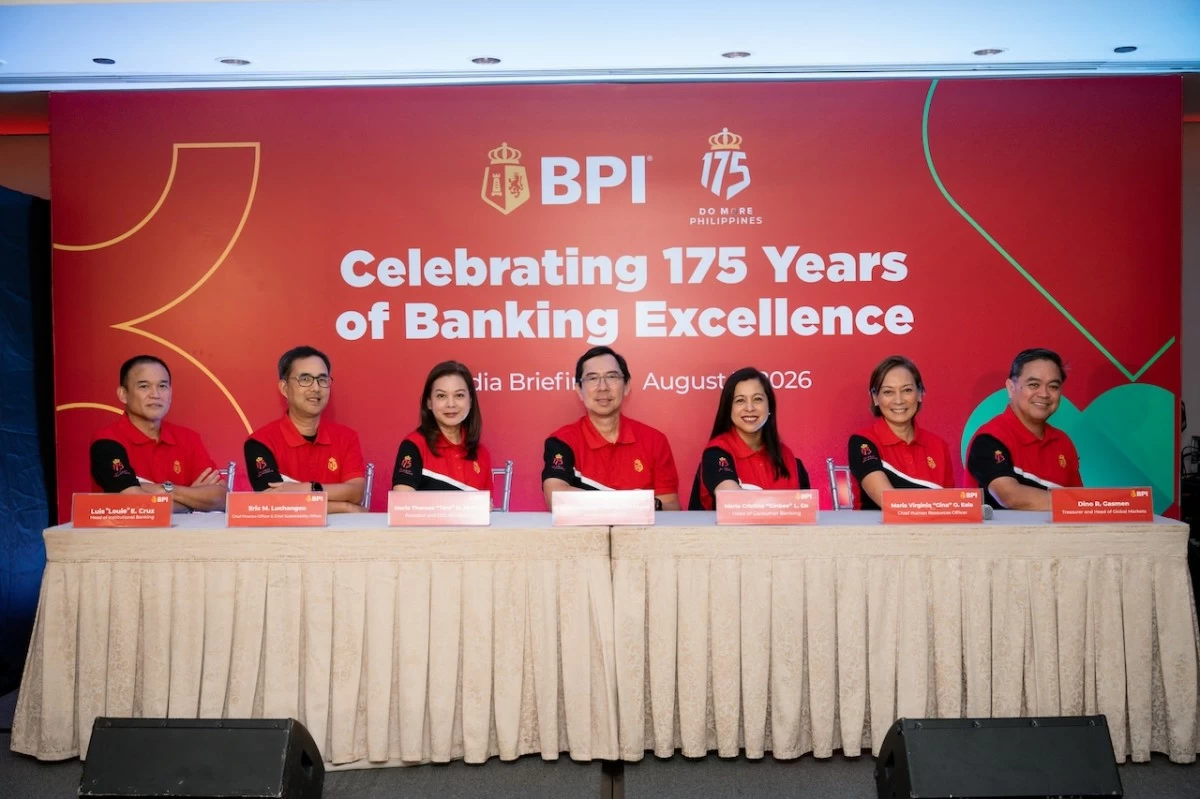
Ayala-led Bank of the Philippine Islands (BPI) expects a better performance in the second half of this year after its earnings were trimmed by higher provisioning in the second quarter due to risks arising from the Middle East conflict.
In a media briefing on Monday, Aug. 3, to kick off the bank’s 175th anniversary, BPI Chief Financial Officer (CFO) and Chief Sustainability Officer Eric Luchangco said, “Typically in any given year we tend to see the second half perform a little better than the first half.”
He added, “There’s good reason for us to expect that we can see a little better performance in the second half versus effectively the annualized second quarter.”
In terms of loan-loss provisioning, Luchangco explained that the bank’s decision in the second quarter was already close to the worst-case scenario since it was made at the peak of the hostilities and before a ceasefire was agreed upon by the United States (US) and Iran.
“And so, in order for the model to dictate further provisioning for the macroeconomic variables, macroeconomic variables or the conditions would have to deteriorate further. If it stays the same, then there’s going to be no more addition to account for macroeconomic conditions,” he added.
Meanwhile, “If it improves, we might actually see a return on some of those provisions. But I guess that’s a bit of a long way of saying that we don’t expect the second quarter to be representative of what the rest of the year should be,” Luchangco said.
BPI President Jose Teodoro K. Limcaoco also pointed out, “Banking is a cyclical business. So when the economy is doing really well, the banks will do well. And when the economy goes a little bit awkward, like moderates, the bank will be there for the customers. So, when we talk about tightening credit standards, it doesn’t mean we are shutting off our customers.”
“So, even as clients have problems, and we will have clients who have issues, we work with them to try to work out payment methodologies because the last thing we want to do, the last thing we want to happen is our clients fail,” he added.
BPI Institutional Banking Head Luis E. Cruz said they are still tracking corporate banking growth of eight to 10 percent, as forecast at the start of the year.
“Given that we see the pipelines of most of the project finance of different companies. After the first half, we’ve seen them complete the others already based on their existing timeline... So, overall, on the corporate side, we continue to see a low growth of eight percent to 10 percent given the visibility that we have at the moment,” he said.
On the other hand, BPI Consumer Banking Head Cristina L. Go said credit cards and retail lending for homes and automobiles are more tempered compared to the previous year.
“This shows the importance that people place on their ability to budget and to prioritize where they will invest and spend on today. What we will focus in the next half of the year is really to make sure that we’re able to underwrite more responsibly and to provide the needed credit to those that can still afford,” she added.
BPI Wealth President Maria Theresa D. Marcial said BPI Wealth has grown about 18 percent over the last five years compared to the industry, which has grown by only about 16 percent.
“In fact, as of the first quarter of this year, BPI Asset Management and Trust Corp. is now the largest trust entity in the country with ₱1.95 trillion in assets under management (AUM). Going forward for the balance of the year, we believe this strong momentum will continue. We’re looking to grow around 15 percent to 20 percent in AUM for 2026,” she noted.
BPI marked its 175th anniversary on Aug. 1, 2026, celebrating nearly two centuries of banking excellence, earning the trust of generations of Filipinos, and helping build a better Philippines through inclusive and sustainable banking.
“For 175 years, BPI has stood alongside generations of Filipinos through every milestone, challenge, and opportunity. Our history is defined not only by being first, but by continuously serving our customers and contributing to the country’s progress. As we look ahead, we remain committed to empowering more Filipinos through innovation, financial inclusion, and sustainable growth,” said Limcaoco.
Established on Aug. 1, 1851, as Banco Español-Filipino de Isabel II, BPI is the first bank in the Philippines and the oldest in Southeast Asia. It was renamed Banco Español-Filipino in 1869 before becoming the Bank of the Philippine Islands in 1912.