






Manila Bulletin
 Philippines
National
Marcos urged to focus on implementing existing policies rather than creating new ones
Philippines
National
Marcos urged to focus on implementing existing policies rather than creating new ones
Philippines
National
Marcos urged to focus on implementing existing policies rather than creating new ones
Marcos urged to focus on implementing existing policies rather than creating new ones
Published Aug 2, 2026 01:25 pm


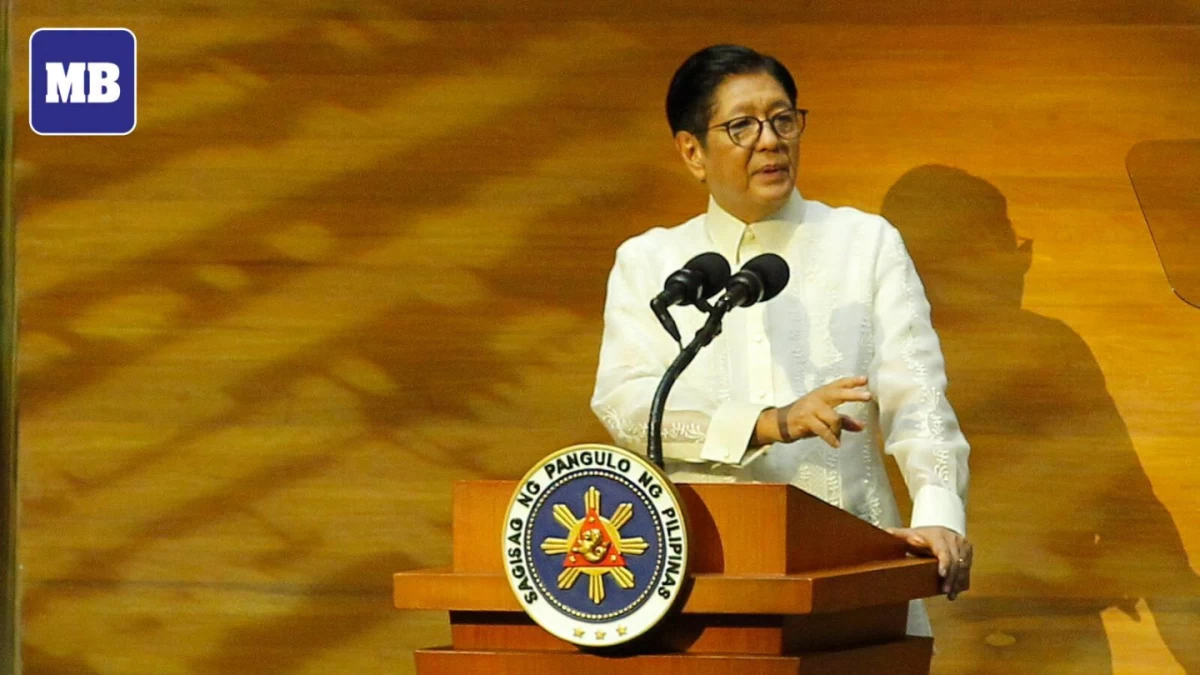
President Ferdinand R. Marcos Jr. outlines his administration’s economic accomplishments, key policy priorities, and upcoming legislative agenda during his fifth State of the Nation Address at the Batasang Pambansa in Quezon City on Monday, July 27, 2026. (Photo by Mark Balmores | MB)
Implementation of existing policies, not new promises, will determine President Marcos' legacy, governance advocates said.
Democracy Watch, a citizen-led democratic initiative of think tank Stratbase, said Marcos faces mounting pressure to prove that his administration can deliver tangible improvements in Filipinos' lives as he enters the final two years of his presidency.
During Democracy Watch's post-State of the Nation Address (SONA) forum on Friday, July 31, Democracy Watch co-convenor Victor Andres Manhit noted that while the President's fifth SONA last July 27 correctly emphasized fighting corruption, strengthening the economy, and improving the lives of ordinary Filipinos, these commitments must now produce visible and measurable outcomes.
"With only two years left in his term, the focus can no longer be on announcing reforms," Manhit said.
"The challenge now is demonstrating that policies already put in place are producing measurable improvements in governance, public services, and the economy. Implementation will ultimately define this administration's legacy," he added.
Citing recent surveys commissioned by Stratbase, Manhit noted that Marcos' trust ratings falling to their lowest level – 34 percent in June 2026 – since taking office signals that "Filipinos are looking for decisive leadership, stronger accountability, and concrete action on the issues affecting their daily lives."
According to Manhit, based on these surveys, Filipinos' top concerns, such as lower food prices, more jobs and livelihood opportunities, and the elimination of corruption, were increasingly viewed as interconnected challenges requiring effective governance.
"Addressing high food prices and creating more livelihood opportunities require a government that uses public resources effectively and remains accountable to its citizens," he said.
Manhit also emphasized that institutional reforms will matter only if they produce visible improvements in the lives of Filipinos.
"What is apparent to the people, after the fifth SONA and with two years remaining in the Marcos Jr. administration, is that their top concerns—food, jobs and livelihood, and the fight against corruption—do not exist independently of each other. Rather, they are interconnected expectations of effective governance," he said.
Speaking at the forum, Department of Budget and Management (DBM) Secretary Kim Robert de Leon echoed Manhit's sentiments, saying that the government's responsibility "is to ensure that these commitments are translated into sound policies, effective programs, and a national budget that delivers meaningful results for every Filipino...Every agency, every public servant, and every peso entrusted to us must contribute to delivering better outcomes for our country."
He said the department had undertaken "one of the most rigorous reviews in recent years" of the 2026 National Expenditure Program (NEP), with agency budget proposals evaluated not only for completeness but also for implementation readiness, strategic relevance, measurable outcomes, fiscal sustainability, and alignment with the Philippine Development Plan and the President's priorities.
He also outlined a series of reforms aimed at strengthening safeguards against corruption in the preparation and implementation of the proposed 2027 national budget.
De Leon further said that the DBM is eyeing to transmit the 2027 NEP to Congress before August 14.
Among the DBM's reforms, De Leon said, was introducing a new requirement for priority regional programs to secure endorsements from Regional Development Councils before being included in agency budget proposals, a measure the department said would strengthen coordination with local governments and make the budget process more responsive to regional needs.
To improve transparency during budget implementation, De Leon highlighted the launch of the DBM Centralized Open Monitoring Platform for Appropriations and Spending Statistics (DBM Compass), which allows the public to monitor government spending from budget allocation to disbursement through a single online portal.
The department is likewise expanding Project DIME, which uses satellite imagery, drones, geotagging and other digital technologies to independently verify the progress of major infrastructure projects, including flood control initiatives.
These reforms, he said, were intended to prevent questionable projects from entering the budget in the first place, arguing that prevention—not merely investigation after the fact—is the government's strongest defense against corruption.