

ADVERTISEMENT

'Electricity bills not an insurance policy': House leaders file bill to abolish systems loss charges

Published Aug 2, 2026 02:23 pm

At A Glance

  • The House leadership filed HB No. 10430, the Systems Loss Charge Abolition Act, to remove system loss as a separate item in electricity bills.
  • The measure bars utilities from passing controllable losses—like theft, defective meters, or negligence—onto consumers, while allowing recovery of prudent costs for efficient service.
  • The Energy Regulatory Commission will phase in reforms within three years, set efficiency standards, and issue implementing rules in consultation with stakeholders.
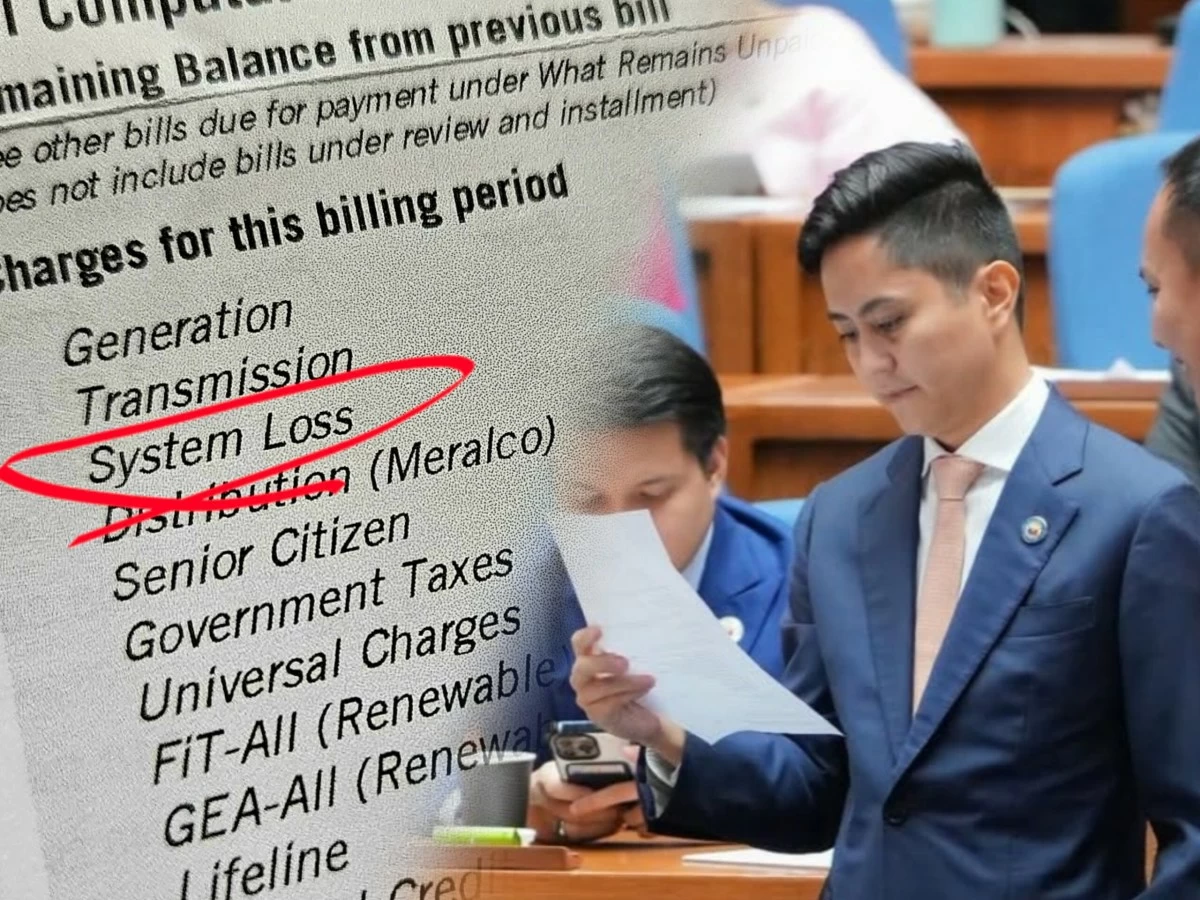
System loss charge on electricity bill (left), Majority Leader Ilocos Norte 1st district Rep. Sandro Marcos (Ellson Quismorio/ MANILA BULLETIN)


The House leadership has filed its version of the measure that would finally get rid of the unreasonable systems loss charges from electricity bills--which is one of President Marcos' marching orders in his latest State of the Nation Address (SONA).
The proposed House Bill (HB) No. 10430 or the Systems Loss Charge Abolition Act filed by presidential son, Majority Leader Ilocos Norte 1st district Rep. Sandro Marcos and House Speaker Isabela 6th district Rep. Faustino “Bojie” Dy III would remove system loss as a separate component of electricity bills.
The bills declares that consumers should be protected from charges arising from conditions within the control of distribution utilities while allowing the recovery of costs genuinely necessary for efficient electricity delivery.
“President Ferdinand ‘Bongbong’ Marcos Jr. has placed high electricity costs at the center of the national agenda, and Speaker Bojie Dy and I are drawing a fair line: consumers should pay for efficient service, not for theft, negligence or operational failures they did not cause," Rep. Marcos said on Sunday, Aug. 2.
"Hindi dapat gawing insurance policy ang buwanang bill ng ordinaryong pamilya para sa mga pagkukulang na kayang pigilan ng utility,” he underscored.
(The monthly bill of an ordinary family should not be turned into an insurance policy for shortcomings that a utility can prevent.)
The elder Marcos made this call--and received a standing ovation from lawmakers as a result--during his fifth and penultimate SONA last July 27.
Under the bill, distribution utilities (DUs) could not recover disallowed system losses through wheeling charges, supply charges, metering charges, universal charges, subsidies or any other item appearing on the monthly bill.
The Energy Regulatory Commission (ERC) would determine what limited portion of electricity necessarily consumed in the efficient operation of a distribution network may be recovered as part of the distribution wheeling charge.
Costs arising from illegal electricity use, power theft and the theft or destruction of electrical lines, equipment and materials can no longer be passed on to paying customers, according to HB No. 10430.
The same prohibition would cover losses caused by defective or inaccurate meters, billing and collection deficiencies, inadequate maintenance, inefficient operations, negligence and other causes reasonably within the utility’s control.
It says DUs would retain the right to recover prudent and reasonable costs necessary to maintain reliable service and remain financially viable.
The ERC would implement the reform in phases to protect consumers without disrupting electricity reliability or destabilizing properly managed utilities.
The transition must progressively reduce the costs recoverable from end-users and be completed within three years from the effectivity of the implementing rules.
The regulator would also establish minimum efficiency standards for distribution utilities, including benchmarks for service interruption frequency and collection performance.
“This is not a blanket denial of legitimate costs...Utilities that operate efficiently may recover prudent expenses, but costs born of controllable losses must remain where responsibility belongs,” Rep. Marcos explained.
The ERC would issue the implementing rules within 90 days in consultation with the Department of Energy (DOE), distribution utilities, consumer groups and other stakeholders, with the law taking effect 15 days after publication.

Related Tags

Sandro Marcos PBBM Marcos SONA Faustino \"Bojie\" Dy III House of Representatives Systems loss
ADVERTISEMENT
.most-popular .layout-ratio{ padding-bottom: 79.13%; } @media (min-width: 768px) and (max-width: 1024px) { .widget-title { font-size: 15px !important; } }

{{ articles_filter_1561_widget.title }}

.most-popular .layout-ratio{ padding-bottom: 79.13%; } @media (min-width: 768px) and (max-width: 1024px) { .widget-title { font-size: 15px !important; } }

{{ static_articles_1562_widget.title }}

.most-popular .layout-ratio{ padding-bottom: 79.13%; } @media (min-width: 768px) and (max-width: 1024px) { .widget-title { font-size: 15px !important; } }

{{ articles_filter_1563_widget.title }}

{{ articles_filter_1564_widget.title }}

.mb-article-details { position: relative; } .mb-article-details .article-body-preview, .mb-article-details .article-body-summary{ font-size: 17px; line-height: 30px; font-family: "Libre Caslon Text", serif; color: #000; } .mb-article-details .article-body-preview iframe , .mb-article-details .article-body-summary iframe{ width: 100%; margin: auto; } .read-more-background { background: linear-gradient(180deg, color(display-p3 1.000 1.000 1.000 / 0) 13.75%, color(display-p3 1.000 1.000 1.000 / 0.8) 30.79%, color(display-p3 1.000 1.000 1.000) 72.5%); position: absolute; height: 200px; width: 100%; bottom: 0; display: flex; justify-content: center; align-items: center; padding: 0; } .read-more-background a{ color: #000; } .read-more-btn { padding: 17px 45px; font-family: Inter; font-weight: 700; font-size: 18px; line-height: 16px; text-align: center; vertical-align: middle; border: 1px solid black; background-color: white; } .hidden { display: none; }
function initializeAllSwipers() { // Get all hidden inputs with cms_article_id document.querySelectorAll('[id^="cms_article_id_"]').forEach(function (input) { const cmsArticleId = input.value; const articleSelector = '#article-' + cmsArticleId + ' .body_images'; const swiperElement = document.querySelector(articleSelector); if (swiperElement && !swiperElement.classList.contains('swiper-initialized')) { new Swiper(articleSelector, { loop: true, pagination: false, navigation: { nextEl: '#article-' + cmsArticleId + ' .swiper-button-next', prevEl: '#article-' + cmsArticleId + ' .swiper-button-prev', }, }); } }); } setTimeout(initializeAllSwipers, 3000); const intersectionObserver = new IntersectionObserver( (entries) => { entries.forEach((entry) => { if (entry.isIntersecting) { const newUrl = entry.target.getAttribute("data-url"); if (newUrl) { history.pushState(null, null, newUrl); let article = entry.target; // Extract metadata const author = article.querySelector('.author-section').textContent.replace('By', '').trim(); const section = article.querySelector('.section-info ').textContent.replace(' ', ' '); const title = article.querySelector('.article-title h1').textContent; // Parse URL for Chartbeat path format const parsedUrl = new URL(newUrl, window.location.origin); const cleanUrl = parsedUrl.host + parsedUrl.pathname; // Update Chartbeat configuration if (typeof window._sf_async_config !== 'undefined') { window._sf_async_config.path = cleanUrl; window._sf_async_config.sections = section; window._sf_async_config.authors = author; } // Track virtual page view with Chartbeat if (typeof pSUPERFLY !== 'undefined' && typeof pSUPERFLY.virtualPage === 'function') { try { pSUPERFLY.virtualPage({ path: cleanUrl, title: title, sections: section, authors: author }); } catch (error) { console.error('ping error', error); } } // Optional: Update document title if (title && title !== document.title) { document.title = title; } } } }); }, { threshold: 0.1 } ); function showArticleBody(button) { const article = button.closest("article"); const summary = article.querySelector(".article-body-summary"); const body = article.querySelector(".article-body-preview"); const readMoreSection = article.querySelector(".read-more-background"); // Hide summary and read-more section summary.style.display = "none"; readMoreSection.style.display = "none"; // Show the full article body body.classList.remove("hidden"); } document.addEventListener("DOMContentLoaded", () => { let loadCount = 0; // Track how many times articles are loaded const offset = [1, 2, 3, 4, 5, 6, 7, 8, 9, 10]; // Offset values const currentUrl = window.location.pathname.substring(1); let isLoading = false; // Prevent multiple calls if (!currentUrl) { console.log("Current URL is invalid."); return; } const sentinel = document.getElementById("load-more-sentinel"); if (!sentinel) { console.log("Sentinel element not found."); return; } function isSentinelVisible() { const rect = sentinel.getBoundingClientRect(); return ( rect.top < window.innerHeight && rect.bottom >= 0 ); } function onScroll() { if (isLoading) return; if (isSentinelVisible()) { if (loadCount >= offset.length) { console.log("Maximum load attempts reached."); window.removeEventListener("scroll", onScroll); return; } isLoading = true; const currentOffset = offset[loadCount]; window.loadMoreItems().then(() => { let article = document.querySelector('#widget_1690 > div:nth-last-of-type(2) article'); intersectionObserver.observe(article) loadCount++; }).catch(error => { console.error("Error loading more items:", error); }).finally(() => { isLoading = false; }); } } window.addEventListener("scroll", onScroll); });

Sign up by email to receive news.