






Manila Bulletin
 Philippines
National
China warns of 'resolute' response over Philippine baselines around Bajo de Masinloc
Philippines
National
China warns of 'resolute' response over Philippine baselines around Bajo de Masinloc
Philippines
National
China warns of 'resolute' response over Philippine baselines around Bajo de Masinloc
China warns of 'resolute' response over Philippine baselines around Bajo de Masinloc
Published Aug 2, 2026 07:37 am


At A Glance
- China warned that it would "respond resolutely" if the Philippines continues what Beijing described as acts of infringement or provocation around Bajo de Masinloc.
- Beijing rejected the Philippines' delimitation of territorial sea baselines around the shoal as "illegal, null and void," while renewing its opposition to the 2016 South China Sea Arbitral Award and the Philippine Maritime Zones Act.
- The warning comes as Manila continues to assert its maritime rights through UNCLOS and the arbitral ruling, including its recent presentation before a United Nations body of its extended continental shelf submission in the West Philippine Sea.
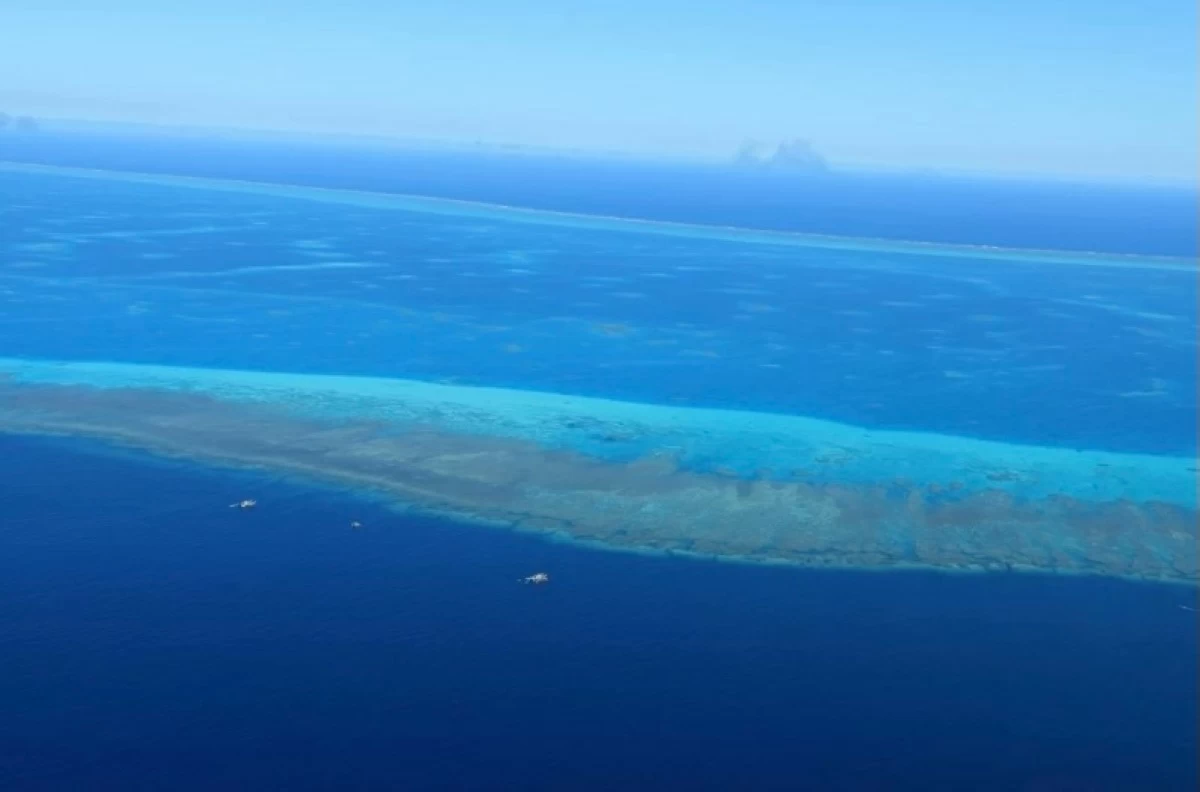
File photo
China has warned that it would "respond resolutely" if the Philippines continues what Beijing described as acts of infringement or provocation around Bajo de Masinloc, as it rejected Manila's delimitation of territorial sea baselines around the disputed shoal.
In a statement posted on the Chinese Embassy in Manila’s Facebook page, China's Ministry of Foreign Affairs urged the Philippines to respect what Beijing claims as its territorial sovereignty and maritime rights and interests over Huangyan Dao, its name for Bajo de Masinloc, also known internationally as Scarborough Shoal.
"China urges the Philippines to earnestly respect China’s territorial sovereignty and maritime rights and interests, and refrain from any act of infringement or provocation in Huangyan Dao," the ministry said.
"Otherwise, China will respond resolutely," it added.
Beijing accused Manila of repeatedly engaging in what it called provocations around the shoal and of using maritime disputes between the two countries to heighten tensions in the South China Sea.
"For some time, the Philippines has been frequently making provocations in the waters of Huangyan Dao and hyping the maritime issues between China and the Philippines," the Chinese Foreign Ministry said, claiming that such actions "heighten maritime tensions, and undermine peace and stability in the South China Sea."
China rejects PH baselines
China also rejected the Philippines' delimitation of what Manila considers the territorial sea baselines around Bajo de Masinloc, describing the move as a violation of Chinese sovereignty and international law.
"The Philippines’ delimitation of the so-called ‘baselines of the territorial sea’ of China’s territory of Huangyan Dao (Huangyan Island) is a grave infringement upon China’s territorial sovereignty and a serious violation of international law including the United Nations Charter and the United Nations Convention on the Law of the Sea (UNCLOS)," the ministry said.
"It is illegal, null and void. China firmly rejects and will never accept it," it added.
Beijing maintained that the shoal is China's "inherent territory" and claimed "indisputable sovereignty" over it and its adjacent waters, arguing that the feature was never included in Philippine territory as defined by international treaties.
Beijing hits Maritime Zones Act, arbitral ruling
China likewise assailed the Philippines' Maritime Zones Act, accusing Manila of using domestic legislation to reinforce the landmark 2016 South China Sea Arbitral Award and include Bajo de Masinloc and features in the Spratly Islands within Philippine maritime zones.
Beijing claimed that the law "severely violates China's territorial sovereignty and maritime rights and interests in the South China Sea," insisting that its claims would not be affected by Philippine legislation.
China also renewed its rejection of the 2016 Arbitral Award, maintaining that the Philippines' initiation of arbitration violated international law, previous bilateral agreements, and the Declaration on the Conduct of Parties in the South China Sea.
"The so-called ‘award’ is illegal, null and void, and has no binding force,” the Chinese Foreign Ministry said.
“China neither accepts nor recognizes the ‘award,’ and opposes and will never accept any claim or action based on it," it added.
The 2016 tribunal, however, ruled that there was no legal basis for China's sweeping claims to historic rights within its so-called "nine-dash line" under UNCLOS, while also making findings concerning the maritime entitlements of features in the South China Sea.
PH turns to international law
Beijing's latest warning comes as the Philippines continues to invoke UNCLOS and the 2016 Arbitral Award in asserting its maritime entitlements in the West Philippine Sea.
The Philippines recently formally presented before the United Nations Commission on the Limits of the Continental Shelf (CLCS) its partial submission concerning the country's entitlement to an extended continental shelf in the West Philippine Sea covering the West Palawan Region.
During the presentation at the United Nations Headquarters, the Philippine delegation asked the Commission to consider relevant decisions of tribunals constituted under UNCLOS, including the 2016 South China Sea Arbitral Award, which determined maritime entitlements of littoral states in the South China Sea.
The Department of Foreign Affairs (DFA) said the submission demonstrates the Philippines' commitment to the UN Charter and UNCLOS and reflects the country's reliance on a rules-based order to promote a peaceful South China Sea, sustain Filipino livelihoods, foster trade, protect marine biodiversity, and strengthen cooperation among coastal states.
The submission was prepared over 15 years by the Extended Continental Shelf Technical Working Group led by the National Mapping and Resource Information Authority, with the Philippine delegation to the CLCS headed by Ambassador and Permanent Representative to the United Nations Enrique A. Manalo.
Marcos: PH will uphold arbitral award
President Marcos also recently vowed that the government would continue defending the country's landmark arbitral victory through peaceful and legal means, using his fifth State of the Nation Address (SONA) to declare that the Philippines would not abandon the 2016 ruling.
"This is not a claim that we advance alone, nor one that we will abandon," he said.
"Your government will do all that is necessary to continue upholding this Award, utilizing every peaceful and legal means available to the Republic against any attempt, foreign or domestic, to undermine this achievement," he added.
The President likewise paid tribute to the Armed Forces of the Philippines, the Philippine Coast Guard, and Filipino fisherfolk who continue to operate in the West Philippine Sea despite the risks they face, saying their presence gives life to the "letter and spirit" of the arbitral ruling.
Marcos also called for national unity in defending Philippine sovereignty amid continuing security challenges.
"We are not greedy. We are not racists. We are not liars. We are respectful, and we are dignified. We are Filipinos, and we do not yield," he said.