

ADVERTISEMENT

Rescuers recover 3 bodies from Pakistan's Broad Peak avalanche

Published Aug 1, 2026 10:10 am

At A Glance

  • ISLAMABAD (AP) — Rescuers searching for 10 climbers missing after an avalanche on Pakistan's Broad Peak found four bodies and recovered three of them Friday, July 31, and were continuing to search for the other missing climbers despite adverse weather that hampered helicopter flights, officials said.
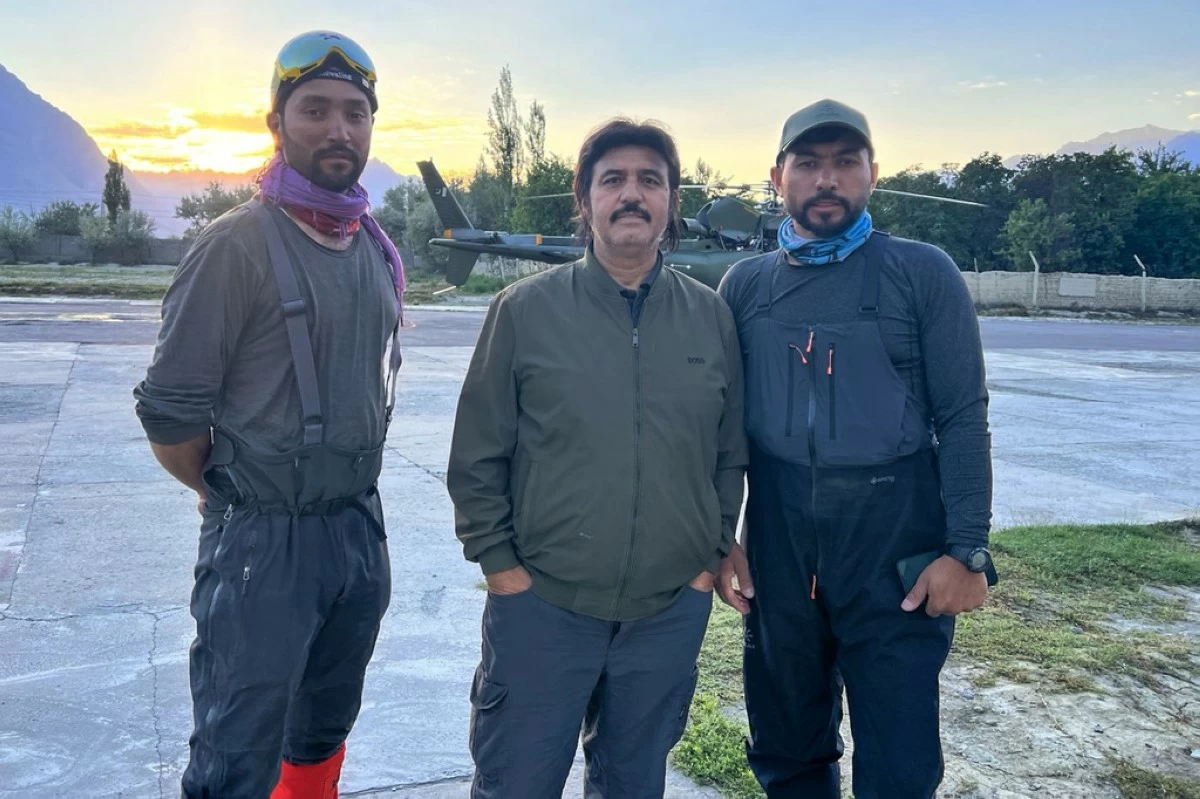
In this photo released by the Alpine Club of Pakistan on Friday, July 31, 2026, members of a mountaineers rescue team pose for photo with honorary general secretary of Alpine Club of Pakistan Ayaz Ahmed Shigri, center, before departing from an airbase on a search operation for climbers missing after an avalanche on Pakistan's Broad Peak, in Skardu, in Gilgit-Baltistan's region, in northern Pakistan. (Alpine Club of Pakistan via AP)
ISLAMABAD (AP) — Rescuers searching for 10 climbers missing after an avalanche on Pakistan's Broad Peak found four bodies and recovered three of them Friday, July 31, and were continuing to search for the other missing climbers despite adverse weather that hampered helicopter flights, officials said.
A statement from the regional Gilgt-Baltistan government identified the three recovered bodies as Nepalese climber Pur Bahadur Gurung, Omani climber Nathira Ahmed and American climber Mallory Geis. It said the bodies had been transported to a hospital.
The announcement came hours after officials said search teams had located the remains of four climbers despite harsh weather. The officials spoke on condition of anonymity because they were not authorized to speak to the media. They did not immediately identify the fourth body that had been spotted.
Bad weather continued to hamper the rescue effort Friday, according to a statement from the Gilgit-Baltistan region's Chief Minister Amjad Hussain.
The climbers lost contact with their base camp after an avalanche struck Broad Peak while they were attempting to scale the mountain, said Karrar Haidri, vice president of the Alpine Club of Pakistan. “The team has been out of communication since Thursday,” said Haidri, adding that army helicopters were part of the search-and-rescue operation.
Authorities said the search for the missing climbers continued until Friday evening and would resume Saturday.
According to the Alpine Club, the expedition comprised five Nepali climbers in addition to the Omani and American climbers, as well as Pakistani climber Sohail Sakhi, a Chinese climber identified only as Wang, and one other foreign climber.
On Friday, China’s government said it was trying to verify whether any of its nationals were among the 10 climbers missing.
“We will provide assistance to Chinese citizens in need and are also willing to offer help in accordance with the needs of the Pakistani side,” Chinese Foreign Ministry spokesperson Mao Ning said Friday in Beijing.
The expedition leader was the renowned mountaineer Nirmal Purja, a Nepal-born former soldier in the British army widely known as Nims Dai. He climbed the world’s 14 highest peaks in a record 189 days in 2019, an achievement featured in the Netflix documentary, “14 Peaks: Nothing is Impossible.” His record was surpassed in 2023.
Moving Mountains, a travel company based in Pakistan, announced late last month that the expedition team was on its way to the small town of Askole and wished them a safe journey climbing Broad Peak. The company said this was Geis’ first try at an 8,000-meter peak in Pakistan, while it was expected to be Sakhi’s final one.
Sakhi is a guide for the company, as well as a geographer and high-altitude photographer, and has climbed some of the world’s major peaks, according to Moving Mountains’ website.
Geis, 39, lives in San Antonio. She announced on social media earlier this year that she was closing her Pilates studio to take “a giant leap of faith into the unknown to see where life goes. I have a sneaking suspicion there will be lots of helmets, harnesses, and crampons involved.”
Broad Peak, at 8,047 meters (26,401 feet), is the world’s 12th-highest mountain. It lies in Pakistan’s Karakoram range, home to five of the world’s 14 peaks above 8,000 meters, attracting climbers from around the globe.
Accidents are common during climbing expeditions in northern Pakistan because of avalanches and rapidly changing weather.
ADVERTISEMENT
.most-popular .layout-ratio{ padding-bottom: 79.13%; } @media (min-width: 768px) and (max-width: 1024px) { .widget-title { font-size: 15px !important; } }

{{ articles_filter_1561_widget.title }}

.most-popular .layout-ratio{ padding-bottom: 79.13%; } @media (min-width: 768px) and (max-width: 1024px) { .widget-title { font-size: 15px !important; } }

{{ static_articles_1562_widget.title }}

.most-popular .layout-ratio{ padding-bottom: 79.13%; } @media (min-width: 768px) and (max-width: 1024px) { .widget-title { font-size: 15px !important; } }

{{ articles_filter_1563_widget.title }}

{{ articles_filter_1564_widget.title }}

.mb-article-details { position: relative; } .mb-article-details .article-body-preview, .mb-article-details .article-body-summary{ font-size: 17px; line-height: 30px; font-family: "Libre Caslon Text", serif; color: #000; } .mb-article-details .article-body-preview iframe , .mb-article-details .article-body-summary iframe{ width: 100%; margin: auto; } .read-more-background { background: linear-gradient(180deg, color(display-p3 1.000 1.000 1.000 / 0) 13.75%, color(display-p3 1.000 1.000 1.000 / 0.8) 30.79%, color(display-p3 1.000 1.000 1.000) 72.5%); position: absolute; height: 200px; width: 100%; bottom: 0; display: flex; justify-content: center; align-items: center; padding: 0; } .read-more-background a{ color: #000; } .read-more-btn { padding: 17px 45px; font-family: Inter; font-weight: 700; font-size: 18px; line-height: 16px; text-align: center; vertical-align: middle; border: 1px solid black; background-color: white; } .hidden { display: none; }
function initializeAllSwipers() { // Get all hidden inputs with cms_article_id document.querySelectorAll('[id^="cms_article_id_"]').forEach(function (input) { const cmsArticleId = input.value; const articleSelector = '#article-' + cmsArticleId + ' .body_images'; const swiperElement = document.querySelector(articleSelector); if (swiperElement && !swiperElement.classList.contains('swiper-initialized')) { new Swiper(articleSelector, { loop: true, pagination: false, navigation: { nextEl: '#article-' + cmsArticleId + ' .swiper-button-next', prevEl: '#article-' + cmsArticleId + ' .swiper-button-prev', }, }); } }); } setTimeout(initializeAllSwipers, 3000); const intersectionObserver = new IntersectionObserver( (entries) => { entries.forEach((entry) => { if (entry.isIntersecting) { const newUrl = entry.target.getAttribute("data-url"); if (newUrl) { history.pushState(null, null, newUrl); let article = entry.target; // Extract metadata const author = article.querySelector('.author-section').textContent.replace('By', '').trim(); const section = article.querySelector('.section-info ').textContent.replace(' ', ' '); const title = article.querySelector('.article-title h1').textContent; // Parse URL for Chartbeat path format const parsedUrl = new URL(newUrl, window.location.origin); const cleanUrl = parsedUrl.host + parsedUrl.pathname; // Update Chartbeat configuration if (typeof window._sf_async_config !== 'undefined') { window._sf_async_config.path = cleanUrl; window._sf_async_config.sections = section; window._sf_async_config.authors = author; } // Track virtual page view with Chartbeat if (typeof pSUPERFLY !== 'undefined' && typeof pSUPERFLY.virtualPage === 'function') { try { pSUPERFLY.virtualPage({ path: cleanUrl, title: title, sections: section, authors: author }); } catch (error) { console.error('ping error', error); } } // Optional: Update document title if (title && title !== document.title) { document.title = title; } } } }); }, { threshold: 0.1 } ); function showArticleBody(button) { const article = button.closest("article"); const summary = article.querySelector(".article-body-summary"); const body = article.querySelector(".article-body-preview"); const readMoreSection = article.querySelector(".read-more-background"); // Hide summary and read-more section summary.style.display = "none"; readMoreSection.style.display = "none"; // Show the full article body body.classList.remove("hidden"); } document.addEventListener("DOMContentLoaded", () => { let loadCount = 0; // Track how many times articles are loaded const offset = [1, 2, 3, 4, 5, 6, 7, 8, 9, 10]; // Offset values const currentUrl = window.location.pathname.substring(1); let isLoading = false; // Prevent multiple calls if (!currentUrl) { console.log("Current URL is invalid."); return; } const sentinel = document.getElementById("load-more-sentinel"); if (!sentinel) { console.log("Sentinel element not found."); return; } function isSentinelVisible() { const rect = sentinel.getBoundingClientRect(); return ( rect.top < window.innerHeight && rect.bottom >= 0 ); } function onScroll() { if (isLoading) return; if (isSentinelVisible()) { if (loadCount >= offset.length) { console.log("Maximum load attempts reached."); window.removeEventListener("scroll", onScroll); return; } isLoading = true; const currentOffset = offset[loadCount]; window.loadMoreItems().then(() => { let article = document.querySelector('#widget_1690 > div:nth-last-of-type(2) article'); intersectionObserver.observe(article) loadCount++; }).catch(error => { console.error("Error loading more items:", error); }).finally(() => { isLoading = false; }); } } window.addEventListener("scroll", onScroll); });

Sign up by email to receive news.