

ADVERTISEMENT

Marine Corps says F-35B stealth fighter crashed in California, pilot ejected safely

Published Aug 1, 2026 07:19 am
SAN DIEGO (AP) — The U.S. Marine Corps says the pilot of an F-35B stealth fighter is expected to live after ejecting from the jet before it crashed in California.
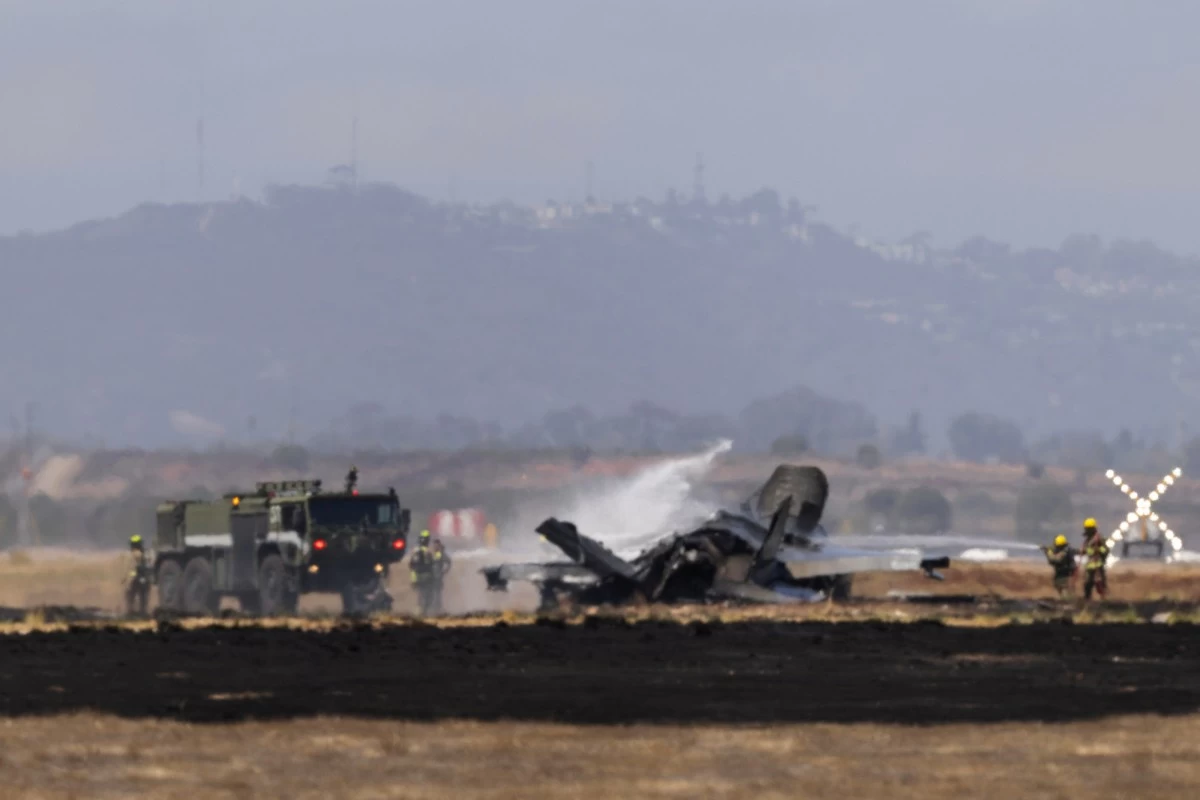
Crews extinguish an F-35 fighter jet that crashed near the runway at Marine Corps Air Station Miramar in San Diego, Calif., on Friday, July 31, 2026 (Luke Johnson/The San Diego Union-Tribune via AP)
The jet went down Friday near the Miramar air base in San Diego. “The pilot ejected, was transported to a local medical facility in stable condition for evaluation and treatment of non-life-threatening injuries,” the Marine Corps said in an updated statement.
Aerial video from a news helicopter showed a plume of black smoke rising from the wreckage in a dirt field, with multiple military and firefighting vehicles and people standing nearby. What appeared to be white flame retardant covered the ground, and at least one person was spraying the wreckage with a fire hose.
Wade Lott saw the crash as he drove to work at a concrete company just south of the flight line.
“It just blew up, it was crazy,” said Lott, 36, who watched from his truck as two jets descended toward the runway together. The first landed without incident, but the second suddenly began slowing down, almost as if it were trying to hover, Lott said. When the jet was about 100 feet (30 m) above the ground, the pilot ejected and their parachute deployed as they rose about 200 feet (61 m) into the air just in time.
“The jet hit the ground right next to another plane,” said Lott. “It plowed into the runway and just blew up.”
Candace Hadley, a spokesperson for San Diego Fire, said firefighters were on scene to respond to a vegetation fire that sparked near the crash site. She referred additional questions to Marine Corps Air Station Miramar.
The base used to host the Navy fighter pilot training school depicted in the original “Top Gun” movie, and was known as “Fightertown USA” in its heyday. The school was relocated to Naval Air Station Fallon in Nevada in 1996 after the base was transferred to the Marine Corps.
The U.S. Marine Corps, Navy and Air Force together have more than 630 F-35s, according to a 2024 analysis by the Government Accounting Office. The F-35B is one of several versions, and has an engine designed for short takeoffs and vertical landings. A single F-35B costs about $109 million. The report estimated that the overall F-35 program will cost roughly $2 trillion after the military buys more than 1,800 more jets and operates them for decades to come.
A Marines statement called Friday’s crash a “Class A mishap.” That’s the most severe mishap category, used when the damage totals more than $2 million, an aircraft is destroyed or a service member killed. In the Air Force alone, there have been at least 17 other “Class A mishaps” involving F-35 aircraft since 2000, according to Air Force Safety Center statistics.
At least seven other military aircraft mishaps have happened in the U.S. this year, according to the Flight Safety Foundation’s Aviation Safety Network database.
The F-35s are considered the safest and most capable fighter jets the military has in its fleet, according to the Lexington Institute think tank that focuses on defense technology and national security.
There have been fewer crashes involving any of the F-35 models since the jet was adopted in 2015 compared to other fighters when those planes were new, and fatal crashes are rare in F-35s.
In five F-35 crashes, the pilots were able to eject, though at least one sustained injuries. That pilot was injured when an F-35 crashed near the international airport in Albuquerque, New Mexico, in May 2024. The jet was heading an Air Force base in California from Texas.

Related Tags

WORLDNEWS
ADVERTISEMENT
.most-popular .layout-ratio{ padding-bottom: 79.13%; } @media (min-width: 768px) and (max-width: 1024px) { .widget-title { font-size: 15px !important; } }

{{ articles_filter_1561_widget.title }}

.most-popular .layout-ratio{ padding-bottom: 79.13%; } @media (min-width: 768px) and (max-width: 1024px) { .widget-title { font-size: 15px !important; } }

{{ static_articles_1562_widget.title }}

.most-popular .layout-ratio{ padding-bottom: 79.13%; } @media (min-width: 768px) and (max-width: 1024px) { .widget-title { font-size: 15px !important; } }

{{ articles_filter_1563_widget.title }}

{{ articles_filter_1564_widget.title }}

.mb-article-details { position: relative; } .mb-article-details .article-body-preview, .mb-article-details .article-body-summary{ font-size: 17px; line-height: 30px; font-family: "Libre Caslon Text", serif; color: #000; } .mb-article-details .article-body-preview iframe , .mb-article-details .article-body-summary iframe{ width: 100%; margin: auto; } .read-more-background { background: linear-gradient(180deg, color(display-p3 1.000 1.000 1.000 / 0) 13.75%, color(display-p3 1.000 1.000 1.000 / 0.8) 30.79%, color(display-p3 1.000 1.000 1.000) 72.5%); position: absolute; height: 200px; width: 100%; bottom: 0; display: flex; justify-content: center; align-items: center; padding: 0; } .read-more-background a{ color: #000; } .read-more-btn { padding: 17px 45px; font-family: Inter; font-weight: 700; font-size: 18px; line-height: 16px; text-align: center; vertical-align: middle; border: 1px solid black; background-color: white; } .hidden { display: none; }
function initializeAllSwipers() { // Get all hidden inputs with cms_article_id document.querySelectorAll('[id^="cms_article_id_"]').forEach(function (input) { const cmsArticleId = input.value; const articleSelector = '#article-' + cmsArticleId + ' .body_images'; const swiperElement = document.querySelector(articleSelector); if (swiperElement && !swiperElement.classList.contains('swiper-initialized')) { new Swiper(articleSelector, { loop: true, pagination: false, navigation: { nextEl: '#article-' + cmsArticleId + ' .swiper-button-next', prevEl: '#article-' + cmsArticleId + ' .swiper-button-prev', }, }); } }); } setTimeout(initializeAllSwipers, 3000); const intersectionObserver = new IntersectionObserver( (entries) => { entries.forEach((entry) => { if (entry.isIntersecting) { const newUrl = entry.target.getAttribute("data-url"); if (newUrl) { history.pushState(null, null, newUrl); let article = entry.target; // Extract metadata const author = article.querySelector('.author-section').textContent.replace('By', '').trim(); const section = article.querySelector('.section-info ').textContent.replace(' ', ' '); const title = article.querySelector('.article-title h1').textContent; // Parse URL for Chartbeat path format const parsedUrl = new URL(newUrl, window.location.origin); const cleanUrl = parsedUrl.host + parsedUrl.pathname; // Update Chartbeat configuration if (typeof window._sf_async_config !== 'undefined') { window._sf_async_config.path = cleanUrl; window._sf_async_config.sections = section; window._sf_async_config.authors = author; } // Track virtual page view with Chartbeat if (typeof pSUPERFLY !== 'undefined' && typeof pSUPERFLY.virtualPage === 'function') { try { pSUPERFLY.virtualPage({ path: cleanUrl, title: title, sections: section, authors: author }); } catch (error) { console.error('ping error', error); } } // Optional: Update document title if (title && title !== document.title) { document.title = title; } } } }); }, { threshold: 0.1 } ); function showArticleBody(button) { const article = button.closest("article"); const summary = article.querySelector(".article-body-summary"); const body = article.querySelector(".article-body-preview"); const readMoreSection = article.querySelector(".read-more-background"); // Hide summary and read-more section summary.style.display = "none"; readMoreSection.style.display = "none"; // Show the full article body body.classList.remove("hidden"); } document.addEventListener("DOMContentLoaded", () => { let loadCount = 0; // Track how many times articles are loaded const offset = [1, 2, 3, 4, 5, 6, 7, 8, 9, 10]; // Offset values const currentUrl = window.location.pathname.substring(1); let isLoading = false; // Prevent multiple calls if (!currentUrl) { console.log("Current URL is invalid."); return; } const sentinel = document.getElementById("load-more-sentinel"); if (!sentinel) { console.log("Sentinel element not found."); return; } function isSentinelVisible() { const rect = sentinel.getBoundingClientRect(); return ( rect.top < window.innerHeight && rect.bottom >= 0 ); } function onScroll() { if (isLoading) return; if (isSentinelVisible()) { if (loadCount >= offset.length) { console.log("Maximum load attempts reached."); window.removeEventListener("scroll", onScroll); return; } isLoading = true; const currentOffset = offset[loadCount]; window.loadMoreItems().then(() => { let article = document.querySelector('#widget_1690 > div:nth-last-of-type(2) article'); intersectionObserver.observe(article) loadCount++; }).catch(error => { console.error("Error loading more items:", error); }).finally(() => { isLoading = false; }); } } window.addEventListener("scroll", onScroll); });

Sign up by email to receive news.