






Manila Bulletin
 World
At least 18 die after breach of border between Morocco and Spanish exclave of Ceuta
World
At least 18 die after breach of border between Morocco and Spanish exclave of Ceuta
World
At least 18 die after breach of border between Morocco and Spanish exclave of Ceuta
At least 18 die after breach of border between Morocco and Spanish exclave of Ceuta
Published Jul 31, 2026 11:43 am
|
Updated Jul 31, 2026 03:44 pm


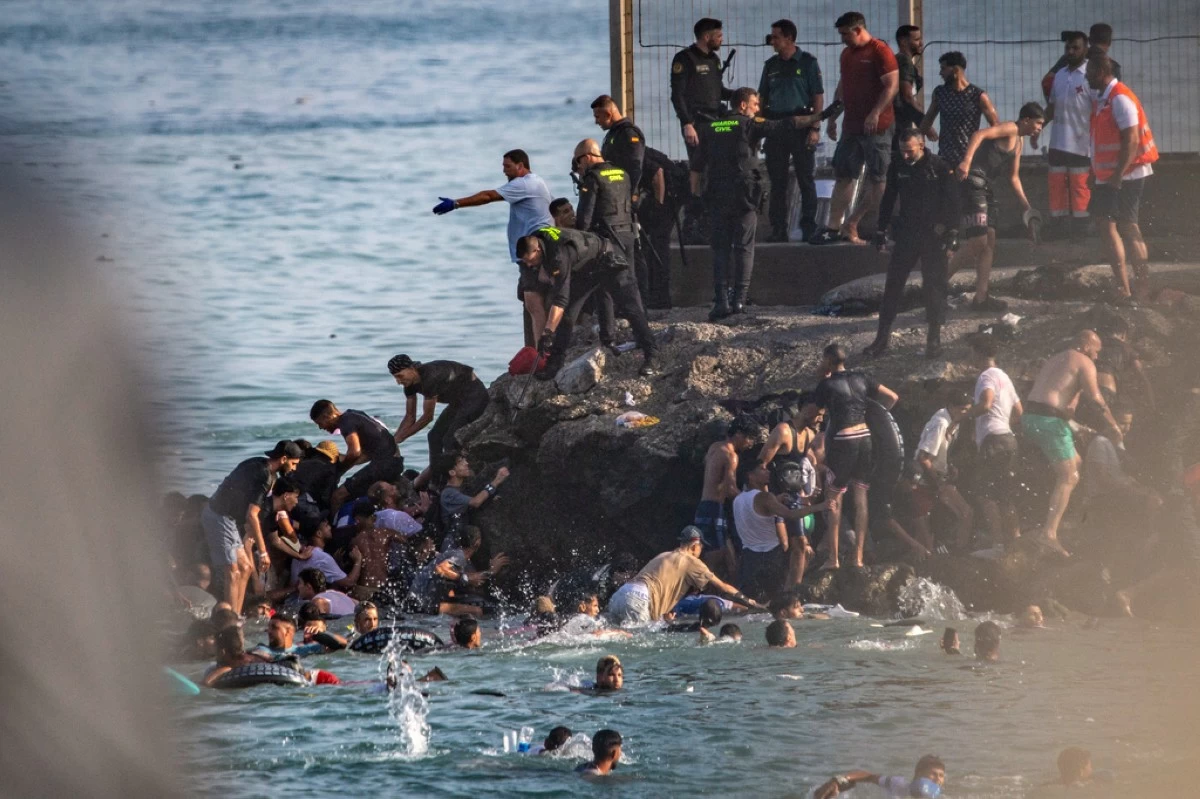
Migrants try to cross from Morocco into the Spanish enclave of Ceuta, Thursday, July 30, 2026. (AP Photo/Antonio Sempere)
CEUTA, Spain (AP) — At least eighteen migrants have died trying to reach the Spanish exclave of Ceuta, where Spain deployed its military after thousands of people breached the border with Morocco and poured into the tiny Spanish territory.
Spanish Prime Minister Pedro Sánchez is expected to join Interior Minister Fernando Grande-Marlaska in a visit to Ceuta on Friday morning.
Rachid Sbihi, who leads a local workers association representing Civil Guard officers described the situation as a “serious humanitarian crisis.”
“People are still entering. The reinforcements that have arrived are only helping the injured and other humanitarian efforts,” he said.
Without shelter, thousands of migrants, including unaccompanied children, were left sleeping in parks and sidewalks, with others roaming the streets aimlessly, he said. “It’s chaotic.”
Among the 18 who died, many drowned but some were also killed in the stampede to cross the breakwater fence at Tarajal beach, Sbihi said.
Video footage on Thursday showed crowds of people, mainly Moroccans, walking around the breakwaters at Tarajal beach onto local roads. While most appeared to be young men, there were also families with women and small children.
“Viva España!” some shouted to a freelance photographer working for the AP. It was not immediately clear what prompted so many migrants to cross to Ceuta.
Arrivals had been increasing, but reasons are still unclear
The escalation at the frontier between Spain and Morocco comes after a surge in migrants attempting to reach the small exclave, mainly by swimming, on Wednesday.
Moroccan authorities have not publicly commented on the crossings, and Morocco's Interior Ministry did not respond to requests for comment.
Spain’s Interior Ministry said the Moroccan government was “closely cooperating” with Spain to handle the situation and that Moroccan police are stopping “numerous people” who are trying to cross the border. Both countries agreed to work together “for the return, as soon as possible, of all the people who entered Ceuta illegally.”
The ministry earlier said it would guarantee the safety of citizens and the integrity of the nation’s border but that the Spanish government could not declare a national emergency — as local authorities had asked — over migration concerns.
The chaos had ripple effects in Italy, another key destination for migrants. Premier Giorgia Meloni threatened to suspend Italy's open-border Schengen agreement with Spain “to defend our borders and ensure the safety of our citizens," though Italy doesn't share a border with Spain.
Ceuta authorities had previously linked the surge to a Spanish Supreme Court ruling earlier this month that barred authorities from immediately returning migrants who arrive by sea without due process. The ruling does not apply to migrants who enter Spain by land, including by climbing over the border fence.
But some activists in Morocco expressed doubt that the ruling was behind the surge, arguing most migrants would have been unaware of such legal decisions.
Spain is a main point of arrival into Europe for migrants seeking better economic opportunities or an escape from violence in their home countries.
To reach Ceuta, located on the northern African coast, migrants often swim from the Moroccan town of Fnideq, covering about 3.1 miles (5 kilometers) to reach Spanish territory. Others attempt the crossing from the nearby town of Belyounech, where the distance is shorter.
The scenes of people streaming across the frontier recall the border crisis of May 2021 when more than 8,000 migrants poured into Ceuta in just two days.
At the time, Morocco was accused of easing border controls and allowing migrants to cross into Ceuta after Spain allowed Polisario Front leader Brahim Ghali to receive treatment at a Spanish hospital, triggering a diplomatic crisis between Rabat and Madrid. The pro-independence Polisario Front for decades has claimed to be the legitimate representative of the Sahrawi people of the Western Sahara. Morocco claims Western Sahara as its own.
Ceuta authorities ask Madrid to declare emergency, send army
Juan Jesús Vivas, the head of Ceuta’s regional government, called for the national government to declare an emergency on grounds of national security, asking for more police and for the army to be deployed on the border “to guarantee the inviolability of the frontier and citizen safety.”
He had warned Wednesday that migrant reception centers were overwhelmed with hundreds of people sleeping on the streets after more than 1,500 migrants entered the territory in the past week. Thousands more crossed overnight and on Thursday.
Spain’s Interior Ministry, which tracks irregular migration, would not confirm the number of migrants who had made it to Ceuta in the last few days but said it would publish its next migration report on Aug. 3. As of July 15, nearly 3,000 migrants had entered Ceuta by land or sea this year, according to ministry figures.
Legislation covering a declaration of national emergencies does not consider migration flows as a risk to national security, according to the ministry, which said government agencies are “coordinating to respond with speed and efficacy to the situation in Ceuta.”
Ceuta, which is perched on a historical isthmus, has been a Spanish possession since 1580. Its mixed population of Christians and Muslims, Spanish and Moroccan residents and day workers, lives in relative harmony behind a border fence that many desperate migrants from across Africa attempt to cross for a better life in Europe.