






 Philippines
National
Philippines asks UN body to consider 2016 arbitral ruling in West Philippine Sea seabed claim
Philippines
National
Philippines asks UN body to consider 2016 arbitral ruling in West Philippine Sea seabed claim
Philippines asks UN body to consider 2016 arbitral ruling in West Philippine Sea seabed claim


At A Glance
- The Philippines formally presented before the United Nations its partial submission for an extended continental shelf in the West Philippine Sea covering the West Palawan Region.
- Manila urged the UN Commission on the Limits of the Continental Shelf to consider the 2016 South China Sea Arbitral Award and other UNCLOS rulings in evaluating its submission.
- The move reinforces the Marcos administration's policy of asserting the country's maritime rights through international law and peaceful legal mechanisms.
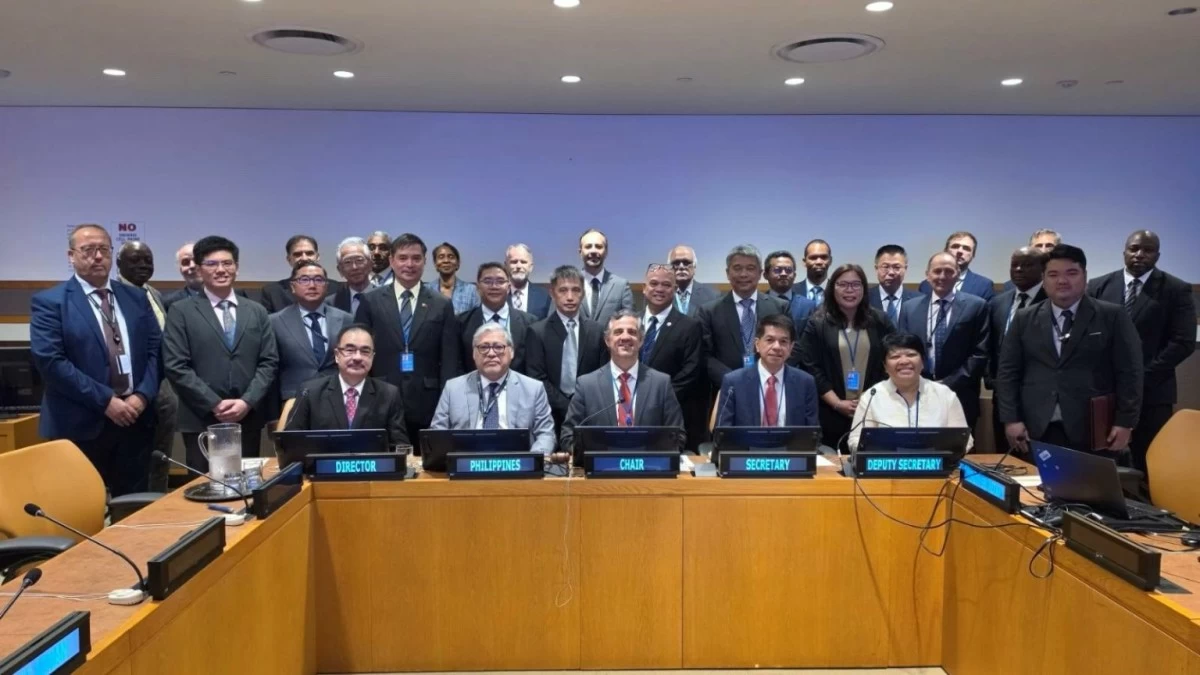
The Philippines has formally presented before the United Nations (UN) Commission on the Limits of the Continental Shelf (CLCS) its partial submission seeking recognition of the country's entitlement to an extended continental shelf (ECS) in the West Philippine Sea, covering the West Palawan Region.
During the presentation on July 29 at the United Nations Headquarters, the Philippine delegation asked the Commission to consider relevant decisions of tribunals constituted under the 1982 United Nations Convention on the Law of the Sea (UNCLOS), including the landmark 2016 South China Sea Arbitral Award, which authoritatively determined the maritime entitlements of littoral states in the South China Sea.
The Department of Foreign Affairs (DFA) said the submission demonstrates the Philippines' steadfast commitment to the United Nations Charter, UNCLOS, and the rules-based international order governing the world's oceans.
The DFA said the submission also reflects the country's responsibility to promote a peaceful South China Sea through the rule of law while protecting the livelihoods of Filipino fisherfolk, fostering international trade, conserving marine biodiversity, and strengthening cooperation among coastal and littoral states.
The Philippines submitted its claim pursuant to Article 76 of UNCLOS, which allows coastal states to establish the outer limits of their continental shelf beyond 200 nautical miles, subject to scientific and technical evaluation by the Commission, but not exceeding 350 nautical miles from their baselines.
Unlike maritime boundary disputes, the CLCS process deals with the scientific and technical determination of the outer limits of a state's continental shelf and does not settle overlapping territorial or maritime claims among states.
The Philippine delegation was headed by Ambassador and Permanent Representative to the United Nations Enrique Manalo and included the Extended Continental Shelf Technical Working Group led by National Mapping and Resource Information Authority (NAMRIA) Administrator Undersecretary Peter Tiangco, together with representatives from the DFA, the Department of Justice, the Office of the Solicitor General, NAMRIA, and academic experts from the University of the Philippines.
The DFA said NAMRIA led the preparation of the submission through the Extended Continental Shelf Technical Working Group over a period of 15 years, involving extensive hydrographic, geological, geophysical, and legal studies required under UNCLOS.
The presentation marks the second time the Philippines has sought international recognition of an extended continental shelf after its partial submission covering the Philippine Rise in April 2009.
The Commission validated the Philippine Rise submission in 2012, resulting in the recognition of an additional 135,506 square kilometers of seabed for the Philippines, while Manila reserved the right to submit claims over other areas in the future.
The latest submission also comes days after President Marcos used his fifth State of the Nation Address (SONA) to reaffirm that the Philippines would continue defending its maritime rights in the West Philippine Sea through peaceful and lawful means anchored on international law.
Marcos declared that the government would never abandon the landmark 2016 South China Sea Arbitral Award, describing it as a definitive benchmark in the interpretation and application of the UNCLOS.
"This is not a claim that we advance alone, nor one that we will abandon," the President said.
"Will do all that is necessary to continue upholding this Award, utilizing every peaceful and legal means available to the Republic against any attempt, foreign or domestic, to undermine this achievement," he added.
Marcos also underscored the need for national unity in defending Philippine sovereignty as he paid tribute to the Armed Forces of the Philippines, the Philippine Coast Guard, and Filipino fisherfolk for safeguarding the country's lawful rights despite continuing risks in the West Philippine Sea.
"We are not greedy. We are not racists. We are not liars. We are respectful, and we are dignified. We are Filipinos, and we do not yield," he said.
For Palace ally and civic leader Dr. Jose Antonio Goitia, President Marcos’ reaffirmation of the 2016 Arbitral Award during his SONA complements Manila's continued use of legal mechanisms, including its extended continental shelf submission before the CLCS, to protect the country's maritime entitlements.
He added that the President's remarks reflected a foreign policy that remains firm in defending Philippine sovereignty while anchored on international law.
"The 2016 Arbitral Award is one of the Philippines' greatest victories on the world stage. No amount of foreign propaganda can erase what international law has already affirmed," Goitia said.
He added that the administration has shown that "sovereignty is defended not by bluster but through principled diplomacy, capable institutions, and the resolve to stand firm for every Filipino."
Goitia likewise said Marcos’ penultimate SONA made one thing unmistakable: development and sovereignty go hand in hand.
“Economic growth creates opportunity. Good governance earns public trust. A nation that governs well at home stands stronger when it stands its ground abroad,” he said.
He added that Marcos’ SONA reflected an administration delivering results.
"President Marcos presented concrete gains in governance, public services, and accountability. Those are the foundations of a stronger Republic," the civic leader said.