






Manila Bulletin
 Philippines
National
Perseid meteor shower: Up to 150 meteors an hour may streak across August skies
Philippines
National
Perseid meteor shower: Up to 150 meteors an hour may streak across August skies
Philippines
National
Perseid meteor shower: Up to 150 meteors an hour may streak across August skies
Perseid meteor shower: Up to 150 meteors an hour may streak across August skies
Published Jul 31, 2026 01:53 pm


At A Glance
- The Perseids, classified as a major meteor shower, are expected to produce around 150 meteors per hour under moonless, dark-sky conditions.
- PAGASA said the Perseid meteor shower will be active from July 17 to Aug. 24, with peak activity expected on Aug. 12.
PAGASA
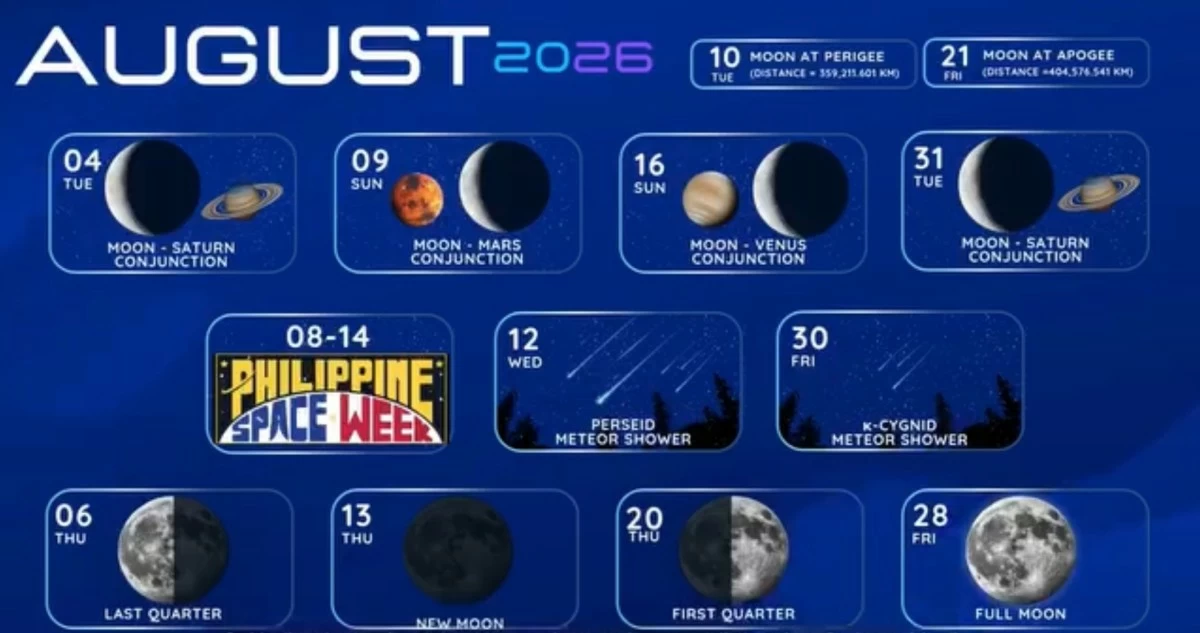
Skywatchers in the Philippines may have a chance to catch one of the year's major meteor showers at its peak this August, along with another meteor shower and several close approaches between the Moon and planets, according to the Philippine Atmospheric, Geophysical and Astronomical Services Administration (PAGASA).
Citing the International Meteor Organization, PAGASA said the Perseid meteor shower will be active from July 17 to Aug. 24, with peak activity expected on Aug. 12.
The Perseids, classified as a major meteor shower, are expected to produce around 150 meteors per hour under moonless, dark-sky conditions.
Its radiant, or the point in the sky where the meteors appear to originate, will rise above the northeastern horizon before midnight.
The shower will be best observed when its radiant reaches its highest point in the sky before sunrise.
PAGASA said another meteor shower to watch is the Kappa Cygnids, which will be active from Aug. 3 to 25 and peak on Aug. 17.
The Kappa Cygnids are expected to produce about three meteors per hour during their peak. Its radiant in Draco will be observable after sunset until it sets at around 5 a.m.
PAGASA said the Kappa Cygnids will be best observed at around 9 p.m., when the radiant is at its highest point in the sky.
The first quarter Moon in Virgo is expected to produce only minimal moonlight during the peak, allowing generally favorable conditions for meteor shower observations.
Moreover, PAGASA said skywatchers can look forward to several close approaches between the Moon and planets throughout August.
On Aug. 4, the waning gibbous Moon and Saturn will make their closest approach. The pair, located in the constellation Pisces, will be visible about 10 degrees above the eastern horizon at around 11 p.m.
On Aug. 9, the waning crescent Moon will move close to Mars in the constellation Taurus. The pair will be visible on the eastern horizon at around 3 a.m.
The waxing crescent Moon and Venus will then make a close approach on Aug. 16. The pair will be visible in the western sky before setting a few hours after sunset.
Another close approach between the Moon and Saturn will be observed on Aug. 31, with both objects rising in the eastern sky.
PAGASA said August will also mark the celebration of Philippine Space Week.
The agency is inviting the public to join free planetarium shows, stargazing sessions, and telescope viewing activities at the PAGASA Planetarium and PAGASA Astronomical Observatory.
The public may check PAGASA's Facebook page for the full schedule and other details of the activities.