ADVERTISEMENT

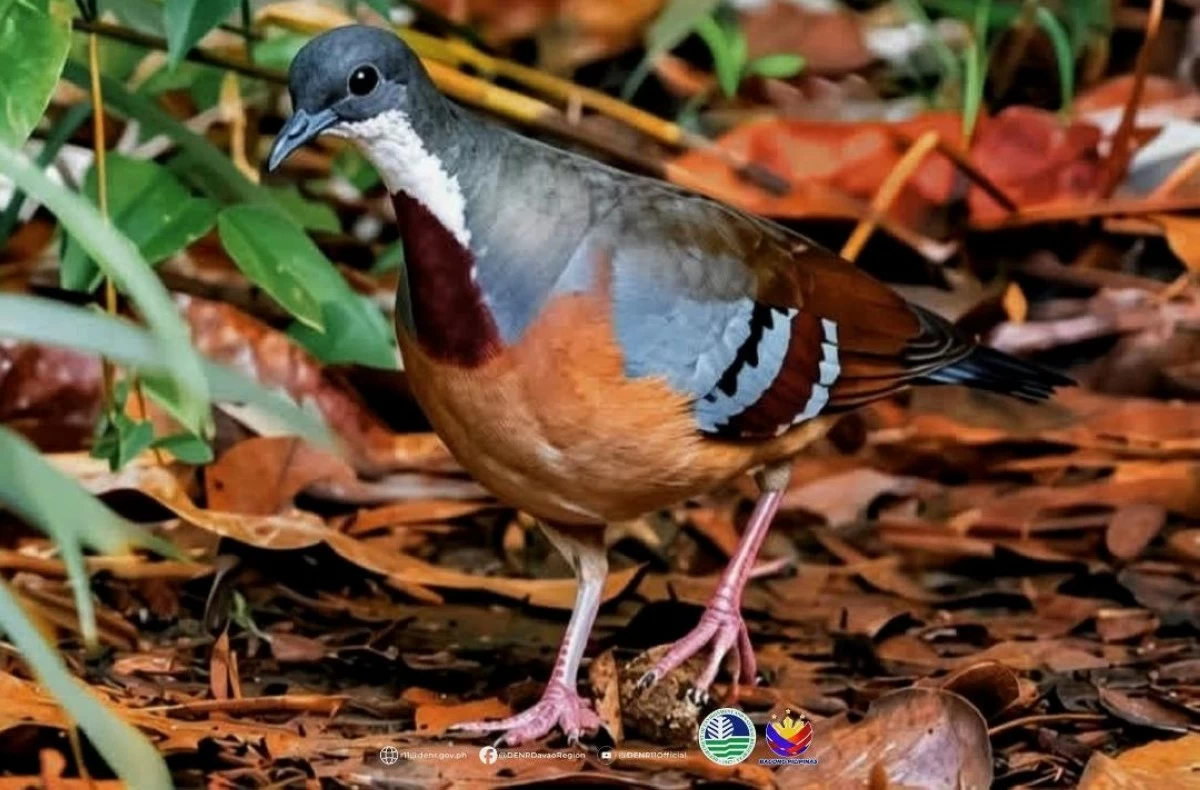
Rare Mindanao bleeding heart pigeon sighted in Davao Oriental

Published Jul 30, 2026 02:36 pm
MINDANAO bleeding heart pigeon (DENR Davao)
DAVAO CITY – The Department of Environment and Natural Resources (DENR)-Davao said a rare Mindanao bleeding heart pigeon (Gallicolumba crinigera) was sighted at the foothills of the Mount Hamiguitan Range Wildlife Sanctuary in Davao Oriental on July 29 during a Biodiversity Assessment and Monitoring System (BAMS) activity.
The Mindanao bleeding heart pigeon, one of the 274 endemic birds in the Philippines, was also sighted in the area by a biodiversity monitoring intern between June and July this year, the DENR-Davao said.
The agency said that the bird that the intern spotted was a male performing a courtship display towards a female, suggesting possible breeding activity within the sanctuary.
DENR-Davao emphasized that the documentation of this elusive avifauna species reflects the success of ongoing Biodiversity Assessment and Monitoring System jointly undertaken by the Protected Area Management Office (PAMO)-Mount Hamiguitan Range Wildlife Sanctuary (MHRWS) and the DENR-11 through the Conservation and Development Division-Protected Area Management and Biodiversity Conservation Section (CDD-PAMBCS).
Prior to the documentation on Wednesday, the last confirmed observation of the species within the sanctuary was on Aug. 8, 2019.
Mount Hamiguitan Range Wildlife Sanctuary is a United Nations Educational, Scientific, and Cultural Organization (UNESCO) heritage site that straddles Gov. Generoso, Mati City, and San Isidro in Davao Oriental.
The mountain range is known for its pygmy forests and also home to different endemic species, including the critically-endangered Philippine Eagle.
DENR-Davao added that the Mindanao bleeding-heart is a ground-dwelling dove belonging to the pigeon family (Columbidae).
It added that the rare bird species is naturally distributed in Mindanao, Basilan, Samar, Leyte, and Bohol, and Dinagat Islands.
The bird lives in both primary and secondary tropical lowland rainforests at elevations of up to 750 meters above sea level.
Mindanao bleeding heart is one of the five endemic bleeding heart dove species found in the Philippines, each restricted to specific island groups.
“Based on the Updated National List of Threatened Philippine Fauna and their Categories (DENR Administrative Order No. 2019-09), the Mindanao bleeding-heart is classified as Vulnerable, indicating that the species faces a high risk of population decline in the wild if current threats persist,” the DENR-Davao bared.
The agency said anti-illegal wildlife trade measures and conservation measures must be strengthened to support the species' long-term survival and recovery.

Related Tags

Mindanao bleeding heart pigeon Birds DENR Davao
ADVERTISEMENT
.most-popular .layout-ratio{ padding-bottom: 79.13%; } @media (min-width: 768px) and (max-width: 1024px) { .widget-title { font-size: 15px !important; } }

{{ articles_filter_1561_widget.title }}

.most-popular .layout-ratio{ padding-bottom: 79.13%; } @media (min-width: 768px) and (max-width: 1024px) { .widget-title { font-size: 15px !important; } }

{{ static_articles_1562_widget.title }}

.most-popular .layout-ratio{ padding-bottom: 79.13%; } @media (min-width: 768px) and (max-width: 1024px) { .widget-title { font-size: 15px !important; } }

{{ articles_filter_1563_widget.title }}

{{ articles_filter_1564_widget.title }}

.mb-article-details { position: relative; } .mb-article-details .article-body-preview, .mb-article-details .article-body-summary{ font-size: 17px; line-height: 30px; font-family: "Libre Caslon Text", serif; color: #000; } .mb-article-details .article-body-preview iframe , .mb-article-details .article-body-summary iframe{ width: 100%; margin: auto; } .read-more-background { background: linear-gradient(180deg, color(display-p3 1.000 1.000 1.000 / 0) 13.75%, color(display-p3 1.000 1.000 1.000 / 0.8) 30.79%, color(display-p3 1.000 1.000 1.000) 72.5%); position: absolute; height: 200px; width: 100%; bottom: 0; display: flex; justify-content: center; align-items: center; padding: 0; } .read-more-background a{ color: #000; } .read-more-btn { padding: 17px 45px; font-family: Inter; font-weight: 700; font-size: 18px; line-height: 16px; text-align: center; vertical-align: middle; border: 1px solid black; background-color: white; } .hidden { display: none; }
function initializeAllSwipers() { // Get all hidden inputs with cms_article_id document.querySelectorAll('[id^="cms_article_id_"]').forEach(function (input) { const cmsArticleId = input.value; const articleSelector = '#article-' + cmsArticleId + ' .body_images'; const swiperElement = document.querySelector(articleSelector); if (swiperElement && !swiperElement.classList.contains('swiper-initialized')) { new Swiper(articleSelector, { loop: true, pagination: false, navigation: { nextEl: '#article-' + cmsArticleId + ' .swiper-button-next', prevEl: '#article-' + cmsArticleId + ' .swiper-button-prev', }, }); } }); } setTimeout(initializeAllSwipers, 3000); const intersectionObserver = new IntersectionObserver( (entries) => { entries.forEach((entry) => { if (entry.isIntersecting) { const newUrl = entry.target.getAttribute("data-url"); if (newUrl) { history.pushState(null, null, newUrl); let article = entry.target; // Extract metadata const author = article.querySelector('.author-section').textContent.replace('By', '').trim(); const section = article.querySelector('.section-info ').textContent.replace(' ', ' '); const title = article.querySelector('.article-title h1').textContent; // Parse URL for Chartbeat path format const parsedUrl = new URL(newUrl, window.location.origin); const cleanUrl = parsedUrl.host + parsedUrl.pathname; // Update Chartbeat configuration if (typeof window._sf_async_config !== 'undefined') { window._sf_async_config.path = cleanUrl; window._sf_async_config.sections = section; window._sf_async_config.authors = author; } // Track virtual page view with Chartbeat if (typeof pSUPERFLY !== 'undefined' && typeof pSUPERFLY.virtualPage === 'function') { try { pSUPERFLY.virtualPage({ path: cleanUrl, title: title, sections: section, authors: author }); } catch (error) { console.error('ping error', error); } } // Optional: Update document title if (title && title !== document.title) { document.title = title; } } } }); }, { threshold: 0.1 } ); function showArticleBody(button) { const article = button.closest("article"); const summary = article.querySelector(".article-body-summary"); const body = article.querySelector(".article-body-preview"); const readMoreSection = article.querySelector(".read-more-background"); // Hide summary and read-more section summary.style.display = "none"; readMoreSection.style.display = "none"; // Show the full article body body.classList.remove("hidden"); } document.addEventListener("DOMContentLoaded", () => { let loadCount = 0; // Track how many times articles are loaded const offset = [1, 2, 3, 4, 5, 6, 7, 8, 9, 10]; // Offset values const currentUrl = window.location.pathname.substring(1); let isLoading = false; // Prevent multiple calls if (!currentUrl) { console.log("Current URL is invalid."); return; } const sentinel = document.getElementById("load-more-sentinel"); if (!sentinel) { console.log("Sentinel element not found."); return; } function isSentinelVisible() { const rect = sentinel.getBoundingClientRect(); return ( rect.top < window.innerHeight && rect.bottom >= 0 ); } function onScroll() { if (isLoading) return; if (isSentinelVisible()) { if (loadCount >= offset.length) { console.log("Maximum load attempts reached."); window.removeEventListener("scroll", onScroll); return; } isLoading = true; const currentOffset = offset[loadCount]; window.loadMoreItems().then(() => { let article = document.querySelector('#widget_1690 > div:nth-last-of-type(2) article'); intersectionObserver.observe(article) loadCount++; }).catch(error => { console.error("Error loading more items:", error); }).finally(() => { isLoading = false; }); } } window.addEventListener("scroll", onScroll); });

Sign up by email to receive news.