






Manila Bulletin
 Business
Trade & Industry
Philippine foreign trade hits records in H1, defying war, tariff threats
Business
Trade & Industry
Philippine foreign trade hits records in H1, defying war, tariff threats
Business
Trade & Industry
Philippine foreign trade hits records in H1, defying war, tariff threats
Philippine foreign trade hits records in H1, defying war, tariff threats
Published Jul 30, 2026 02:58 pm


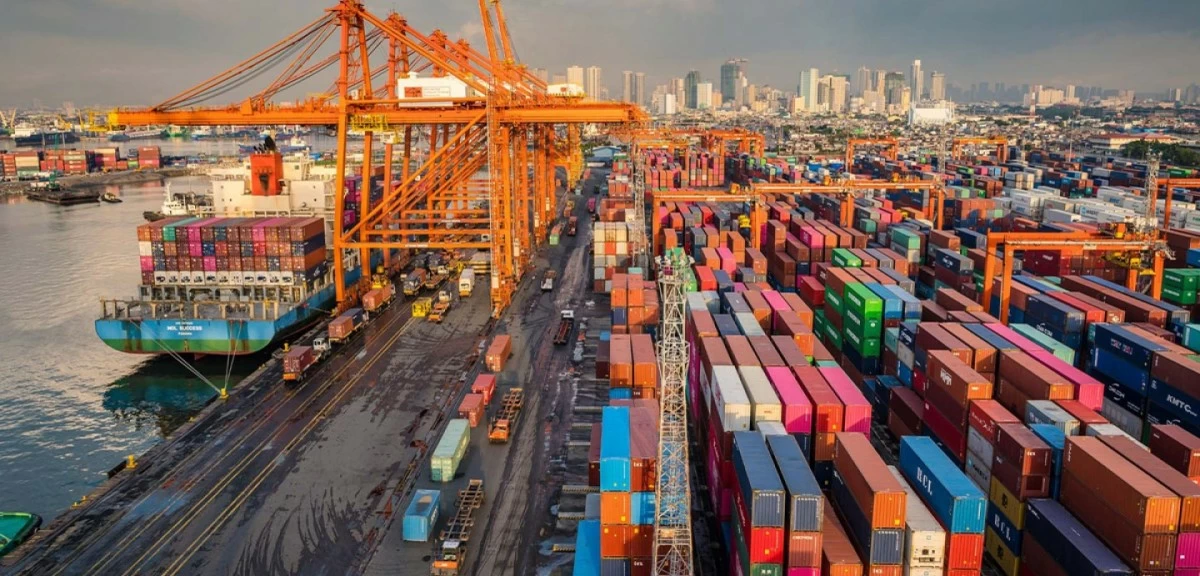
Philippine goods exports and imports both reached record highs in the first half of 2026, defying disruptions from the Middle East war and persistent threats of higher United States (US) tariffs, with outbound shipments climbing to $46.72 billion and inbound purchases totaling $77.53 billion.
The latest preliminary Philippine Statistics Authority (PSA) data on Thursday, July 30, showed that cumulative merchandise exports increased by 13.1 percent from $41.31 billion in the same six-month period last year, while imports rose by 17.8 percent from $65.79 billion. These first-half 2026 figures were the highest since the PSA’s data series began in 1991, National Statistician Claire Dennis S. Mapa confirmed to Manila Bulletin.
The country’s total merchandise trade reached $124.25 billion in the first half, resulting in a trade-in-goods deficit of $30.81 billion.
The strong external trade performance so far this year “[suggests] that Philippine exporters remained competitive despite a challenging global environment,” Philippine Institute for Development Studies (PIDS) senior research fellow John Paolo Rivera told Manila Bulletin.
“This is likely because of stronger external demand for electronics and manufactured goods, continued integration into regional and global supply chains, and exporters frontloading shipments amid lingering uncertainty over US tariff policies,” Rivera said.
“The record exports show that Philippine exporters are proving more resilient than many expected. For now, stronger external demand is outweighing global headwinds, but we cannot be complacent because the external environment remains highly volatile,” Reyes Tacandong & Co. senior adviser Jonathan Ravelas, for his part, told Manila Bulletin.
In June alone, export sales surged by 24.1 percent to a record $8.77 billion from $7.07 billion in the same month last year. Exports also rose by 10.4 percent from May, or by 6.6 percent on a seasonally adjusted basis.
Electronic products remained the country’s top export commodity, generating $5.25 billion or 59.9 percent of total outbound shipments in June. Their export value increased by $1.37 billion from a year ago, the largest gain among commodity groups.
Manufactured goods accounted for the biggest share among major types of exports at $7.21 billion, equivalent to 82.2 percent of total. Mineral products followed at $754.98 million, while agro-based products contributed $575.11 million.
Agro-based exports declined by 17.9 percent from May, or by 9.8 percent on a seasonally adjusted basis.
The US remained the Philippines’ largest export market in June, purchasing $1.76 billion worth of goods or 20.1 percent of total exports. It was followed by Hong Kong with $1.34 billion, China with $1 billion, Japan with $990.16 million, and Singapore with $508.18 million.
In June, imports climbed by 19.6 percent to $13.71 billion from $11.46 billion a year ago, although they declined by 2.4 percent from May. On a seasonally adjusted basis, imports fell by 3.3 percent.
Electronic products recorded the largest annual increase in imports at $2.16 billion, followed by cereals and cereal preparations at $158.86 million, and mineral fuels, lubricants, and related materials at $95.91 million.
Raw materials and intermediate goods comprised the largest share of imports at $5.89 billion or 42.9 percent, followed by capital goods at $3.62 billion, and consumer goods at $2.54 billion.
China remained the Philippines’ largest source of imports, supplying $4.35 billion worth of goods or 31.7 percent of total. South Korea followed with $1.78 billion, Japan with $919.13 million, Indonesia with $912.63 million, and the US with $706.70 million.
The balance of trade in goods posted a $4.94-billion deficit in June, 12.3 percent wider than the $4.4-billion shortfall a year ago. However, it narrowed from $6.1 billion in May and was the smallest deficit since February.
Rizal Commercial Banking Corp. (RCBC) chief economist Michael Ricafort said faster export growth than import expansion helped narrow the monthly trade deficit. He added that the weaker peso, diversification into more export markets, and some frontloading of shipments by international buyers supported exports.
However, Ricafort cautioned that future trade performance would largely depend on developments in the Middle East war, their impact on global oil prices, commodity prices, and supply chains, and the latest 12.5-percent US tariffs, which could weigh on global trade and economic growth.
Rivera also warned that heightened geopolitical tensions could increase shipping and energy costs, while higher US tariffs may soften demand for some Philippine exports.
“I want to echo again that we need to diversify export markets, move up the value chain, and improve trade competitiveness to sustain export growth,” Rivera said.