






Manila Bulletin
 Philippines
National
'Business has losses': Erwin Tulfo questions Meralco over stance on system loss
Philippines
National
'Business has losses': Erwin Tulfo questions Meralco over stance on system loss
Philippines
National
'Business has losses': Erwin Tulfo questions Meralco over stance on system loss
'Business has losses': Erwin Tulfo questions Meralco over stance on system loss
By Dhel Nazario
Published Jul 30, 2026 03:02 pm


At A Glance
- Senator Erwin Tulfo challenged Meralco's argument that removing non-technical system loss charges could increase electricity rates, saying distribution utilities should absorb normal business losses instead of passing them on to consumers.
- The Energy Regulatory Commission and the Department of Energy said eliminating non-technical system loss charges would not bankrupt distribution utilities and could instead encourage them to improve efficiency and intensify efforts against electricity theft.
- Meralco said it already operates below the ERC's allowable system loss cap and argued that completely eliminating electricity theft would require costly additional personnel and infrastructure, expenses that would still have to be reviewed by the ERC before being included in electricity tariffs.
Senator Erwin Tulfo on Thursday pushed back against Meralco's argument that eliminating non-technical system loss charges could lead to higher operating costs that may eventually be reflected in electricity rates, saying distribution utilities should absorb ordinary business losses instead of passing them on to consumers.
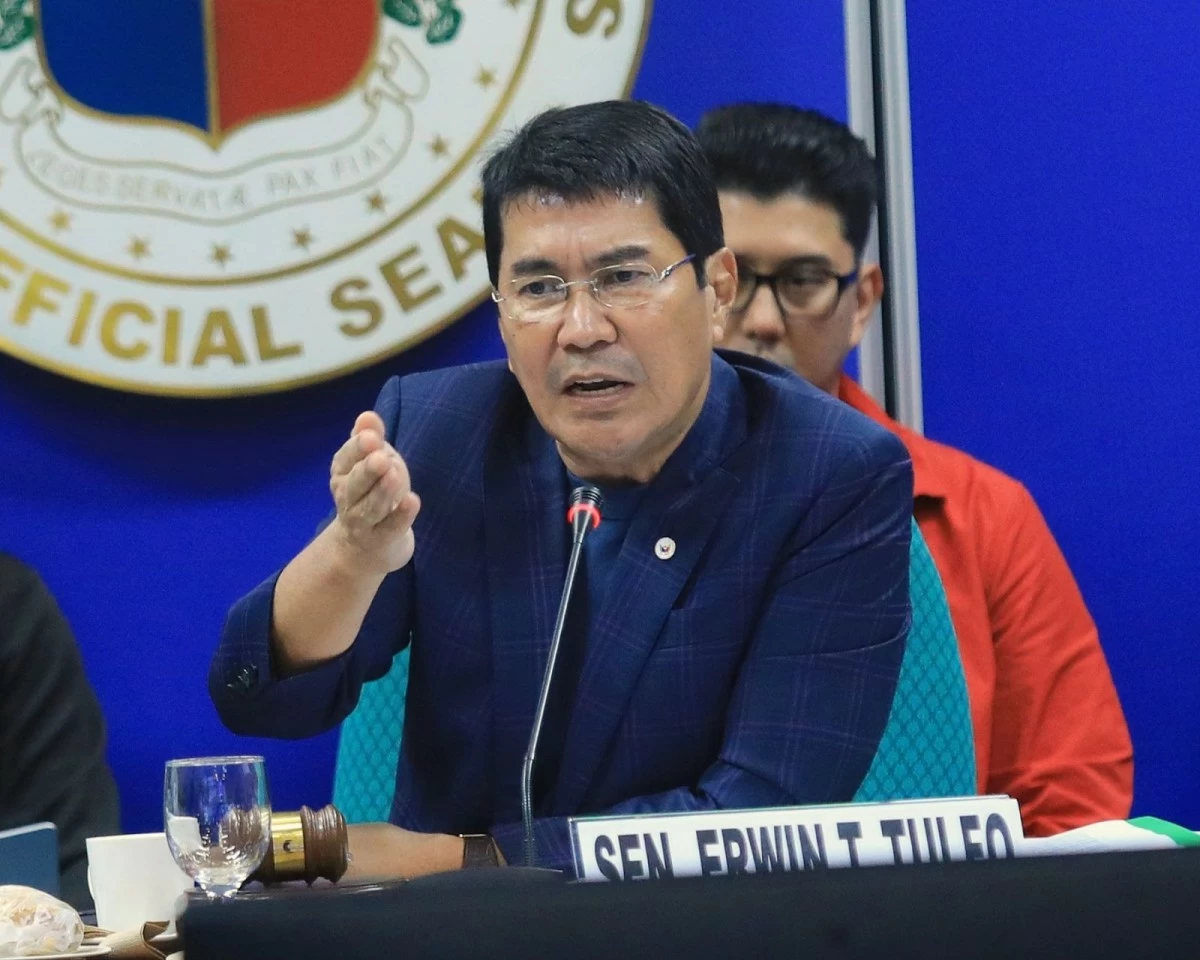
Sen. Erwin Tulfo, during the hearing of the Committee on Energy on Thursday, July 30, 2026, pushes for the removal of the system loss charge passed on to electricity consumers. (Senate PRIB photo)
During the Senate Committee on Energy hearing on proposals to remove system loss charges in the power industry, Tulfo challenged Meralco officials over their assertion that eliminating non-technical losses, such as electricity theft, would require significant spending on additional personnel and infrastructure, costs that could ultimately be recovered through electricity tariffs.
"I totally disagree with your explanation," Tulfo told Meralco Senior Vice President and Head of Regulatory Management Jose Ronald Valles.
The senator argued that losses are an inherent part of doing business and should already be factored into a company's operations rather than shifted to consumers through higher electricity bills.
"You are a business, while at the same time providing a public service," Tulfo said.
"Business, sir, ay may mga losses. Dapat you have to be prepared for that. Pinag-aralan ko po sa eskwelahan yun eh. Normal po yun sa isang negosyo na magkaroon ng losses," he added.
Tulfo questioned why consumers should bear the cost of hiring more personnel to curb electricity pilferage and illegal connections, saying those responsibilities fall squarely on the distribution utility.
"That is your business. We are not part of Meralco. We are your consumers and customers," he said.
Drawing an analogy, Tulfo said a store owner who suffers losses from theft, fire or flooding should not simply raise prices to recover those losses at the expense of customers.
He added that distribution utilities and electric cooperatives should maintain allowances for such operational risks instead of treating them as costs that must always be passed on to consumers.
The senator also stressed the financial burden that electricity charges impose on ordinary Filipinos, noting that many households struggle to pay their monthly bills despite modest incomes.
"The people are the ones who suffer," Tulfo said. "We are not a rich country. The money used to pay these charges could have been spent on food."
Tulfo's remarks came after Valles defended Meralco's position that driving non-technical system losses to zero would require substantial investments in additional field personnel, round-the-clock inspections and capital expenditures to prevent electricity theft. He said those operational expenses would eventually have to be evaluated by the Energy Regulatory Commission (ERC) for possible inclusion in the company's regulated tariff.
ERC chair Francis Saturnino Juan said non-technical losses account for only about 1 percent to 1.5 percent of a distribution utility's total system loss. Removing that component would reduce utilities' earnings but would not necessarily threaten the viability of the power industry.
Juan said the ERC believes distribution utilities would instead adapt to stricter regulations by intensifying efforts to crack down on electricity theft if non-technical system loss charges were no longer recoverable from consumers.
Department of Energy Undersecretary Riolita Inocencio echoed the regulator's position, saying reducing the allowable system loss cap could serve as a "self-regulating mechanism" that would encourage distribution utilities and electric cooperatives to improve operational efficiency. She added that addressing technical losses would require longer-term investments in infrastructure, particularly for electric cooperatives.
Valles, however, maintained that Meralco already operates below the ERC's allowable feeder loss cap. He said the company's total system loss stood at 4.22 percent in 2025, below the regulator's 5.5 percent cap, with non-technical losses accounting for less than 1 percent.
According to Valles, Meralco has implemented aggressive anti-electricity theft measures, including prosecuting illegal connections and relocating electric meters in some communities, but said completely eradicating pilferage remains impractical because offenders often reconnect after inspection teams leave.
Valles clarified that utilities already absorb system losses that exceed the regulatory cap, while only losses within the allowable threshold are recognized under existing regulations. He also said revenues recovered from prosecuting electricity theft are returned to customers by reducing generation costs rather than retained by Meralco.