







Work underway on proposed amendments to EPIRA—Marcos
Marcos inaugurates Energy Museum
Published Jul 29, 2026 01:06 pm


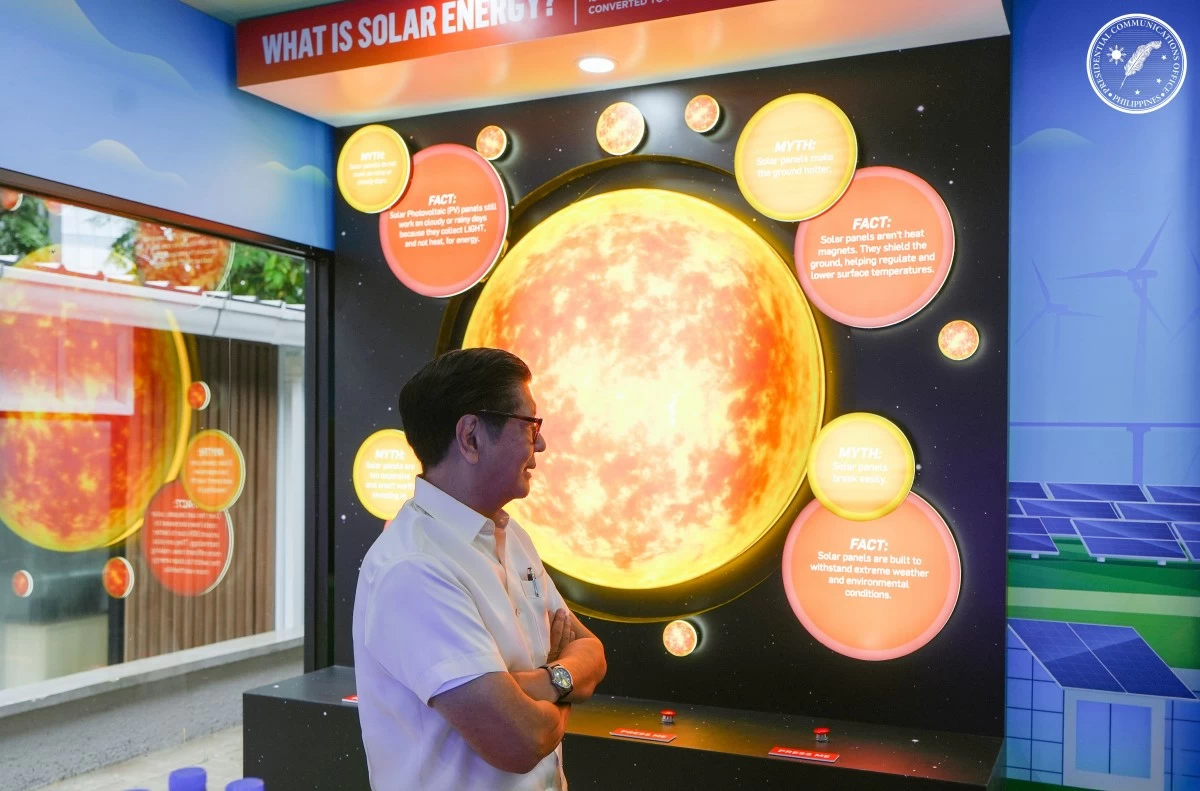
President Ferdinand R. Marcos Jr. inaugurates the Energy Museum in Bonifacio Global City, Taguig City on July 29, 2026. (PCO)
Two days after urging Congress to immediately amend the Electric Power Industry Reform Act (EPIRA), President Marcos said the government is working closely with private companies on the proposed amendments to the law.
Speaking during the inauguration of the Energy Museum in Bonifacio Global City, Taguig City, and the 25th anniversary of EPIRA on Wednesday, July 29, Marcos said work is underway to amend the law to prohibit distribution utilities from passing systems loss charges, including the corresponding value-added tax (VAT), to consumers.
In his speech at the inauguration, the President recognized that the electricity sector reform is an ongoing process; thus, the government continues to work with them in pursuing the amendments.
"At the same time, we recognize that the electricity sector reform is an ongoing process. Significant gains have certainly been made; critical challenges remain, such as high electricity rates, among others," Marcos said.
"And that is why we are working closely with our private partners and the government to advance the proposed amendments to EPIRA, particularly to support the ERC (Energy Regulatory Commission)," Marcos added.
He reiterated that removing the charging of system loss, including the corresponding VAT, to consumers was only fair to the people.
"It is only fair that Filipino families pay for what electricity they use—not for inefficiencies that really are beyond their control," he said.
According to Marcos, EPIRA was the government's solution to the challenges faced by the Philippine power sector 25 years ago.
"Twenty-five years ago, the Philippine power sector faced a difficult reality. Chronic power shortages, a heavily indebted state utility, and the absence of meaningful competition constrained our ability to meet the country’s growing energy needs. The government’s response was the EPIRA," the President said.
"This law restructured the power industry by opening power generation to private investment, establishing the WESM, and creating the Energy Regulatory Commission," he added.
Marcos wants to ensure utility companies have plans
In a Palace briefing, Palace Press Officer and Communications Undersecretary Claire Castro said the President also wants to ensure that utility companies have plans to avoid losses.
"Ang nais lamang po ng Pangulo ay tiyakin din ng mga utility companies na mayroon silang isinasagawang plano at pagmo-monitor para maiwasan po itong losses na ito, lalung-lalo na po iyong mga losses because of theft, pilferage na napapasan ng mga maaayos at mga matitinong mga Pilipino na nagbabayad ng kanilang mga obligasyon (What the President wants is to ensure that utility companies also have plans and monitoring systems in place to prevent these losses, particularly losses due to theft and pilferage, which are ultimately being shouldered by law-abiding Filipinos who faithfully pay their obligations)," Castro said.
The Palace official stressed that utility companies should be responsible for addressing this.
"Bakit? Dahil kailangan nilang gumawa ng programa para maiwasan ito. So, kailangan na maging efficient din sila para maiwasan ang losses na napapasan ng ating mga kababayan (Why? Because they need to implement programs to prevent these losses. They also need to operate more efficiently to avoid passing these costs on to our fellow Filipinos)," Castro explained.
"So, ito po ay inaaral dahil hindi po nais ng Pangulo na hindi rin maging maganda ang epekto nito sa mga utility companies (This matter is currently being studied because the President also does not want any measures to harm utility companies)," she added.
The Philippine Rural Electric Cooperatives Association, a group of electric cooperatives, stated that the proposed amendment should be accompanied by a government subsidy to prevent financial losses.
Castro said it is not yet being discussed and reiterated that utility companies should study how to avoid losses.
Energy Museum
In inaugurating the Energy Museum at the Department of Energy (DOE) Energy Center, Marcos said it would help Filipinos to understand the Philippine energy sector through interactive exhibits highlighting the country's energy history, power system, and long-term energy goals.
"This space transforms complex energy concepts into engaging and accessible learning experiences for students, educators, and for communities," he said.
"It is immersive and interactive, and features exhibits on the country’s diverse energy resources and technologies— solar, geothermal, wind, hydro to natural gas, energy storage, and, slowly, nuclear energy," he added.
The President further said that the museum stands as "a bridge between the classroom and the control room, between curiosity and career."
"To every young Filipino who walks through these pods and sees an engineer, a geoscientist, a policy analyst reflected in these exhibits, I say: This could be you. This is the future of the Philippines that will be built by the students who will visit or stand in this museum," the Chief Executive added.
In his speech, Marcos also encouraged Filipinos to take part in the Oras Natin sa Efficiency campaign, urging them to help conserve electricity, switch off non-essential lights, and unplug unused appliances.
"Moving forward, may this milestone remind us that energy security is a shared responsibility. Let us continue to use our resources wisely, follow energy conservation measures, and support meaningful reforms," the President said.