







Dredging eases impact of flooding in Cotabato
Published Jul 29, 2026 03:39 pm


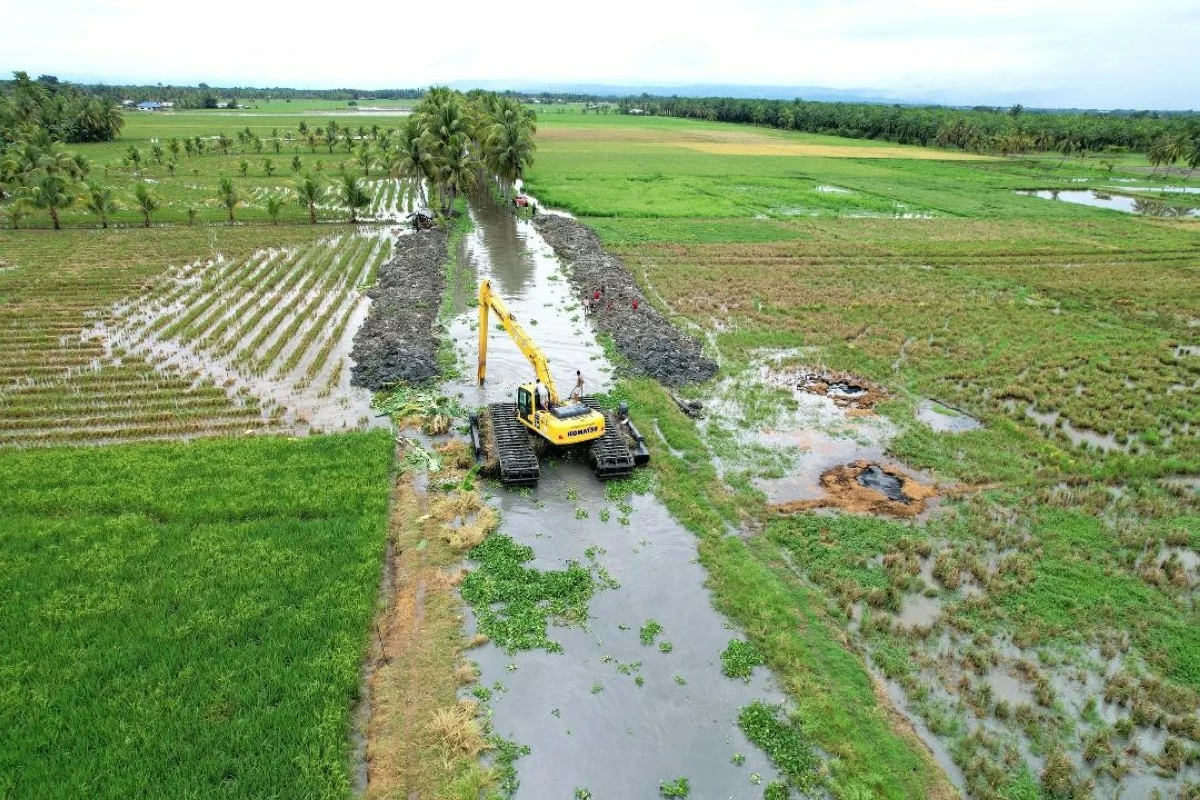
AN excavator desilts a waterway in Barangay Magatos in Kabacan, Cotabato. (Provincial Government of Cotabato)
KIDAPAWAN CITY – Continuous dredging operations in waterways in low-lying areas in Cotabato province have significantly reduced the impact of perennial flooding due to monsoon rains.
The provincial government intensified its dredging operations in silted waterways to address perennial flooding since June last year.
Gov. Emmylou Taliño-Mendoza said that ongoing dredging operations have eased the impact, if not totally prevent flooding, in most low-lying areas.
Mendoza said that floodwater rose in some barangays but it immediately receded because most of the vital waterways have been cleared.
The governor was referring to monsoon rains that swamped several towns in Maguindanao del Sur and Maguindanao del Norte and displaced thousands of villagers.
Four amphibious excavators are deployed in low-lying areas in Kabacan, M’lang, Pikit, and Tulunan for dredging operations.
Dredging operations have been completed in Barangay Bulucaon in Pigcawayan.
Mendoza said that desilting operations are part of the provincial government’s mitigation measures to address perennial flooding.
Data from the Provincial Engineering Office (PEO) showed that dredging operations have cleared at least 39 kilometers of waterways since it started in June last year. Cleared waterways had a width of 12 to 15 meters and depth of three to five meters.
The governor said dredging operations did not just cover villages in Cotabato. “We also included some barangays that used to be part of Cotabato province and now already part of SGA (Special Geographic Area) in BARMM (Bangsamoro Autonomous Region in Muslim Mindanao) since these waterways cuts through several barangays or towns before draining to the Ligawasan Marsh,” Mendoza said.
Local government units in SGA-BARMM contributed fuel and security efforts in the ongoing dredging operations, the governor added.
Cotabato Provincial Disaster Risk Reduction and Management Office (PDRRMO) chief Abril Espadera said that dredging operations have significantly contributed in mitigating the impact of possible flooding.
“Unlike in the past, massive flooding had swamped several barangays in almost all of the eight towns that sit on the periphery of the Ligawasan Marsh,” Espadera recalled.
He said the catching capacity in the areas where waterways have been desilted has also increased. “Unlike before, the water could not immediately flow to the marsh area because of silt and water hyacinths that are clogging the waterways.”
Espadera acknowledged that there are still some areas in Pikit flooded by recent heavy rains but it was not as deep as in the past.
In 2024, widespread flooding caused by heavy rains submerged many parts of the low-lying barangays in Kabacan and Pikit and some parts of neighboring Datu Montawal and Pagulangan towns in Maguindanao del Sur.
In Kabacan, flooding affected over 25,000 persons in 13 of its 17 barangays. Flooding also damaged at least 1,000 hectares of agricultural land. Almost 75, 000 persons were affected by flood in 17 of 20 barangays of Pikit.
“Recently, there were some who were forced to evacuate but it’s not as many as in the previous flooding,” Espadera said.
So much silt accumulated in years of flooding in most of the waterways that drain to the Ligawasan Marsh. As silt deposits piled up, rivers and tributaries breached its banks, inundating thousands of hectares of agricultural land.
To prevent or mitigate the impact of siltation downstream, Espadera said that there should be some mitigating measures in the upstream areas such as massive tree-planting and other slope protection measures.
With a cost of at least P50 million each, deploying the amphibious excavators are more economical compared to flood control infrastructures.
“Our P50-million worth of equipment can address several kilometers of flooding. While the P50-million worth of funds can only build a few meters of flood control project,” the governor pointed out.
Mendoza believes that the approach in addressing perennial flooding is not just economical but also more efficient. “The excavated silts are also piled on the banks of the waterways and also serve as a natural dike protection.”
Once dredging operations are completed, the governor said that she is looking forward to the former flooded areas becoming productive.
She underscored the significance of addressing perennial flooding as these hundreds of hectares of land are vital to agricultural production as well as to the food security of the province.
“People can plant crops in these areas that have been drained with floodwaters. Hindi na aasa na lang palagi sa ayuda (they won’t rely anymore on assistance),” Mendoza said.