






Manila Bulletin
 Philippines
Mindanao
Rep. Paolo Duterte: PBBM failed to address issue of corruption in SONA
Philippines
Mindanao
Rep. Paolo Duterte: PBBM failed to address issue of corruption in SONA
Philippines
Mindanao
Rep. Paolo Duterte: PBBM failed to address issue of corruption in SONA
Rep. Paolo Duterte: PBBM failed to address issue of corruption in SONA
By Ivy Tejano
Published Jul 27, 2026 10:30 pm


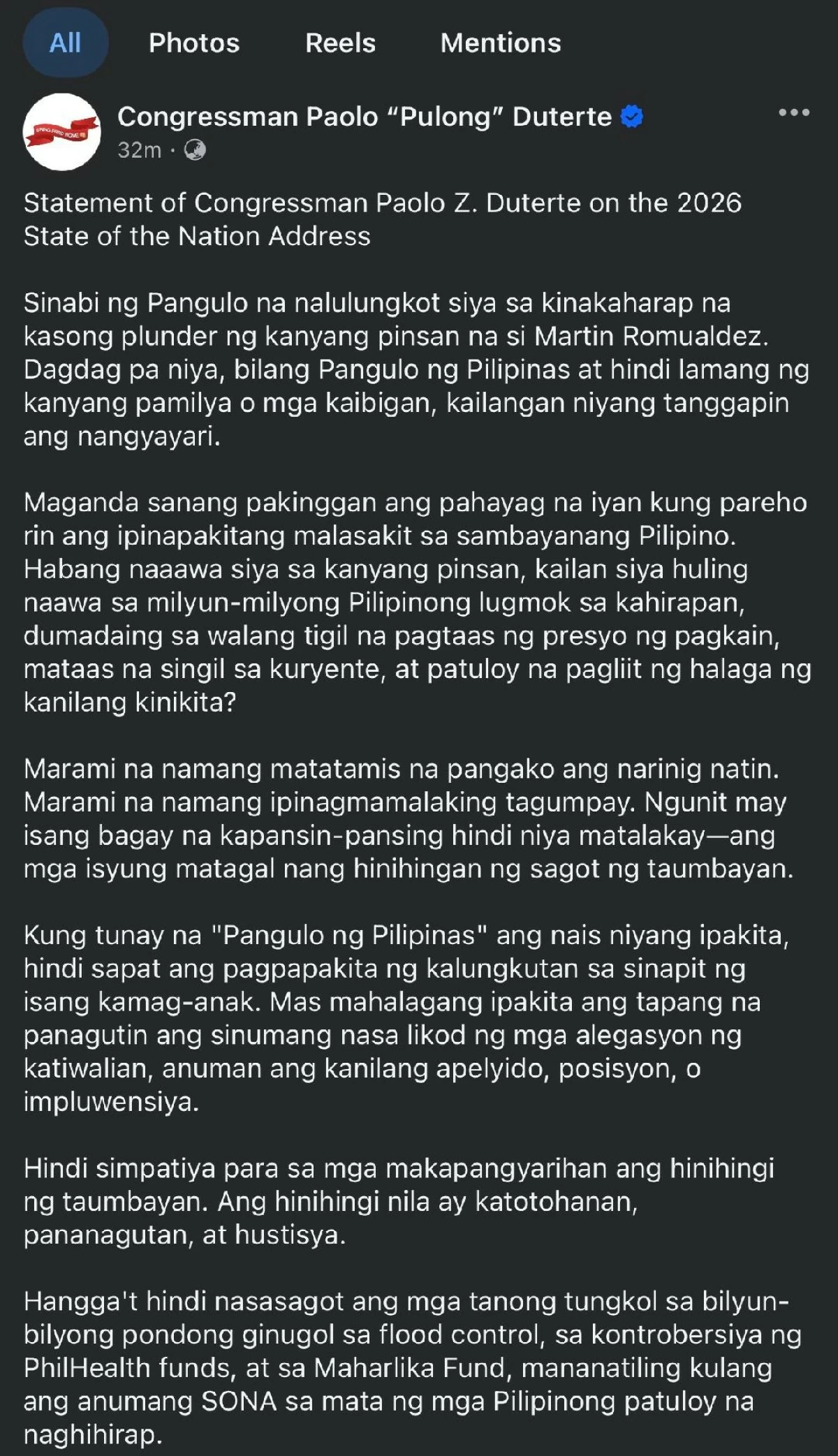
DAVAO CITY – Davao City Rep. Paolo Duterte said President Ferdinand R. Marcos Jr. failed to address the issue of corruption in his fifth State-of-the-Nation Address on Monday.
The President acknowledged that the investigation into alleged irregularities in flood control projects has already reached his cousin, former House Speaker Martin Romualdez.
Marcos said according to the Ombudsman, multiple cases against a former House Speaker are now nearing filing.
But Duterte said Marcos’ comments would have carried more weight if they had been matched by the same concern for Filipinos struggling with poverty, rising food prices, high electricity costs, and declining purchasing power.
The Davao City lawmaker said the President’s statements highlighted the administration’s achievements and promises but failed to address issues that the public has long been demanding answers to.
He added that if Marcos truly wants to demonstrate that he is “the President of the Philippines,” he should show the resolve to hold accountable anyone facing allegations of corruption, regardless of family ties, position, or influence.
“The public is not asking for sympathy for the powerful. They are asking for truth, accountability, and justice,” Duterte said.
He added that questions surrounding the billions of pesos allocated for flood control projects, the controversy over Philippine Health Insurance Corp. funds and the Maharlika fund remain unanswered.
According to Duterte, any State-of-the-Nation Address would remain incomplete in the eyes of many Filipinos as long as these issues are left unresolved.
“The true state of the nation is not measured by the applause inside the Batasang Pambansa,” he said. “It is measured by what families can put on the table, the prices they pay for basic goods, the quality of government services, and the public’s trust in state institutions.”
Magno praises SONA
On the other hand, Mindanao Development Authority Chairman Secretary Leo Tereso Magno said the SONA outlined key reforms that would strengthen the economy, improve public services, and accelerate inclusive development, particularly in Mindanao.
He added that Marcos presented a comprehensive roadmap focused on economic growth, energy security, disaster resilience, and better government services.
Magno highlighted Marcos’ statement that he is “the President of all Filipinos, not of his family or friends,” referring to the plunder charges soon to be filed against Romualdez.
He said the President’s remarks underscored a commitment to uphold the rule of law and ensure that justice prevails over personal relationships.
Magno welcomed Marcos’ directive to amend the Electric Power Industry Reform Act to remove system loss charges from electricity consumers, describing it as a significant step towards lowering power costs for Filipino households and businesses.
"The proposal would benefit Mindanao, where affordable and reliable electricity remains essential to economic growth," Magno said.
He added that the President’s priorities, including strengthening agriculture, expanding energy sources, promoting waste-to-energy facilities, exploring hydrogen and nuclear energy, modernizing infrastructure, and enhancing disaster preparedness, are aligned with Mindanao’s development agenda.
Magno cited the administration’s commitment to tax relief, expanded healthcare services, digitalized government assistance, and energy sector reforms, saying these measures aim to make public services more responsive and accessible.
He welcomed the government’s continued support for the Bangsamoro Autonomous Region in Muslim Mindanao, particularly the conduct of its first parliamentary elections, which he said would help sustain peace, strengthen institutions, and promote inclusive development in the region.
According to Magno, the administration’s continued focus on infrastructure, investment promotion, and regional connectivity would create more opportunities for Mindanao, which remains a key contributor to the country’s food security, energy, trade, and investment.
Magno said MinDA is ready to work with national government agencies, local government units, development partners, and the private sector to implement the administration’s priorities and deliver lasting benefits to Mindanao communities.