







EU's strategic pivot
Published Jul 27, 2026 01:21 pm


DFA Secretary Ma. Theresa Lazaro and High Representative/Vice-President Kaja Kallas during the signing of the Joint Statement on an Enhanced Partnership between the European Union and the Republic of the Philippines. (Photo: EU Delegation in the Philippines)
Geography may place the European Union thousands of kilometers from the West Philippine Sea, but its strategic interests are increasingly anchored in the Indo-Pacific.
That reality was evident this past week as European Union High Representative for Foreign Affairs and Security Policy and Vice-President of the European Commission Kaja Kallas visited Manila for the ASEAN Foreign Ministers’ Meetings, where the EU advanced a series of initiatives that deepened its partnership with both the Philippines and the wider region.
While ASEAN meetings routinely produce lengthy communiqués and diplomatic declarations, this year’s gathering also delivered tangible outcomes for the Philippines.
Kallas and Secretary of Foreign Affairs Ma. Theresa Lazaro signed a Joint Statement elevating EU-Philippines relations to an Enhanced Partnership, marking one of the most significant upgrades in bilateral ties in more than six decades of diplomatic relations.
The agreement broadens cooperation well beyond traditional political dialogue to include security and defense, trade and investment, climate action, digital connectivity, sustainable development, and people-to-people exchanges.
Its timing was no coincidence. As ASEAN Chair this year, the Philippines has found itself at the center of growing international attention as major powers seek stronger engagement with Southeast Asia amid an increasingly complex geopolitical environment. The European Union has made clear that it intends to be part of that conversation.
Speaking during the meetings, Kallas reaffirmed the EU’s commitment to ASEAN centrality and to what has become a recurring theme throughout the week: a free, open, and rules-based Indo-Pacific anchored in international law.
That commitment was reinforced through another milestone announced during her visit. Following talks with Defense Secretary Gilberto Teodoro Jr., the European Union unveiled its first-ever assistance measure for the Philippines under the European Peace Facility, valued at €15 million.
More significantly, it is also the first European Peace Facility assistance package to be implemented anywhere in the Indo-Pacific.
The funding will provide non-lethal equipment and training to strengthen the Armed Forces of the Philippines’ maritime domain awareness, improving the country’s ability to detect, monitor, and analyze activities within its maritime zones, develop a more comprehensive maritime picture, enhance early warning, and support more effective coordination among naval and maritime security forces.
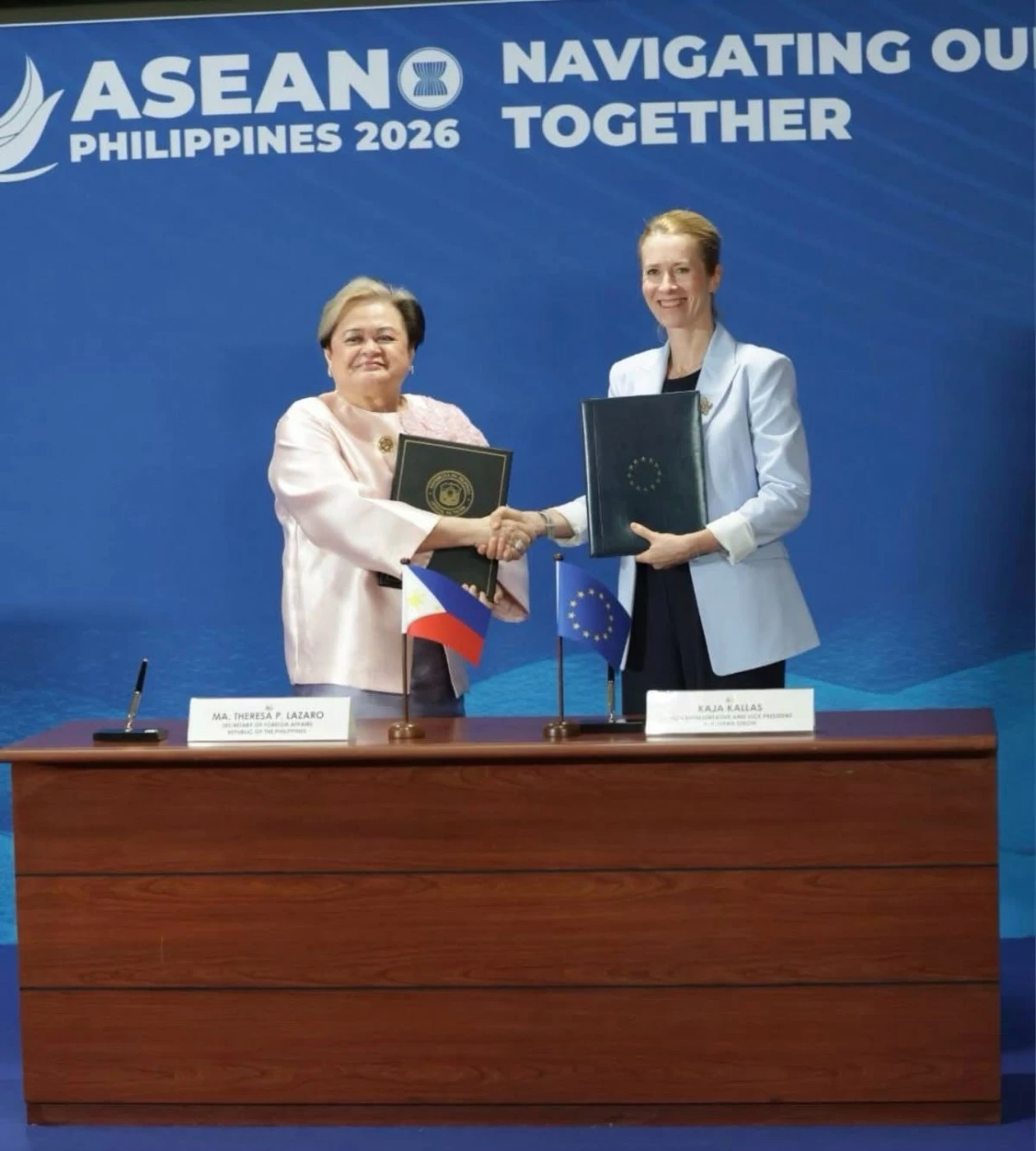
Enhanced partnership. Ties between the Philippines and the European Union are upgraded to a stronger, more comprehensive, and more forward-looking framework.
While modest compared with the scale of military assistance provided by the Philippines’ traditional security partners, the announcement carries considerable diplomatic significance.
For years, the European Union has consistently advocated for respect for international law, freedom of navigation, and a rules-based international order in the Indo-Pacific. The European Peace Facility assistance measure demonstrates that it is prepared to support those principles not only through diplomacy, but through practical cooperation that strengthens the Philippines’ ability to safeguard its maritime domain.
In other words, the EU is matching its words with action. The assistance signals that Europe increasingly views stability in the Indo-Pacific as directly linked to its own strategic interests—and recognizes that supporting regional partners is an essential part of preserving that stability.
That message was echoed throughout Kallas’ meetings with both Lazaro and Teodoro, where discussions repeatedly returned to maritime security, freedom of navigation and overflight, cybersecurity, hybrid threats, foreign information manipulation and interference, and the importance of upholding the United Nations Convention on the Law of the Sea (UNCLOS).
Those priorities closely mirror many of the issues confronting the Philippines in the West Philippine Sea.
The visit also reflected how the European Union’s engagement with the region continues to evolve.
Beyond bilateral meetings, Kallas participated in the ASEAN-EU Post-Ministerial Conference, the 33rd ASEAN Regional Forum, and the ceremony marking the 50th anniversary of the Treaty of Amity and Cooperation, reaffirming the EU’s support for ASEAN centrality and the region’s multilateral architecture.
She likewise took part in the inaugural Kyiv-Manila Strategic Dialogue, drawing a connection between defending international law in Europe and upholding a rules-based order in the Indo-Pacific.
For the Philippines, the week’s announcements represent more than new agreements. They underscore how the country’s role within ASEAN—and its position at the heart of the Indo-Pacific—continues to attract partners from well beyond the region.
For the European Union, meanwhile, the visit underscored a changing reality. Europe’s interests no longer end at its own borders. They now extend across vital sea lanes, resilient supply chains, digital connectivity, and maritime security in the Indo-Pacific.
The elevation of EU-Philippines relations to an Enhanced Partnership and the launch of the European Peace Facility assistance measure signal that the European Union is no longer content to be viewed primarily as an economic and development partner. It is increasingly positioning itself as a strategic stakeholder in the region—one that recognizes peace and stability in the Indo-Pacific as inseparable from Europe’s own future.