

ADVERTISEMENT

Sweden, Poland, Romania, Lithuania join ASEAN peace treaty

Published Jul 24, 2026 03:53 pm

At A Glance

  • Sweden, Poland, Romania, and Lithuania formally acceded to the ASEAN Treaty of Amity and Cooperation (TAC) during the ASEAN Foreign Ministers' Meeting in Manila.
  • The accession brings the number of parties to the treaty to 62, underscoring growing international support for ASEAN's principles of peace, dialogue, and rules-based cooperation.
  • Foreign Affairs Secretary Ma. Theresa Lazaro said the accession affirms ASEAN's central role in promoting regional peace and stability.
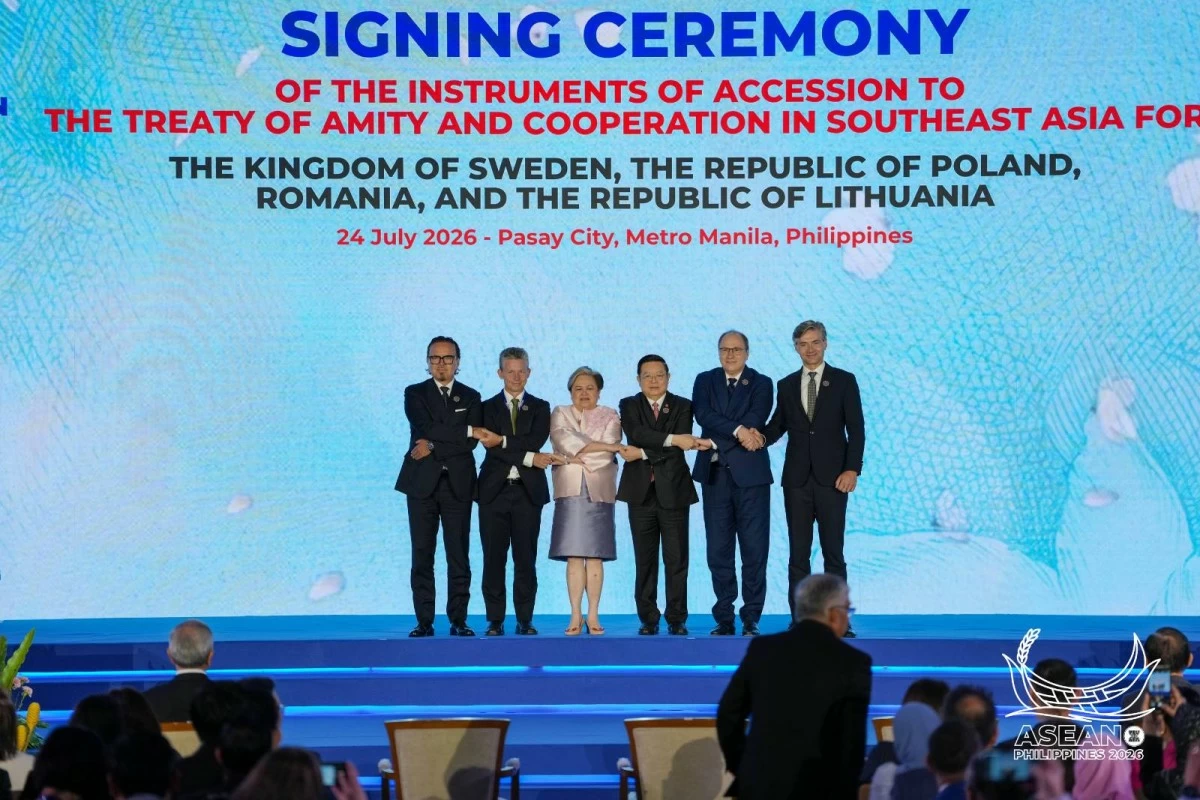
(L-R) Poland's Minister of State Assets Wojciech Balczun, Swedish Defense Minister Pål Jonson, Philippines Department of Foreign Affairs Secretary Ma. Theresa Lazaro, ASEAN Secretary-General Kao Kim Hourn, Romania's Minister of Education and Research Mihai Dimian, and Lithuania's Foreign Minister Kestutis Budrys do the ASEAN handshake during the signing ceremony for the Treaty of Amity and Cooperation in Southeast Asia (TAC), following the Association of Southeast Asian Nations (ASEAN) Foreign Ministers' Meeting in Pasay City on July 24, 2026. (ASEAN 2026 PH)

Sweden, Poland, Romania, and Lithuania formally acceded to the Treaty of Amity and Cooperation in Southeast Asia (TAC) on Friday, expanding the landmark Association of Southeast Asian Nations (ASEAN) pact to 62 High Contracting Parties and reaffirming support for a rules-based regional order anchored on peace, dialogue, and mutual respect.

The four European countries signed their respective Instruments of Accession following the 59th ASEAN Foreign Ministers' Meeting (AMM) and Related Meetings in Pasay City on Friday, July 24, under the Philippines' ASEAN chairmanship.

Department of Foreign Affairs (DFA) Secretary Ma. Theresa Lazaro welcomed the four countries as the treaty's newest parties, saying their accession reflects the growing international recognition of the principles that have guided ASEAN for nearly five decades.

"The accession of our newest High Contracting Parties reflects a shared conviction in the universality of the fundamental principles enshrined in the Treaty, principles that emanate from the core values that ASEAN has upheld for six decades," she said.

Lazaro said the accession also recognizes ASEAN's role as the "primary driving force" in shaping a rules-based regional architecture and preserving peace, stability, and prosperity.

She noted that while the treaty was conceived in Southeast Asia, its principles have transcended geographical boundaries, with the diversity of the four new parties demonstrating a shared commitment to mutual respect and cooperation.

The Foreign Affairs chief added that the signing ceremony marked the beginning of deeper partnerships between ASEAN and the four European countries, likening the occasion to the "first bloom" of a relationship that should be nurtured through sustained dialogue and continued commitment to the treaty's principles.

Representatives of the four countries likewise reaffirmed their support for ASEAN Centrality and pledged to deepen cooperation with the regional bloc across a range of sectors.

Swedish Defence Minister Pål Jonson said Sweden remains committed to strengthening cooperation with ASEAN in trade, security, the green and digital transition, and science and technology.

"You can count on Sweden as your long-term partner. We are ready to contribute and also to listen and to learn, which is even more important," he said.

Polish Minister of State Assets Wojciech Balczun said Poland is prepared to expand cooperation with ASEAN in trade, investment, digitalization, energy transition, cybersecurity, and food security.

For his part, Romanian Minister of Education and Research Mihai Dimian highlighted education, research, innovation, and digital skills as key areas for long-term collaboration.

Lithuanian Foreign Minister Kęstutis Budrys thanked the Philippines for supporting his country's accession and said Lithuania considers ASEAN "one of our key global economic partners," with plans to strengthen cooperation in energy security, digitalization, cybersecurity, connectivity, sustainable development, and people-to-people exchanges.

Adopted in 1976, the TAC serves as ASEAN's code of conduct, committing its parties to respect sovereignty, refrain from interference in one another's internal affairs, settle disputes peacefully, and promote regional cooperation.

The signing ceremony formed part of activities marking the 50th anniversary of the treaty, with President Marcos scheduled to host a gala dinner in Malacañan Palace for ASEAN foreign ministers and representatives of the treaty's High Contracting Parties later Friday.

Related Tags

ASEAN Ma. Theresa Lazaro DFA Poland Lithuania Sweden Romania Treaty of Amity and Cooperation in Southeast Asia
ADVERTISEMENT
.most-popular .layout-ratio{ padding-bottom: 79.13%; } @media (min-width: 768px) and (max-width: 1024px) { .widget-title { font-size: 15px !important; } }

{{ articles_filter_1561_widget.title }}

.most-popular .layout-ratio{ padding-bottom: 79.13%; } @media (min-width: 768px) and (max-width: 1024px) { .widget-title { font-size: 15px !important; } }

{{ static_articles_1562_widget.title }}

.most-popular .layout-ratio{ padding-bottom: 79.13%; } @media (min-width: 768px) and (max-width: 1024px) { .widget-title { font-size: 15px !important; } }

{{ articles_filter_1563_widget.title }}

{{ articles_filter_1564_widget.title }}

.mb-article-details { position: relative; } .mb-article-details .article-body-preview, .mb-article-details .article-body-summary{ font-size: 17px; line-height: 30px; font-family: "Libre Caslon Text", serif; color: #000; } .mb-article-details .article-body-preview iframe , .mb-article-details .article-body-summary iframe{ width: 100%; margin: auto; } .read-more-background { background: linear-gradient(180deg, color(display-p3 1.000 1.000 1.000 / 0) 13.75%, color(display-p3 1.000 1.000 1.000 / 0.8) 30.79%, color(display-p3 1.000 1.000 1.000) 72.5%); position: absolute; height: 200px; width: 100%; bottom: 0; display: flex; justify-content: center; align-items: center; padding: 0; } .read-more-background a{ color: #000; } .read-more-btn { padding: 17px 45px; font-family: Inter; font-weight: 700; font-size: 18px; line-height: 16px; text-align: center; vertical-align: middle; border: 1px solid black; background-color: white; } .hidden { display: none; }
function initializeAllSwipers() { // Get all hidden inputs with cms_article_id document.querySelectorAll('[id^="cms_article_id_"]').forEach(function (input) { const cmsArticleId = input.value; const articleSelector = '#article-' + cmsArticleId + ' .body_images'; const swiperElement = document.querySelector(articleSelector); if (swiperElement && !swiperElement.classList.contains('swiper-initialized')) { new Swiper(articleSelector, { loop: true, pagination: false, navigation: { nextEl: '#article-' + cmsArticleId + ' .swiper-button-next', prevEl: '#article-' + cmsArticleId + ' .swiper-button-prev', }, }); } }); } setTimeout(initializeAllSwipers, 3000); const intersectionObserver = new IntersectionObserver( (entries) => { entries.forEach((entry) => { if (entry.isIntersecting) { const newUrl = entry.target.getAttribute("data-url"); if (newUrl) { history.pushState(null, null, newUrl); let article = entry.target; // Extract metadata const author = article.querySelector('.author-section').textContent.replace('By', '').trim(); const section = article.querySelector('.section-info ').textContent.replace(' ', ' '); const title = article.querySelector('.article-title h1').textContent; // Parse URL for Chartbeat path format const parsedUrl = new URL(newUrl, window.location.origin); const cleanUrl = parsedUrl.host + parsedUrl.pathname; // Update Chartbeat configuration if (typeof window._sf_async_config !== 'undefined') { window._sf_async_config.path = cleanUrl; window._sf_async_config.sections = section; window._sf_async_config.authors = author; } // Track virtual page view with Chartbeat if (typeof pSUPERFLY !== 'undefined' && typeof pSUPERFLY.virtualPage === 'function') { try { pSUPERFLY.virtualPage({ path: cleanUrl, title: title, sections: section, authors: author }); } catch (error) { console.error('ping error', error); } } // Optional: Update document title if (title && title !== document.title) { document.title = title; } } } }); }, { threshold: 0.1 } ); function showArticleBody(button) { const article = button.closest("article"); const summary = article.querySelector(".article-body-summary"); const body = article.querySelector(".article-body-preview"); const readMoreSection = article.querySelector(".read-more-background"); // Hide summary and read-more section summary.style.display = "none"; readMoreSection.style.display = "none"; // Show the full article body body.classList.remove("hidden"); } document.addEventListener("DOMContentLoaded", () => { let loadCount = 0; // Track how many times articles are loaded const offset = [1, 2, 3, 4, 5, 6, 7, 8, 9, 10]; // Offset values const currentUrl = window.location.pathname.substring(1); let isLoading = false; // Prevent multiple calls if (!currentUrl) { console.log("Current URL is invalid."); return; } const sentinel = document.getElementById("load-more-sentinel"); if (!sentinel) { console.log("Sentinel element not found."); return; } function isSentinelVisible() { const rect = sentinel.getBoundingClientRect(); return ( rect.top < window.innerHeight && rect.bottom >= 0 ); } function onScroll() { if (isLoading) return; if (isSentinelVisible()) { if (loadCount >= offset.length) { console.log("Maximum load attempts reached."); window.removeEventListener("scroll", onScroll); return; } isLoading = true; const currentOffset = offset[loadCount]; window.loadMoreItems().then(() => { let article = document.querySelector('#widget_1690 > div:nth-last-of-type(2) article'); intersectionObserver.observe(article) loadCount++; }).catch(error => { console.error("Error loading more items:", error); }).finally(() => { isLoading = false; }); } } window.addEventListener("scroll", onScroll); });

Sign up by email to receive news.