ADVERTISEMENT

Philippines concludes first Latin America free trade deal with Chile

Published Jul 24, 2026 09:57 pm
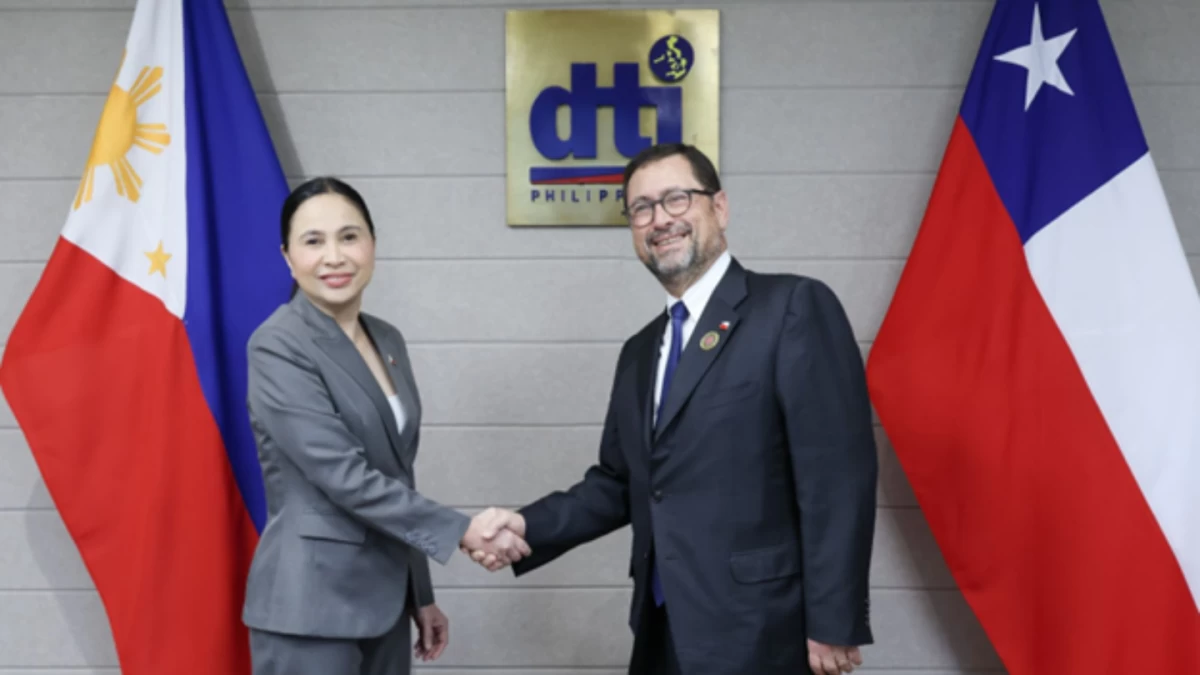
Trade Secretary Cristina A. Roque and Chile’s Foreign Minister H.E. Francisco Pérez Mackenna seal negotiations for the PH–CL CEPA, the country's first free trade agreement with a Latin American nation, timed with the 80th anniversary of bilateral relations.
The Philippines will soon have its first free trade agreement (FTA) with a Latin American country after concluding negotiations for a historic deal with Chile, according to the Department of Trade and Industry (DTI).
In a social media post on Friday, July 24, the DTI announced that the Philippines has completed negotiations for the Comprehensive Economic Partnership Agreement (CEPA) with Chile.
Trade Secretary Cristina Roque welcomed the completion of the FTA talks during her recent meeting with Chile’s Minister of Foreign Affairs Francisco Pérez Mackenna in Manila, the DTI said.
The development is timely as 2026 marks the 80th anniversary of the establishment of diplomatic relations between the two countries.
Roque said the conclusion of the negotiations reflects the government’s commitment to expanding the Philippines’ network of high-quality trade agreements.
“[This] advances the country's trade agenda while creating greater opportunities for Filipino businesses, workers, farmers, consumers, and investors,” she said.
The Philippines-Chile CEPA is designed to be a comprehensive and modern agreement that builds on the complementary strengths of the two countries.
For one, securing tariff liberalization would strengthen the Philippines’ exports of electronic products, coconut products, and personal care products to Chile.
Meanwhile, greater access to the Philippine market would boost demand for Chile’s key products, such as salmon and copper ores and concentrates.
In particular, the DTI said having a reliable supply of copper would help support the country’s electronic products industry, its top export sector, as well as the renewable energy and advanced manufacturing sectors.
“By leveraging these complementary strengths, the CEPA creates new opportunities for collaboration across value chains, technology exchange, investments, and the adoption of sustainable practices,” the DTI said.
The DTI noted that Chile was the Philippines’ 51st trading partner, 49th export market, and 48th import source in 2025.
Data from the United Nations Commodity Trade (UN Comtrade) showed that Philippine exports to Chile reached $45.43 million, while imports from Chile stood at $72.41 million last year.
The DTI said the CEPA also goes beyond traditional tariff liberalization for trade in goods and services, as it establishes a strong framework for deeper cooperation in areas such as innovation and the digital economy.
It also incorporates commitments to sustainability, inclusivity, and economic resilience, as reflected in the CEPA’s chapters on the environment, labor, global value chains, and trade and gender.
The Philippines is banking on FTAs such as the trade deal with Chile to sustain the growth momentum of the country’s exports this year and potentially achieve a new record.
The country’s merchandise exports rose by 10 percent to $37.87 billion in the first five months of the year from $34.25 billion in the same period last year, according to the Philippine Statistics Authority (PSA).
The country’s exports of goods reached $84.48 billion in 2025, the highest on record since the PSA began tracking the data in 1991.
The Philippines is expected to complete negotiations for FTAs with the European Union, Canada, and India, as well as amendments to its economic partnership agreement with Japan, within the year.

Related Tags

Department of Trade and Industry (DTI) free trade agreement (FTA) Chile
ADVERTISEMENT
.most-popular .layout-ratio{ padding-bottom: 79.13%; } @media (min-width: 768px) and (max-width: 1024px) { .widget-title { font-size: 15px !important; } }

{{ articles_filter_1561_widget.title }}

.most-popular .layout-ratio{ padding-bottom: 79.13%; } @media (min-width: 768px) and (max-width: 1024px) { .widget-title { font-size: 15px !important; } }

{{ static_articles_1562_widget.title }}

.most-popular .layout-ratio{ padding-bottom: 79.13%; } @media (min-width: 768px) and (max-width: 1024px) { .widget-title { font-size: 15px !important; } }

{{ articles_filter_1563_widget.title }}

{{ articles_filter_1564_widget.title }}

.mb-article-details { position: relative; } .mb-article-details .article-body-preview, .mb-article-details .article-body-summary{ font-size: 17px; line-height: 30px; font-family: "Libre Caslon Text", serif; color: #000; } .mb-article-details .article-body-preview iframe , .mb-article-details .article-body-summary iframe{ width: 100%; margin: auto; } .read-more-background { background: linear-gradient(180deg, color(display-p3 1.000 1.000 1.000 / 0) 13.75%, color(display-p3 1.000 1.000 1.000 / 0.8) 30.79%, color(display-p3 1.000 1.000 1.000) 72.5%); position: absolute; height: 200px; width: 100%; bottom: 0; display: flex; justify-content: center; align-items: center; padding: 0; } .read-more-background a{ color: #000; } .read-more-btn { padding: 17px 45px; font-family: Inter; font-weight: 700; font-size: 18px; line-height: 16px; text-align: center; vertical-align: middle; border: 1px solid black; background-color: white; } .hidden { display: none; }
function initializeAllSwipers() { // Get all hidden inputs with cms_article_id document.querySelectorAll('[id^="cms_article_id_"]').forEach(function (input) { const cmsArticleId = input.value; const articleSelector = '#article-' + cmsArticleId + ' .body_images'; const swiperElement = document.querySelector(articleSelector); if (swiperElement && !swiperElement.classList.contains('swiper-initialized')) { new Swiper(articleSelector, { loop: true, pagination: false, navigation: { nextEl: '#article-' + cmsArticleId + ' .swiper-button-next', prevEl: '#article-' + cmsArticleId + ' .swiper-button-prev', }, }); } }); } setTimeout(initializeAllSwipers, 3000); const intersectionObserver = new IntersectionObserver( (entries) => { entries.forEach((entry) => { if (entry.isIntersecting) { const newUrl = entry.target.getAttribute("data-url"); if (newUrl) { history.pushState(null, null, newUrl); let article = entry.target; // Extract metadata const author = article.querySelector('.author-section').textContent.replace('By', '').trim(); const section = article.querySelector('.section-info ').textContent.replace(' ', ' '); const title = article.querySelector('.article-title h1').textContent; // Parse URL for Chartbeat path format const parsedUrl = new URL(newUrl, window.location.origin); const cleanUrl = parsedUrl.host + parsedUrl.pathname; // Update Chartbeat configuration if (typeof window._sf_async_config !== 'undefined') { window._sf_async_config.path = cleanUrl; window._sf_async_config.sections = section; window._sf_async_config.authors = author; } // Track virtual page view with Chartbeat if (typeof pSUPERFLY !== 'undefined' && typeof pSUPERFLY.virtualPage === 'function') { try { pSUPERFLY.virtualPage({ path: cleanUrl, title: title, sections: section, authors: author }); } catch (error) { console.error('ping error', error); } } // Optional: Update document title if (title && title !== document.title) { document.title = title; } } } }); }, { threshold: 0.1 } ); function showArticleBody(button) { const article = button.closest("article"); const summary = article.querySelector(".article-body-summary"); const body = article.querySelector(".article-body-preview"); const readMoreSection = article.querySelector(".read-more-background"); // Hide summary and read-more section summary.style.display = "none"; readMoreSection.style.display = "none"; // Show the full article body body.classList.remove("hidden"); } document.addEventListener("DOMContentLoaded", () => { let loadCount = 0; // Track how many times articles are loaded const offset = [1, 2, 3, 4, 5, 6, 7, 8, 9, 10]; // Offset values const currentUrl = window.location.pathname.substring(1); let isLoading = false; // Prevent multiple calls if (!currentUrl) { console.log("Current URL is invalid."); return; } const sentinel = document.getElementById("load-more-sentinel"); if (!sentinel) { console.log("Sentinel element not found."); return; } function isSentinelVisible() { const rect = sentinel.getBoundingClientRect(); return ( rect.top < window.innerHeight && rect.bottom >= 0 ); } function onScroll() { if (isLoading) return; if (isSentinelVisible()) { if (loadCount >= offset.length) { console.log("Maximum load attempts reached."); window.removeEventListener("scroll", onScroll); return; } isLoading = true; const currentOffset = offset[loadCount]; window.loadMoreItems().then(() => { let article = document.querySelector('#widget_1690 > div:nth-last-of-type(2) article'); intersectionObserver.observe(article) loadCount++; }).catch(error => { console.error("Error loading more items:", error); }).finally(() => { isLoading = false; }); } } window.addEventListener("scroll", onScroll); });

Sign up by email to receive news.