








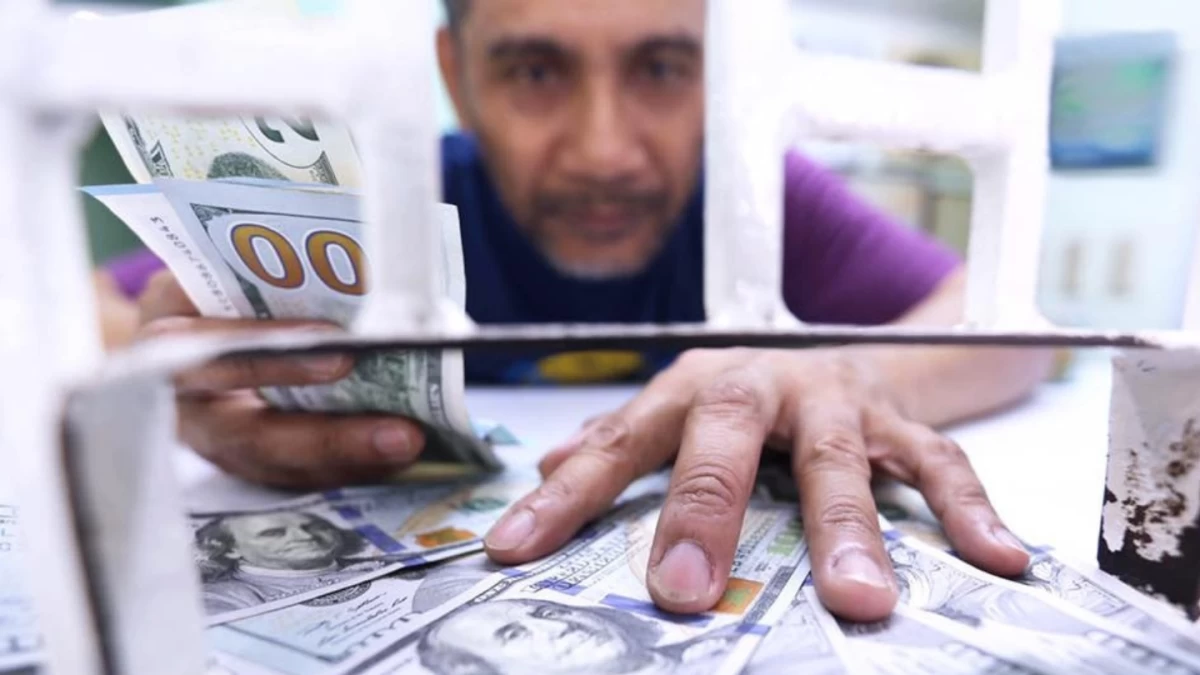
The peso sank to a fresh record low against the United States (US) dollar on Friday, weighed down by escalating import burdens, global energy cost pressures, and persistent demand for foreign currency.
The local currency closed at ₱61.847 per US dollar on July 24, according to official data from the Bankers Association of the Philippines spot market. The settlement surpasses the previous record low of ₱61.75 set during the prior session on July 23.
Spot market trading opened at ₱61.80 and touched an intraday high of ₱61.85 before settling near its trough. Total market turnover contracted sharply to $969.38 million on Friday from $1.153 billion recorded in the preceding session.
Private-sector economists are warning that the peso could fall past ₱62 per dollar in the near term as escalating US-Iran tensions drive oil prices toward $100 a barrel, intensifying pressure on the energy-dependent nation.
The local currency struggled to find support throughout the trading week, weighed down by persistent global demand for the safe-haven US dollar.
A protracted disruption to Middle Eastern oil shipments, combined with high US interest rates, is set to weigh broadly on net energy-importing Asian economies, according to MUFG Bank Ltd.
Analysts from Bank of the Philippine Islands, China Banking Corp., and Reyes Tacandong & Co. noted that resurging crude prices have rapidly erased the brief currency stability observed in early July.
The currency’s recent slump stems primarily from heightened external volatility rather than internal fundamentals, according to Domini Velasquez, chief economist at China Banking. The oil price spike prompted President Ferdinand Marcos Jr. to declare a state of energy emergency as import costs mounted.
“At this stage, the peso appears to be trading more on market sentiment than on underlying fundamentals,” Velasquez said.
She added that risk aversion and safe-haven demand for the greenback have driven the currency well below levels justified by domestic conditions alone.
The Philippines faces compounding economic headwinds, with Middle East conflicts adding to domestic political fallout from an ongoing flood control investigation. Headline inflation continues to hover above the central bank’s four percent target ceiling, constraining domestic growth prospects.
Should Middle Eastern tensions escalate further, the dollar-peso exchange rate could break past the ₱62 threshold, Velasquez said. That outlook is echoed by Jonathan Ravelas, senior adviser at Reyes Tacandong & Co., who projects the currency to trade between ₱61.90 and ₱62.10 per dollar in the near term as it tests new historic lows.
Despite the heightened pressure, analysts expect Bangko Sentral ng Pilipinas to intervene to prevent unruly currency movements.
Velasquez noted the central bank will likely act behind the scenes to smooth excessive swings and mitigate the risk of a disorderly depreciation.
A slide below ₱62 remains possible, though its ultimate trajectory hinges on central bank policy actions, according to Mike Ricafort, chief economist at Rizal Commercial Banking Corp. While monetary authorities face limited options against external shocks, further interest rate hikes could help stabilize the currency. The BSP key borrowing rate currently stands at 4.75 percent following two consecutive 25-basis-point increases.
Ruben Carlo Asuncion, chief economist at Union Bank of the Philippines, affirmed that a test of the ₱62 mark is a realistic scenario driven by robust dollar demand.
He added that the central bank must closely monitor whether sustained exchange-rate weakness feeds into domestic consumer prices, creating secondary inflationary pressures.