






Manila Bulletin
 Technews
Lgenie and Agora bring real-time voice AI to assistive devices for senior citizen care
Technews
Lgenie and Agora bring real-time voice AI to assistive devices for senior citizen care
Technews
Lgenie and Agora bring real-time voice AI to assistive devices for senior citizen care
Lgenie and Agora bring real-time voice AI to assistive devices for senior citizen care
Published Jul 24, 2026 09:11 am


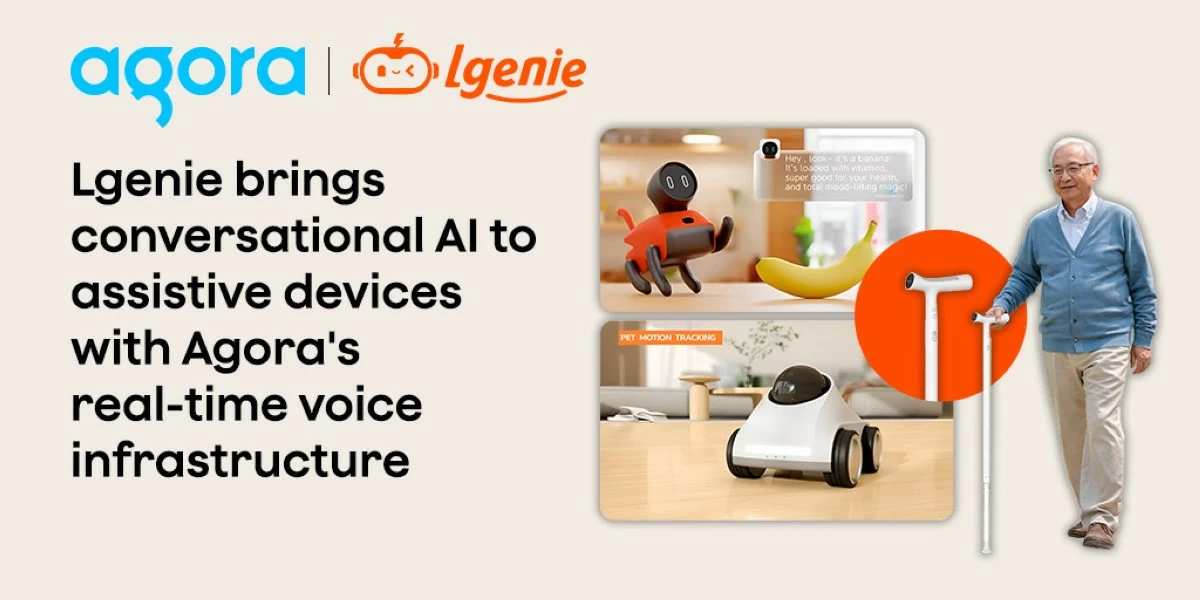
Agora announced that its Conversational AI platform is powering Lgenie's next generation of AI-native assistive devices, enabling reliable real-time voice interactions for elderly users even in outdoor and mobile environments where network conditions can vary.
The deployment reflects a broader shift in conversational AI. While early adoption focused on chatbots and digital assistants, developers are increasingly embedding AI into physical devices used across healthcare, education, smart homes, robotics, mobility, and consumer electronics. For these AI-native devices, the user experience depends not only on the intelligence of the AI model, but also on whether voice interactions remain immediate, reliable, and natural in real-world environments.
Lgenie's AI-powered smart cane is one example of this shift. Designed to support elderly users in daily life, the device relies on real-time voice interaction to help users communicate more naturally while navigating outdoor and mobile environments. Rather than simply answering questions, the smart cane is designed to accompany older adults through daily routines, helping them access information, interact more easily, and move with greater confidence.
Lgenie’s deployment shows why AI-native devices need more than a capable model: they require real-time voice infrastructure that can support low latency, interruption handling, audio quality, and network resilience in everyday environments.
The collaboration comes as conversational AI expands beyond software into connected devices. The global Artificial Intelligence of Things market is projected to grow from US$18.37 billion in 2024 to US$79.13 billion by 2030, driven by rising adoption across healthcare, consumer electronics, manufacturing, and smart infrastructure.
In the Philippines, this trend coincides with a growing need for technologies that support independent living. The country is moving toward becoming an ageing society by 2030, with researchers projecting that people aged 60 and above will account for more than 10% of the population. At the same time, mobile adoption is expanding, with GSMA projecting smartphone adoption to reach 92% by 2030 and more than half of mobile connections to run on 5G. These shifts create stronger conditions for AI-powered devices, while also raising the bar for reliability in real-world environments where connectivity, affordability, and digital access can vary widely.
Building AI devices that can respond in real time
For Lgenie, building AI-powered assistive devices required more than adding voice capabilities to hardware. Since these devices may be used while walking outdoors, asking for guidance, or interacting in noisy environments, delays or unstable voice performance could directly affect usability and user trust.
To address these challenges, Lgenie integrated Agora’s Conversational AI Engine, combining real-time speech recognition, speech activity detection, and full-duplex voice streaming into a production-grade conversational pipeline for AI-native devices.
Agora’s infrastructure enables low-latency conversations, allowing users to speak naturally without waiting for the AI to finish. It also supports reliable streaming, real-time speech recognition, and seamless interruption handling, helping conversations feel more human and responsive even under challenging network conditions.
“Assistive devices show why real-time AI cannot be treated as a nice-to-have feature,” said Xiao Dong Feng, Head of Physical AI Product at Agora. “When AI moves into physical products that people rely on in daily life, latency, audio quality, interruption handling, and network resilience become core parts of the user experience.”
Helping Lgenie improve real-world voice interaction
With Agora powering its conversational AI infrastructure, Lgenie’s AI-powered smart cane achieved measurable improvements in responsiveness, stability, and conversational fluency.
The deployment achieved:
400 ms average response latency, enabling near real-time conversations
100% accuracy, with higher conversational stability and completion rates across conversations and IoT tasks
100% success rate in interruption handling
These results help make voice interaction feel more natural and dependable, allowing elderly users to engage with AI-powered assistive devices more confidently in everyday environments.
"Real-time interaction for older users leaves no room for delay or failure. Agora provided us with the reliability and audio quality we needed to build a device people can genuinely trust in their daily lives," said Margo Wang, Marketing Director at Lgenie.
She added, "Agora has been a valuable partner in helping us deliver better AI product experiences for our customers. With stronger real-time interaction and dependable performance, we can bring AI into real devices more effectively and address real-world user needs with greater confidence."
Real-time infrastructure for the next generation of AI-native devices
For Agora, the deployment demonstrates how real-time conversational AI is becoming a foundational layer for AI-native devices. As conversational AI moves beyond chatbots and into connected products, developers increasingly need infrastructure that can deliver low latency, reliable speech recognition, seamless interruption handling, and resilient performance across real-world network conditions.
“AI-native devices are moving conversational AI from controlled software environments into the real world, where users may be walking, driving, learning, or interacting through devices that cannot afford lag or failed responses,” said Xiao Dong Feng, Head of Physical AI Product at Agora. “The next generation of AI devices will be defined not only by what the AI can understand, but by how naturally and reliably it can respond in the moment.”
Through collaborations like Lgenie’s, Agora is helping developers bring conversational AI into everyday products, from assistive technologies and smart home devices to education and intelligent mobility solutions.