ADVERTISEMENT

Strait of Hormuz reopening could ease Philippine sovereign risks—Oxford Economics

Published Jul 23, 2026 12:24 pm
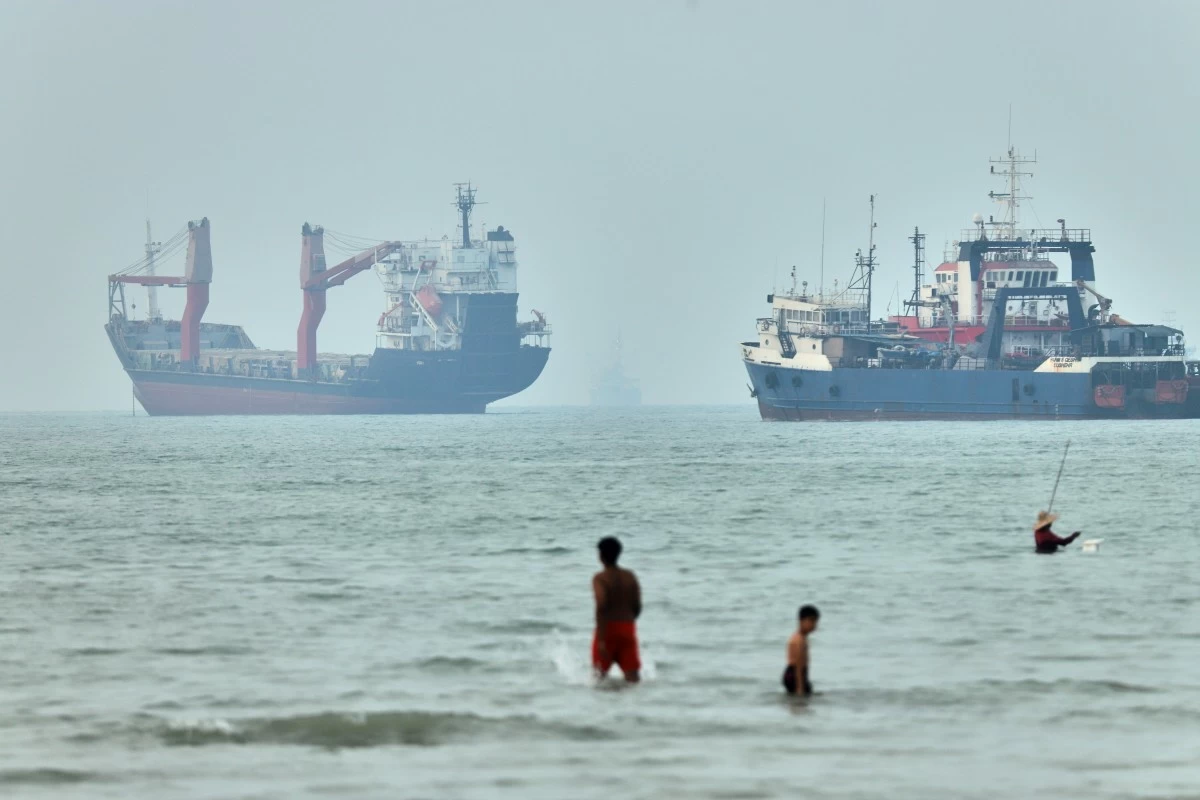
Children wade in the water with cargo ships at anchor in the background and a fisherman nearby, in the Strait of Hormuz off Bandar Abbas, Iran, Tuesday, June 30, 2026. (Amirhosein Khorgooi/ISNA via AP)

The Philippines is among the economies hardest hit by the prolonged Middle East conflict, but it could emerge as a beneficiary once the Strait of Hormuz reopens and global oil shipments normalize, according to think tank Oxford Economics.

In a July 22 report, Oxford Economics senior emerging market (EM) economist Evghenia Sleptsova said a durable reopening of the strait would ease pressure on sovereigns through lower energy import costs, restored trade flows, improved logistics, and a fading geopolitical risk premium.

Oxford Economics estimated that reopening the strait could improve the Philippines’ sovereign risk profile by the equivalent of 0.7 credit-rating notch, reflecting the unwinding of crisis-related pressures while the country’s investment-grade buffer remains preserved.

However, the Philippines could suffer an additional deterioration equivalent to 1.1 credit-rating notches if the strait remains closed through the end of 2027.

Oxford Economics said one credit-rating notch is equivalent to about 0.3 percentage points (ppts) in its sovereign risk tool (SRT) index.

The think tank identified the Philippines, Pakistan, Ghana, Mozambique, Namibia, Kenya, Tunisia, and Bangladesh as among the economies closest to the center of vulnerability, with downside deterioration ranging from roughly 0.7 to 1.4 credit-rating notches.

These economies are particularly exposed because of their dependence on imported energy, thin foreign exchange (forex) reserves, sizable United States (US) dollar-denominated liabilities, and limited fiscal space.

For the Philippines and Bangladesh, Oxford Economics said the “lack of a domestic energy offset” is the dominant source of vulnerability.

Across regions, Southeast Asia is the second-most exposed to a prolonged closure after Sub-Saharan Africa, with sovereign risk deterioration averaging about 0.8 credit-rating notches. Oxford Economics attributed the region’s exposure to its dependence on imported energy and limited fiscal buffers, identifying the Philippines, Pakistan, and Bangladesh among the hardest-hit economies.

Under the downside scenario, the strait would remain largely closed through the end of 2027, pushing Brent crude oil prices to around $131 per barrel and global inflation three ppts above the baseline.

The scenario also assumes that the US Federal Reserve (Fed) would tighten monetary policy in the fourth quarter of 2026 and that the US dollar would strengthen by around 10 percent, raising the cost of servicing dollar-denominated EM debt.

Oxford Economics said inflation would remain the primary channel through which the prolonged disruption would worsen sovereign risk, alongside currency weakness, higher financing costs, deteriorating fiscal positions, and pressure on external accounts.

By contrast, a reopening would gradually release pressure accumulated during the closure by lowering supply premiums and freight and insurance costs while allowing energy inventories to be rebuilt.

Among energy importers, India, Turkey, and Egypt would record the largest improvement, estimated at 1.7, 1.4, and 1.2 credit-rating notches, respectively. Pakistan and the Philippines would post more modest improvements of 0.6 and 0.7 credit-rating notch, respectively.

The report said the downside scenario would not trigger a broad economic crisis but would widen the gap between oil-exporting and oil-importing economies.

The Philippines has been under a state of national energy emergency since March under Executive Order (EO) No. 110 due to oil supply disruptions and price shocks caused by the Middle East conflict. - Danielle T. Bayani

Related Tags

Oxford Economics Strait of Hormuz Middle East war oil prices oil supply credit ratings
ADVERTISEMENT
.most-popular .layout-ratio{ padding-bottom: 79.13%; } @media (min-width: 768px) and (max-width: 1024px) { .widget-title { font-size: 15px !important; } }

{{ articles_filter_1561_widget.title }}

.most-popular .layout-ratio{ padding-bottom: 79.13%; } @media (min-width: 768px) and (max-width: 1024px) { .widget-title { font-size: 15px !important; } }

{{ static_articles_1562_widget.title }}

.most-popular .layout-ratio{ padding-bottom: 79.13%; } @media (min-width: 768px) and (max-width: 1024px) { .widget-title { font-size: 15px !important; } }

{{ articles_filter_1563_widget.title }}

{{ articles_filter_1564_widget.title }}

.mb-article-details { position: relative; } .mb-article-details .article-body-preview, .mb-article-details .article-body-summary{ font-size: 17px; line-height: 30px; font-family: "Libre Caslon Text", serif; color: #000; } .mb-article-details .article-body-preview iframe , .mb-article-details .article-body-summary iframe{ width: 100%; margin: auto; } .read-more-background { background: linear-gradient(180deg, color(display-p3 1.000 1.000 1.000 / 0) 13.75%, color(display-p3 1.000 1.000 1.000 / 0.8) 30.79%, color(display-p3 1.000 1.000 1.000) 72.5%); position: absolute; height: 200px; width: 100%; bottom: 0; display: flex; justify-content: center; align-items: center; padding: 0; } .read-more-background a{ color: #000; } .read-more-btn { padding: 17px 45px; font-family: Inter; font-weight: 700; font-size: 18px; line-height: 16px; text-align: center; vertical-align: middle; border: 1px solid black; background-color: white; } .hidden { display: none; }
function initializeAllSwipers() { // Get all hidden inputs with cms_article_id document.querySelectorAll('[id^="cms_article_id_"]').forEach(function (input) { const cmsArticleId = input.value; const articleSelector = '#article-' + cmsArticleId + ' .body_images'; const swiperElement = document.querySelector(articleSelector); if (swiperElement && !swiperElement.classList.contains('swiper-initialized')) { new Swiper(articleSelector, { loop: true, pagination: false, navigation: { nextEl: '#article-' + cmsArticleId + ' .swiper-button-next', prevEl: '#article-' + cmsArticleId + ' .swiper-button-prev', }, }); } }); } setTimeout(initializeAllSwipers, 3000); const intersectionObserver = new IntersectionObserver( (entries) => { entries.forEach((entry) => { if (entry.isIntersecting) { const newUrl = entry.target.getAttribute("data-url"); if (newUrl) { history.pushState(null, null, newUrl); let article = entry.target; // Extract metadata const author = article.querySelector('.author-section').textContent.replace('By', '').trim(); const section = article.querySelector('.section-info ').textContent.replace(' ', ' '); const title = article.querySelector('.article-title h1').textContent; // Parse URL for Chartbeat path format const parsedUrl = new URL(newUrl, window.location.origin); const cleanUrl = parsedUrl.host + parsedUrl.pathname; // Update Chartbeat configuration if (typeof window._sf_async_config !== 'undefined') { window._sf_async_config.path = cleanUrl; window._sf_async_config.sections = section; window._sf_async_config.authors = author; } // Track virtual page view with Chartbeat if (typeof pSUPERFLY !== 'undefined' && typeof pSUPERFLY.virtualPage === 'function') { try { pSUPERFLY.virtualPage({ path: cleanUrl, title: title, sections: section, authors: author }); } catch (error) { console.error('ping error', error); } } // Optional: Update document title if (title && title !== document.title) { document.title = title; } } } }); }, { threshold: 0.1 } ); function showArticleBody(button) { const article = button.closest("article"); const summary = article.querySelector(".article-body-summary"); const body = article.querySelector(".article-body-preview"); const readMoreSection = article.querySelector(".read-more-background"); // Hide summary and read-more section summary.style.display = "none"; readMoreSection.style.display = "none"; // Show the full article body body.classList.remove("hidden"); } document.addEventListener("DOMContentLoaded", () => { let loadCount = 0; // Track how many times articles are loaded const offset = [1, 2, 3, 4, 5, 6, 7, 8, 9, 10]; // Offset values const currentUrl = window.location.pathname.substring(1); let isLoading = false; // Prevent multiple calls if (!currentUrl) { console.log("Current URL is invalid."); return; } const sentinel = document.getElementById("load-more-sentinel"); if (!sentinel) { console.log("Sentinel element not found."); return; } function isSentinelVisible() { const rect = sentinel.getBoundingClientRect(); return ( rect.top < window.innerHeight && rect.bottom >= 0 ); } function onScroll() { if (isLoading) return; if (isSentinelVisible()) { if (loadCount >= offset.length) { console.log("Maximum load attempts reached."); window.removeEventListener("scroll", onScroll); return; } isLoading = true; const currentOffset = offset[loadCount]; window.loadMoreItems().then(() => { let article = document.querySelector('#widget_1690 > div:nth-last-of-type(2) article'); intersectionObserver.observe(article) loadCount++; }).catch(error => { console.error("Error loading more items:", error); }).finally(() => { isLoading = false; }); } } window.addEventListener("scroll", onScroll); });

Sign up by email to receive news.