

ADVERTISEMENT

Brisbane 2032 countdown clock sparks venue timeline questions

Published Jul 23, 2026 01:57 pm

At A Glance

  • Schrinner didn't miss a beat and the bird moved off before the big digital Omega clock officially started counting down Thursday, July 23, in the downtown Queen Street mall.
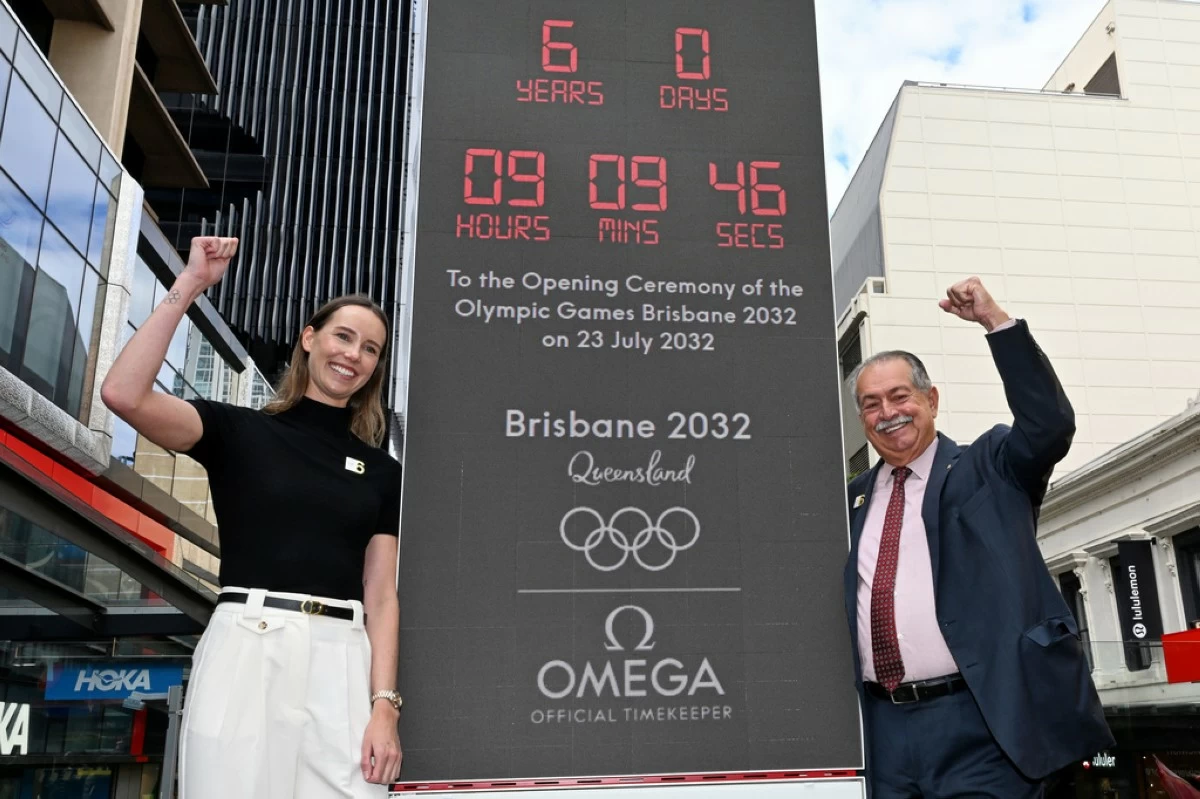
Australian Olympian Emma McKeon, left, and Brisbane 2032 Organising Committee President Andrew Liveris pose at the unveiling of the count-down clock marking six years until the Brisbane 2032 Olympics, in Brisbane, Australia, Thursday, July 23, 2026. (Darren England/AAP Image via AP)
BRISBANE, Australia (AP) — A pesky native bird appeared on the podium almost on cue as organizers prepared to unveil a countdown clock marking six years to go until the 2032 Olympics.
Lord Mayor Adrian Schrinner noted the timely white ibis in his welcoming remarks, joking with the crowd that it wouldn't be an event in Brisbane without the appearance of a “bin chicken,” as the bird is colloquially known.
There's a small, humorous push locally for the ibis to become a mascot for the Brisbane Games rather than one of Australia's more widely known native animals such as the kangaroo or the koala.
Schrinner didn't miss a beat and the bird moved off before the big digital Omega clock officially started counting down Thursday, July 23, in the downtown Queen Street mall.
That was a matter of hours after the Games Independent Infrastructure and Coordination Authority published revamped designs for the National Aquatic Center that will host Olympic events.
A ticking timeline
The new clock put even more emphasis on the diminishing time for construction for the Olympics, with no major works yet underway on the 3.6 billion Australian dollar ($2.6 billion) main stadium almost five years after Brisbane was awarded rights to the Summer Games.
Andrew Liveris, president of the Brisbane 2032 organizing committee, said there's no cause for panic.
“Six years is perfectly fine in construction, even under stress conditions,” he said. “I’m very confident that the contingencies are built (in) to allow that to happen.”
Liveris said he briefed IOC president Kirsty Coventry as recently as Monday in New York, in the wake of the World Cup final.
“We had a long conversation about timelines, venues, sports, and we’re confident it’s not 6 minutes to midnight,” he said.
The International Olympic Committee last year backed the Queensland government’s revised venue plan after several false starts, saying the Brisbane Games were “on the right path.”
There are still groups opposed to building major sports venues in the downtown parklands, and more general concern over rising costs of staging the Games.
GIICA, the coordination authority, only took over possession of the Victoria Park site for the 63,000-seat main stadium last month, after police removed protesters.
Questions over aquatic center revamp
It won't get control of the nearby site for the aquatic venue until September. Organizers haven't revealed if the temporary Olympic capacity — initially projected to be 25,000 — for the aquatic center had been scaled down to avoid cost blowouts.
Whatever that temporary capacity is, Schrinner said the legacy outcome — a permanent 8,000-seat venue — would be “fantastic.”
The Queensland state government, which is the major backer of the 2032 Olympic and Paralympic Games with support from the federal and local governments, sent the original concept for the aquatics venue back to planning for budgetary reasons.
The Queensland “government is doing the responsible thing, in these conditions and changing costs,” Schrinner said. “You have to make adjustments to the plan, and that’s exactly what’s happening, it’s a responsible thing to do.”
More than a dozen new sports venues are in the pipeline, including a contentious rowing center in Rockhampton, a coastal city in Central Queensland. Critics argue the impact of tidal flow and crocodile habitat in the Fitzroy River make it unsuitable to host Olympic events.
Liveris said all venues were still going through validation reporting, including rowing.
“Right now we’ve had no red lights and some very good greens, and a couple of yellows,” he said. “And they’re being worked on for later this year.”
Liveris said he was preparing a revised “bottom-up budget” to present early next year, after the IOC has finalized the sports program.

Related Tags

2032 Brisbane Olympics Olympics LA 2028
ADVERTISEMENT
.most-popular .layout-ratio{ padding-bottom: 79.13%; } @media (min-width: 768px) and (max-width: 1024px) { .widget-title { font-size: 15px !important; } }

{{ articles_filter_1561_widget.title }}

.most-popular .layout-ratio{ padding-bottom: 79.13%; } @media (min-width: 768px) and (max-width: 1024px) { .widget-title { font-size: 15px !important; } }

{{ static_articles_1562_widget.title }}

.most-popular .layout-ratio{ padding-bottom: 79.13%; } @media (min-width: 768px) and (max-width: 1024px) { .widget-title { font-size: 15px !important; } }

{{ articles_filter_1563_widget.title }}

{{ articles_filter_1564_widget.title }}

.mb-article-details { position: relative; } .mb-article-details .article-body-preview, .mb-article-details .article-body-summary{ font-size: 17px; line-height: 30px; font-family: "Libre Caslon Text", serif; color: #000; } .mb-article-details .article-body-preview iframe , .mb-article-details .article-body-summary iframe{ width: 100%; margin: auto; } .read-more-background { background: linear-gradient(180deg, color(display-p3 1.000 1.000 1.000 / 0) 13.75%, color(display-p3 1.000 1.000 1.000 / 0.8) 30.79%, color(display-p3 1.000 1.000 1.000) 72.5%); position: absolute; height: 200px; width: 100%; bottom: 0; display: flex; justify-content: center; align-items: center; padding: 0; } .read-more-background a{ color: #000; } .read-more-btn { padding: 17px 45px; font-family: Inter; font-weight: 700; font-size: 18px; line-height: 16px; text-align: center; vertical-align: middle; border: 1px solid black; background-color: white; } .hidden { display: none; }
function initializeAllSwipers() { // Get all hidden inputs with cms_article_id document.querySelectorAll('[id^="cms_article_id_"]').forEach(function (input) { const cmsArticleId = input.value; const articleSelector = '#article-' + cmsArticleId + ' .body_images'; const swiperElement = document.querySelector(articleSelector); if (swiperElement && !swiperElement.classList.contains('swiper-initialized')) { new Swiper(articleSelector, { loop: true, pagination: false, navigation: { nextEl: '#article-' + cmsArticleId + ' .swiper-button-next', prevEl: '#article-' + cmsArticleId + ' .swiper-button-prev', }, }); } }); } setTimeout(initializeAllSwipers, 3000); const intersectionObserver = new IntersectionObserver( (entries) => { entries.forEach((entry) => { if (entry.isIntersecting) { const newUrl = entry.target.getAttribute("data-url"); if (newUrl) { history.pushState(null, null, newUrl); let article = entry.target; // Extract metadata const author = article.querySelector('.author-section').textContent.replace('By', '').trim(); const section = article.querySelector('.section-info ').textContent.replace(' ', ' '); const title = article.querySelector('.article-title h1').textContent; // Parse URL for Chartbeat path format const parsedUrl = new URL(newUrl, window.location.origin); const cleanUrl = parsedUrl.host + parsedUrl.pathname; // Update Chartbeat configuration if (typeof window._sf_async_config !== 'undefined') { window._sf_async_config.path = cleanUrl; window._sf_async_config.sections = section; window._sf_async_config.authors = author; } // Track virtual page view with Chartbeat if (typeof pSUPERFLY !== 'undefined' && typeof pSUPERFLY.virtualPage === 'function') { try { pSUPERFLY.virtualPage({ path: cleanUrl, title: title, sections: section, authors: author }); } catch (error) { console.error('ping error', error); } } // Optional: Update document title if (title && title !== document.title) { document.title = title; } } } }); }, { threshold: 0.1 } ); function showArticleBody(button) { const article = button.closest("article"); const summary = article.querySelector(".article-body-summary"); const body = article.querySelector(".article-body-preview"); const readMoreSection = article.querySelector(".read-more-background"); // Hide summary and read-more section summary.style.display = "none"; readMoreSection.style.display = "none"; // Show the full article body body.classList.remove("hidden"); } document.addEventListener("DOMContentLoaded", () => { let loadCount = 0; // Track how many times articles are loaded const offset = [1, 2, 3, 4, 5, 6, 7, 8, 9, 10]; // Offset values const currentUrl = window.location.pathname.substring(1); let isLoading = false; // Prevent multiple calls if (!currentUrl) { console.log("Current URL is invalid."); return; } const sentinel = document.getElementById("load-more-sentinel"); if (!sentinel) { console.log("Sentinel element not found."); return; } function isSentinelVisible() { const rect = sentinel.getBoundingClientRect(); return ( rect.top < window.innerHeight && rect.bottom >= 0 ); } function onScroll() { if (isLoading) return; if (isSentinelVisible()) { if (loadCount >= offset.length) { console.log("Maximum load attempts reached."); window.removeEventListener("scroll", onScroll); return; } isLoading = true; const currentOffset = offset[loadCount]; window.loadMoreItems().then(() => { let article = document.querySelector('#widget_1690 > div:nth-last-of-type(2) article'); intersectionObserver.observe(article) loadCount++; }).catch(error => { console.error("Error loading more items:", error); }).finally(() => { isLoading = false; }); } } window.addEventListener("scroll", onScroll); });

Sign up by email to receive news.