








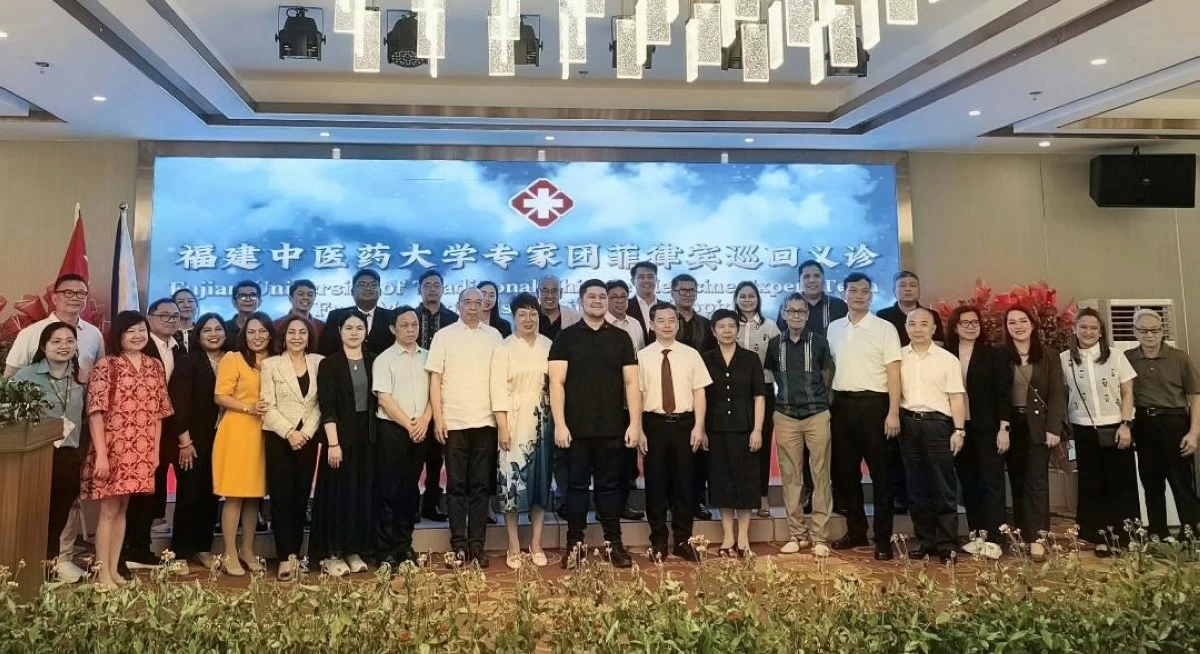
OFFICIALS and a traditional Chinese medicine delegation from Fujian, China, are in Davao City for a healthcare cooperation initiative.
DAVAO CITY – Davao City Vice Mayor Rodrigo Duterte II and members of the City Council welcomed officials and a traditional Chinese medicine delegation from Fujian, China, during a reception on Tuesday, July 21, as part of a healthcare cooperation initiative.
The reception was hosted by Consul General Zhao Xiuzhen of the Consulate General of China in Davao.
According to the City Council, they are staying from July 21 to 23 for a three-day healthcare cooperation visit.
The delegation will provide free TCM consultations to residents while meeting local government officials and healthcare professionals to exchange medical knowledge, promote cultural understanding, and strengthen healthcare cooperation.
The Chinese Consulate in Davao said the delegation will also provide free services, including acupuncture, Chinese herbal medicine, and Tuina, a therapeutic Chinese massage known for promoting healing, pain relief, and overall wellness.
Duterte thanked the Chinese Consulate in Davao and the visiting medical team for extending free healthcare services and sharing their expertise with Davaoeños.
The Vice Mayor added that the initiative strengthens the longstanding friendship between the Philippines and China by promoting healthcare collaboration, cultural exchange, and people-to-people ties.
Duterte said the visit also reflects both sides' shared commitment to improving public health, deepening mutual understanding, and exploring future opportunities for cooperation that will benefit the people of Davao City.
Meanwhile, Davao City continues to attract international attention and gain growing opportunities for foreign partnerships and investments following its participation in the Green Empowerment Seminar for ASEAN Countries in Beijing, China.
The seminar was recently attended by Councilor Radge Ibuyan, chairperson of the Committee on Government Enterprises and Privatization, and Councilor Temujin Ocampo, chairperson of the Environment and Natural Resources, among other city officials.
Ibuyan said the seminar underscored the government's role in strengthening the local economy by supporting micro, small, and medium enterprises, and empowering people through livelihood programs, skills training, job opportunities, and market access.
"We saw how government properties and public spaces can be used for themed fairs, exhibits, pop-up markets, and business events there," Ibuyan said, adding that Davao City could do the same here, where MSMEs can promote and sell their products.
By maximizing the government-owned properties for such activities, the councilor said, this would help local businesses build their brands, generate additional revenue for the city government, and contribute to the local economy's growth.
He said the seminar also allowed participants to exchange ideas and best practices with delegates from Malaysia, Laos, Thailand, China, South America, the Caribbean, Africa, and other ASEAN countries.
Ibuyan said one of the key lessons shared by participating countries was the importance of supporting local products while ensuring that economic development goes hand-in-hand with environmental protection.
"We do not have to sacrifice nature to achieve development. Both can play important roles at the same time by ensuring that economic progress goes hand-in-hand with environmental sustainability," he said.
Ibuyan said the Chinese government organized the seminar through its National Forestry and Grassland Administration to discuss tourism, environmental initiatives, and economic opportunities.
During the event, the councilor said he delivered a lecture on the Philippines and Davao City's economic background, highlighting the city's investment opportunities, strategic economic growth, and institutional development.
He said many foreign delegates initially associate the Philippines with Metro Manila, allowing Davao City to present itself as a gateway to Mindanao and an attractive destination for trade, investments, and business partnerships.
"We emphasize that Davao City has a stable local government, a strong economy, and a high growth rate. We also tell them that the city is open to investments, trade, and economic partnerships," Ibuyan said.