






Manila Bulletin
 Business
Banking & Finance
Visa-powered Landbank cards set to overhaul procurement in 2,000 agencies
Business
Banking & Finance
Visa-powered Landbank cards set to overhaul procurement in 2,000 agencies
Business
Banking & Finance
Visa-powered Landbank cards set to overhaul procurement in 2,000 agencies
Visa-powered Landbank cards set to overhaul procurement in 2,000 agencies
By Derco Rosal
Published Jul 21, 2026 02:35 pm


At A Glance
- Global digital payments firm Visa and the Land Bank of the Philippines (Landbank) are aggressively targeting to onboard a total of 2,000 government agencies onto its freshly launched expense management system (EMS) by year-end, enhancing visibility into public spending.
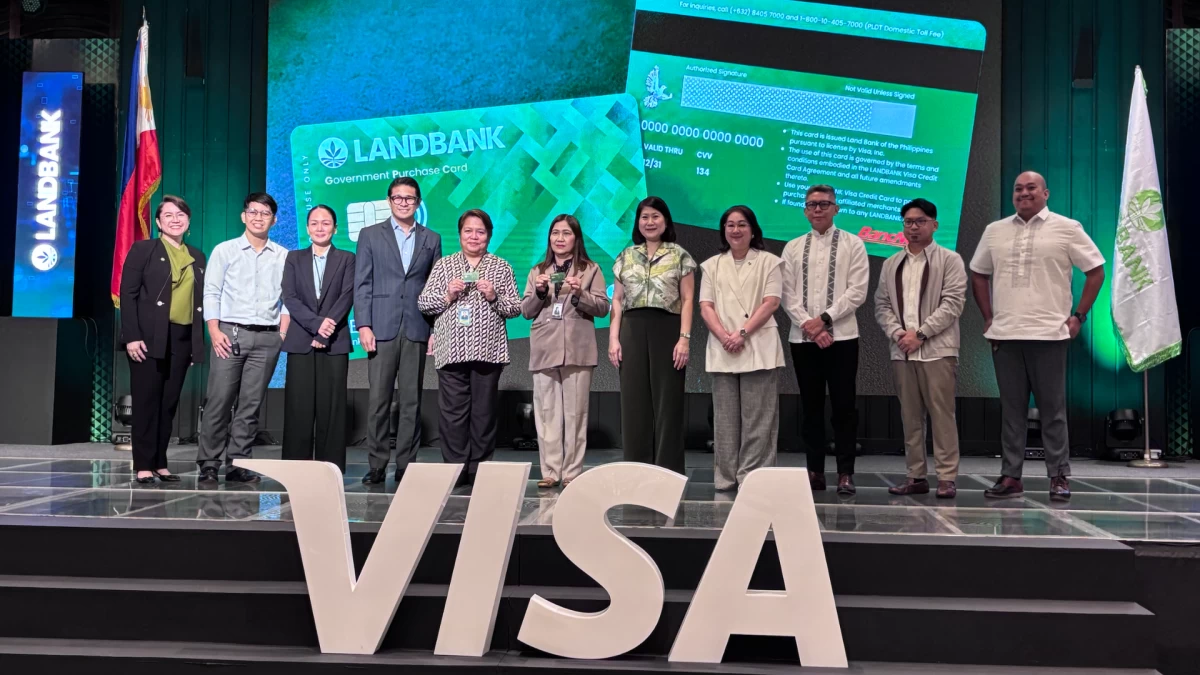
Executives from Land Bank of the Philippines and Visa present the upgraded Government Purchase Card (GPC) during its official launch. The Visa-powered Expense Management System aims to automate public spending, eliminate paper-based cash advances, and enforce strict fiscal controls across 2,000 targeted government agencies by the end of the year. (Photo by Derco Rosal I Manila Bulletin)
Visa and Land Bank of the Philippines (Landbank) are targeting a nearly twentyfold expansion of their digital expense management platform by the end of the year, aiming to bring 2,000 government agencies onto a system designed to automate public spending and curb improper outlays.
During the launch of the Government Purchase Card (GPC), Landbank Department Manager Joseph B. Del Valle said the state-run lender is eyeing a dramatic increase in onboarded state agencies—scaling up from the current 107.
The GPC functions like a corporate credit card for government agencies’ low-value purchases.
“We’re very positive that many agencies have already onboarded—107, to be exact. Our current target is to increase that to about 2,000,” Del Valle said. Nearly 800 cards have been issued so far, mostly to agency heads and senior officials.
According to Landbank, the Bureau of the Treasury (BTr) and its 17 regional offices were the initial adopters. However, the bank is now targeting high-spending sectors—such as healthcare and the Armed Forces of the Philippines (AFP)—to streamline their procurement.
Landbank Executive Vice President Marilou Villafranca noted that while purchase cards have existed in some form since 2023, this new iteration introduces the Visa-powered Expense Management System (EMS), offering immediate visibility and automated reconciliation that were previously unavailable.
“What’s very unique about this implementation is what we call the EMS,” Visa Philippines Country Manager Jeffrey Navarro said. “It captures transactions in real time, enables reconciliation, and at the same time provides governance and visibility over all spending.”
Villafranca, who heads Landbank’s Branch Banking Group, noted that the card brings “efficiency, transparency, and speed” to government accounting operations.
Landbank First Vice President Kris Cuevas, head of the Retail Banking Group, highlighted the elimination of cumbersome manual processes, such as paper-based cash advances and liquidations.
According to Navarro, the joint initiative aligns with the national government’s digitization agenda by extending digital tools beyond consumer payments into the operational side of public service.
He emphasized that the platform serves as more than just a payment method. “It’s a payment tool, it’s a productivity tool—it’s designed to improve efficiency, strengthen financial control, and really give government agencies more visibility over their spend.”
To maintain strict fiscal discipline, the GPC allows for granular control. Navarro explained that the card functions as a “customizable credit card,” allowing agencies to restrict usage strictly to authorized merchant categories.
“If you use it with an unauthorized [merchant], it will be rejected,” Navarro added.
Under Budget Circular 2025-1, eligible expenditures cover travel-related costs, hotel stays, fuel and vehicle expenses, software and digital services, representation expenses, and other miscellaneous low-value purchases.
Depending on the program code, government agencies are assigned a monthly limit ranging from ₱100,000 to ₱5 million.
Another notable feature of the EMS is that it provides an audit trail accessible to oversight bodies, such as the Commission on Audit (COA).
“This EMS can be viewed by COA. We can give them access, and they can see the spending,” Cuevas said. This real-time visibility ensures transactions are recorded as they happen, eliminating the delays typical of paper-based auditing.
While the GPC is a official government card, Landbank clarified that transactions are not restricted to the e-marketplace managed by the Department of Budget and Management (DBM).