







PEF releases necropsy findings on PH Eagle Sawaga-Dalwangan
Published Jul 20, 2026 04:33 pm


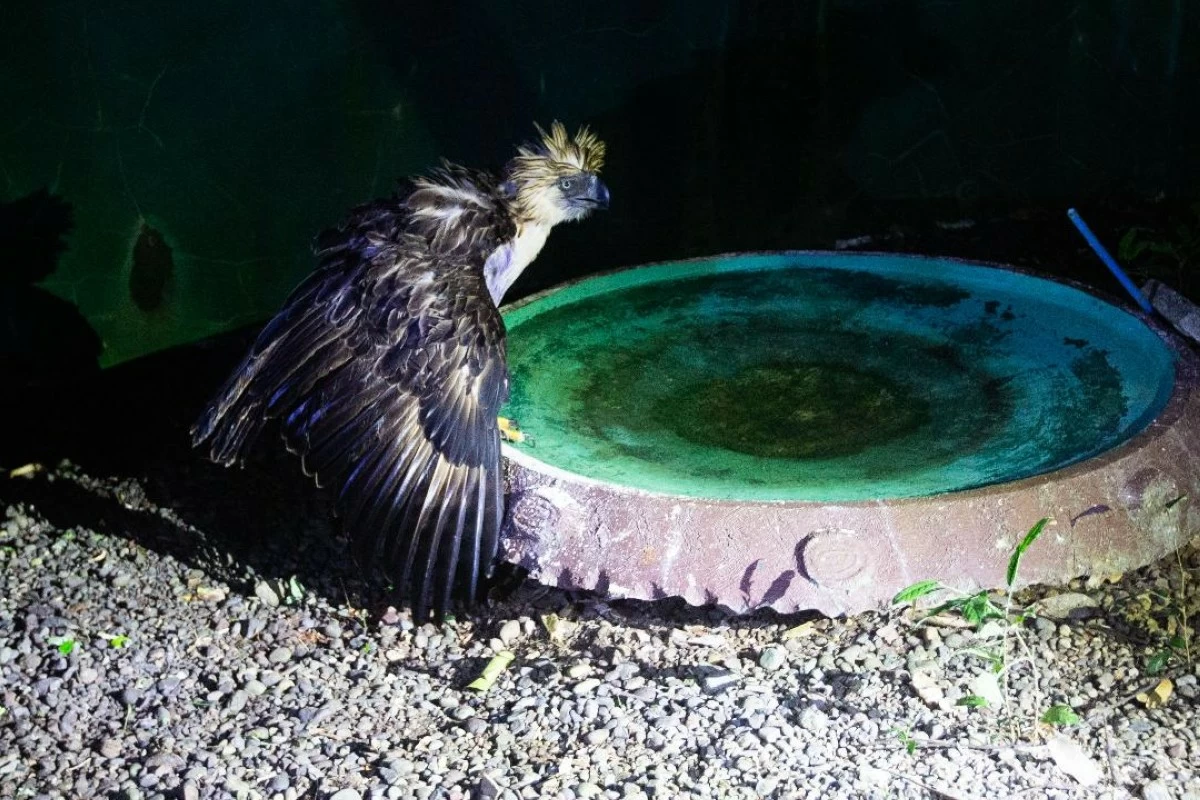
Sawaga-Dalwangan inside the isolation facility at the Philippine Eagle Center, Davao City on July 16. (Keith Bacongco)
DAVAO CITY – The Philippine Eagle Foundation has released initial findings on the necropsy on Philippine Eagle Sawaga-Dalwangan which passed away on Saturday, July 18, while undergoing rehabilitation.
In a statement, the PEF said that attending veterinarians observed that the eagle’s heart was thickened and unusually firm; her liver was enlarged; stomach was greatly enlarged, and contained a large amount of compacted prey fur.
“The initial examination found no evidence of new external trauma or internal bleeding,” it added.
However, the PEF clarified that these findings do not yet establish the cause of death as tissue samples from her organs have been collected for microscopic examination and further laboratory analysis.
The PEF announced the passing of Sawaga-Dalwangan on Saturday despite showing encouraging signs of recovery.
“Her wounds were healing, her hydration and appetite had improved, and she was displaying normal behaviors such as preening and casting food remains,” the PEF added.
The PEF said that an animal keeper discovered that the eagle was having seizures on Saturday morning.
Despite immediate emergency intervention, the PEF Said she passed away shortly after.
PEF consultant veterinarian Bayani Vandenbroeck said further laboratory tests are ongoing to determine the cause of the eagle's death.
But he recalled that the eagle was very weak when it was taken to his clinic all the way from Bukidnon late on July 3.
“The eagle’s presentation upon first arrival at the clinic – heavily soiled lower and ventral parts of the body and wings that were infested with maggots, extensive abrasions on the underside of the wings, and rope burns on the legs – all point towards evidence that the eagle was somehow tied by a rope and grounded for a significant time already,” said Vandenbroeck.
He added that soilage and wounds suggest that the eagle attempted to fly away but instead got pulled back to the ground. “There was no evidence of any bite wounds and there was no sign of any feathers that had been broken or pulled out. “
During the X-ray scan, veterinarians discovered airgun pellets lodged on the right wing and left thigh of the eagle.
The pellet on the wing was removed while the other on the thigh is buried deep in its muscles, requiring major surgery to be removed.
Vandebroeck said the pellets are proof that the eagle was hunted and shot on at least two separate occasions.
PEF Director of Operations Dr. Jayson Ibañez said that the two airgun pellets are not enough to bring down the eagle.
Ibañez recalled that they were able to rescue an eagle in Cotabato province in 1999 with nine airgun pellets in its body following an examination.
“Remarkably, only one pellet had a fresh entry wound. The other eight had already healed over, indicating that the eagle had survived repeated shootings over a long period before it was finally rescued,” he added.
This case, Ibañez emphasized, was a powerful example of the incredible resilience of Philippine Eagles and the persistent threat that indiscriminate shooting poses to the species.
From 2019 to 2024, the PEF rescued 23 eagles from the wild. Nine of the eagles sustained bullet wounds, eight trapped, and the rest were due to various causes.
The rescue of Sawaga-Dalwangan brought the number to 24. Today, fewer than 400 breeding pairs of the Philippine Eagle are believed to remain in the wild.