






Manila Bulletin
 Lifestyle
Arts and Culture
Conclusion hunting, family history, and campus of the absurd
Lifestyle
Arts and Culture
Conclusion hunting, family history, and campus of the absurd
Lifestyle
Arts and Culture
Conclusion hunting, family history, and campus of the absurd
Conclusion hunting, family history, and campus of the absurd
Published Jul 19, 2026 06:38 am


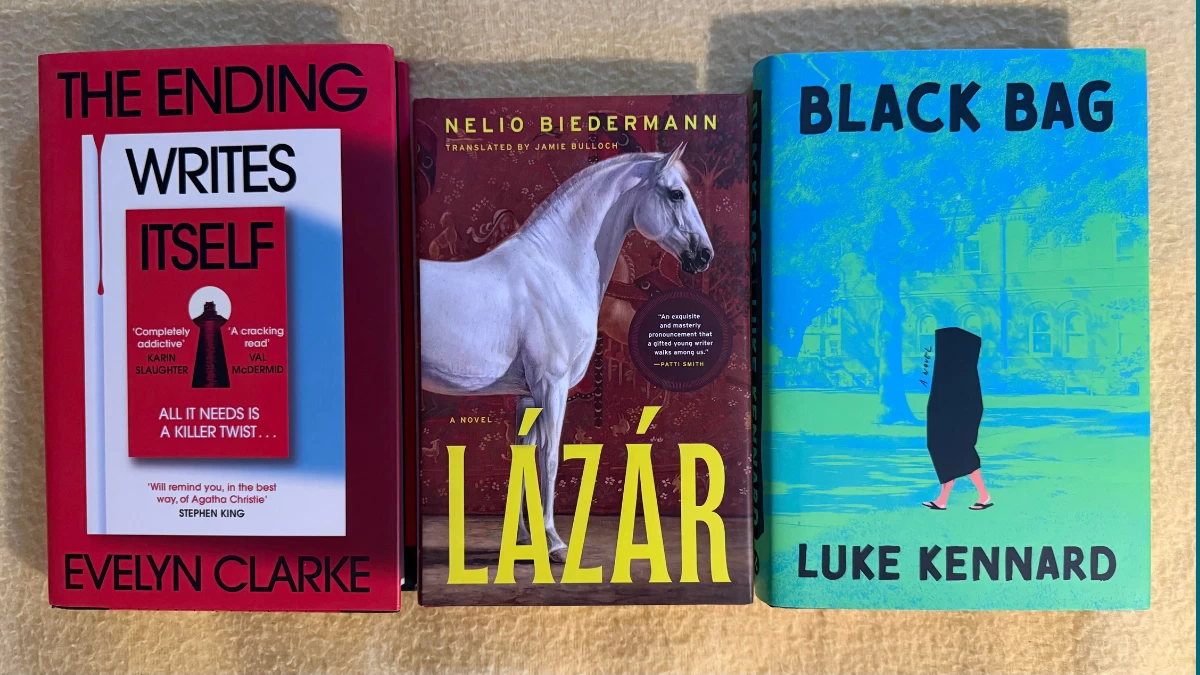
The three novels today cover several genres of fiction. One is a collaborative crime fiction work, the second would be considered a historical fiction/family saga, and the third is inspired by a real-life psychological experiment in Oregon in the late 1960s, relocated to England today.
'The Ending Writes Itself' by Evelyn Clarke
Author V.E. Schwab and screenwriter Cat Clarke collaborate on this locked-room mystery with a twist and collectively call themselves Evelyn Clarke. The premise is a doozy! Arthur Fletch is an icon of crime fiction. His by-invite-only weekend retreats on his private Scottish island are the stuff other writers dream of being invited to. Six struggling, midlist authors are invited for one such weekend, and upon their arrival, it's explained by Fletch’s powerful agent and editor that Fletch drowned the previous week, leaving behind an unfinished final Petrarch novel.
The challenge thrown down to the six is to write the book’s final pages for $2 million and a guaranteed three-book deal. One nagging question is why these six—only two of them work in the genre; one is in horror, the next is in young adult, one dabbles in sci-fi, and the last is a romance writer. All are assigned color-coded rooms with a typewriter and blank pages, and they’re asked to deposit all their devices in a safe that will only unlock after three days.
A send-up of classic mysteries and their tropes, this novel succeeds on the strength of the quirky characters it presents. Then there are the plot twists and turns that keep us off-balance and second-guessing where we are headed.
The backstories of our writers similarly add to the atmosphere and deepen our investment in their fates. Clarke does a good job of making every single one of them sympathetic in their own ways. We may have our favorites and suspect one of them to be the true villain, but the cards are kept close to the chest for much of the book, and we’re never quite sure of our own powers of deduction. More pertinent is whether this locked-room thriller is a one-off collaboration. I hope not, as I really enjoyed this first outing from the pair.
‘Lázár’ by Nelson Beidermann
“Lázár” is a vast multigenerational family story set against the modern history of 20th-century Hungary. The first amazing thing to get over with this work is that the author is only 23 years of age but has come up with such a mature first novel.
Our protagonist is Lajos, born at the dawn of the new century to Baron Sandor von Lázár and his wife Maria—or is he? It would seem a stable hand is his biological father. This is the history of a nation as seen through the lives of a single family, traversing a time when the Habsburg monarchy was in decline and mixing the realistic with the dreamlike and mystical.
It’s a modern version of magical realism, transposed to a Teutonic European setting. There’s an ancient castle on the edge of the forest to evoke the stories of the Brothers Grimm, but here, at one point, the castle is overrun by Nazis and Russians.
Is being a Lázár a miracle or a curse? Upon the death of Sandor, it is Lajos who assumes the role of baron, bringing his business acumen to preserving the family’s fortune. With his wife, Lilly, he has a son named Istvan, who talks to shadows as a young boy, and a daughter named Eva, who only wants to repudiate her blue blood.
While Lajos desires to reignite the old splendors of the family, the Second World War and the subsequent Russian occupation make that wishful thinking on his part. Istvan has his share of young love, not even realizing that his Matilda comes from a Jewish family.
In the latter quarter of the novel, the action shifts to Istvan and Lilly as they live through the Hungarian uprising and witness Russian tanks being brought in to quell dissent. There’s something dreamlike in the quality and style of the writing, and I’d be very interested to read what Beidermann comes up with after this polished debut.
‘Black Bag’ by Luke Kennard
An unorthodox psychological experiment that took place in Oregon in 1967 serves as the inspiration for this campus novel involving an out-of-work actor. He’s our narrator, and after an introduction that sets the scene in terms of his dire work situation and why he’d be clutching at straws, he accepts an offer from Dr. Blend, a university professor. The gig is to sit in a lecture hall throughout an entire semester, zipped inside an oversized black bag, with his head covered, and not make a sound.
Luke relocates his narrative to 2017 England, as Blend replicates the experiment to discover whether the original findings still hold true after half a century. It’s a half-cocked premise that holds so much promise; part SNL sketch, part Spike Jonze surreal film. A warped campus novel that’s markedly different from others in the genre. Can Kennard pull it off?
For much of the novel, rather than getting the reactions of the students, we’re brought along to witness the psychological journey our actor goes through. From first negating his own persona and identity, he becomes involved with a lady professor while remaining Black Bag. This raises the question of how love can be defined: Is it even possible to fall in love with this “person” who won’t remove the bag? Is this a crisis of masculinity and identity?
There’s a friend named Claudio, and his driving quest is to monetize the situation. There are totally unexpected consequences as the narrative chugs along. What we get is a novel that practically “punks” everyone and everything, from higher education to high technology, reality shows, and social experiments. It is clever and biting, but like many films, there is a third act that flags before picking up again in the home stretch.