ADVERTISEMENT

Radenta, Vantiq introduce Aegis for real time disaster management

Published Jul 17, 2026 11:07 am
Radenta Technologies, one of the country’s leading solutions integrators and Vantiq, a global leader in real-time AI orchestration, have just launched Aegis, a platform that forms a cohesive whole from a tangled web of disaster data.
Cities and municipalities deploy cameras, sensors, databases, and responders in times of calamities. However, these bits and pieces of information remain fragmented. Rich in data but poor in context. Officials are then forced to make decisions with incomplete, delayed statistics.
President of Radenta Technologies Randall Lozano has this to say, “Aegis brings clarity into chaos. Real city resilience is not about adding more sensors and cameras. It is about having real-time management layer that is built for how a specific locality works.”
The Aegis platform starts with what you already have like cameras, sensors, traffic systems, emergency hotline, CCTV, social media habits, and agency workflows. Aegis connects them and then adds the most important part, intelligence.
Most LGUs generate data every second. The question is who is connecting the dots? CCTV captures an incident. The footage sits unwatched. The flood sensor at a riverbank spike near a barangay. The disaster management office finds out 20 minutes later via a phone call. Traffic backs up after a road incident. The City Management Office and the Philippine National Police have different views. A public health alert is issued. Hospital and barangay health centers still coordinate manually.
Aegis integrates existing, disparate systems without ripping anything out. Merge incident-response platform across emergency hotline, CCTV, and social media. Add real-time dashboards, ticketing, and cross channel incident workflows. The outcome shows far broader citizen response capability using enhanced existing infrastructure.
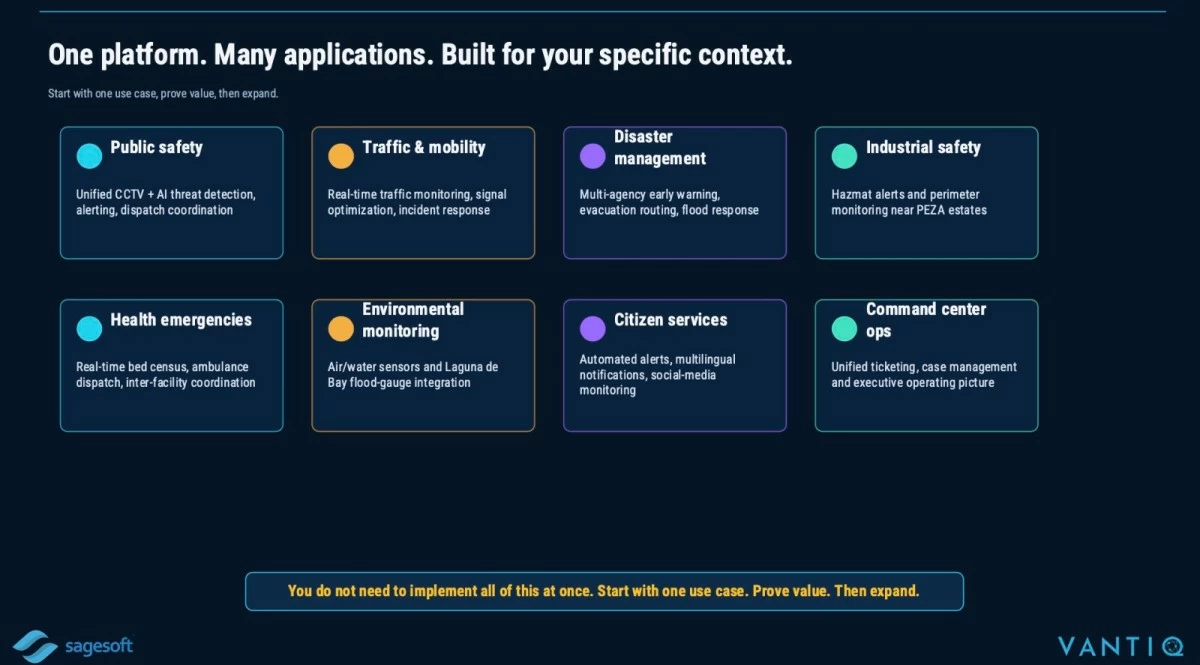
Aegis is one platform but with many applications built for specific content.
1. Public Safety – unified CCTV plus AI threat detection, alerting, dispatch coordination.
2. Traffic and Mobility – Real-time traffic monitoring, signal optimization, incident response.
3. Disaster Management – Multi Agency early warning, evacuation routing, flood response.
4. Emergency Response orchestration – Coordinating across essential public health, fire, and law enforcement agencies.
5. Environmental Monitoring – Air/water sensors and vicinity flood gauge integration.
6. Citizen Services – Automated alerts, multilingual notifications, social media monitoring, and the capability to send incident reports.
The above does not have to be used at all at once. Start with what is needed, and prove the value then expand. Raw information alone is not enough. The true power of an intelligent system lies in getting the right data to the right person at the right time.
Aegis gives results in months, not years. There is no need to replace what is existing and still get access to the latest developments in AI.
To summarize, Aegis does the following:
1. Enhance, not replace.
It sits on top of the existing infrastructure. CCTV, IoT, databases and the command center become inputs, not sunk costs. Technology should complement existing investments, not require a costly overhaul.
2. Speed to ROI.
Scope plus Business Requirements Documents (BRD) leads to Proof of Concept in about 4 weeks. Full implementation will take 4 to 5 months.
This is not like a 3-year modernization program. This is important considering LGU budget cycles and changing administration.
3. Model-agnostic AI
Works with AI models available today and evolves as the models improve. Uses proprietary models or public leaders such as OpenAI where needed. The LGU is not locked into one AI vendor while the market is moving.

Related Tags

Radenta
ADVERTISEMENT
.most-popular .layout-ratio{ padding-bottom: 79.13%; } @media (min-width: 768px) and (max-width: 1024px) { .widget-title { font-size: 15px !important; } }

{{ articles_filter_1561_widget.title }}

.most-popular .layout-ratio{ padding-bottom: 79.13%; } @media (min-width: 768px) and (max-width: 1024px) { .widget-title { font-size: 15px !important; } }

{{ static_articles_1562_widget.title }}

.most-popular .layout-ratio{ padding-bottom: 79.13%; } @media (min-width: 768px) and (max-width: 1024px) { .widget-title { font-size: 15px !important; } }

{{ articles_filter_1563_widget.title }}

{{ articles_filter_1564_widget.title }}

.mb-article-details { position: relative; } .mb-article-details .article-body-preview, .mb-article-details .article-body-summary{ font-size: 17px; line-height: 30px; font-family: "Libre Caslon Text", serif; color: #000; } .mb-article-details .article-body-preview iframe , .mb-article-details .article-body-summary iframe{ width: 100%; margin: auto; } .read-more-background { background: linear-gradient(180deg, color(display-p3 1.000 1.000 1.000 / 0) 13.75%, color(display-p3 1.000 1.000 1.000 / 0.8) 30.79%, color(display-p3 1.000 1.000 1.000) 72.5%); position: absolute; height: 200px; width: 100%; bottom: 0; display: flex; justify-content: center; align-items: center; padding: 0; } .read-more-background a{ color: #000; } .read-more-btn { padding: 17px 45px; font-family: Inter; font-weight: 700; font-size: 18px; line-height: 16px; text-align: center; vertical-align: middle; border: 1px solid black; background-color: white; } .hidden { display: none; }
function initializeAllSwipers() { // Get all hidden inputs with cms_article_id document.querySelectorAll('[id^="cms_article_id_"]').forEach(function (input) { const cmsArticleId = input.value; const articleSelector = '#article-' + cmsArticleId + ' .body_images'; const swiperElement = document.querySelector(articleSelector); if (swiperElement && !swiperElement.classList.contains('swiper-initialized')) { new Swiper(articleSelector, { loop: true, pagination: false, navigation: { nextEl: '#article-' + cmsArticleId + ' .swiper-button-next', prevEl: '#article-' + cmsArticleId + ' .swiper-button-prev', }, }); } }); } setTimeout(initializeAllSwipers, 3000); const intersectionObserver = new IntersectionObserver( (entries) => { entries.forEach((entry) => { if (entry.isIntersecting) { const newUrl = entry.target.getAttribute("data-url"); if (newUrl) { history.pushState(null, null, newUrl); let article = entry.target; // Extract metadata const author = article.querySelector('.author-section').textContent.replace('By', '').trim(); const section = article.querySelector('.section-info ').textContent.replace(' ', ' '); const title = article.querySelector('.article-title h1').textContent; // Parse URL for Chartbeat path format const parsedUrl = new URL(newUrl, window.location.origin); const cleanUrl = parsedUrl.host + parsedUrl.pathname; // Update Chartbeat configuration if (typeof window._sf_async_config !== 'undefined') { window._sf_async_config.path = cleanUrl; window._sf_async_config.sections = section; window._sf_async_config.authors = author; } // Track virtual page view with Chartbeat if (typeof pSUPERFLY !== 'undefined' && typeof pSUPERFLY.virtualPage === 'function') { try { pSUPERFLY.virtualPage({ path: cleanUrl, title: title, sections: section, authors: author }); } catch (error) { console.error('ping error', error); } } // Optional: Update document title if (title && title !== document.title) { document.title = title; } } } }); }, { threshold: 0.1 } ); function showArticleBody(button) { const article = button.closest("article"); const summary = article.querySelector(".article-body-summary"); const body = article.querySelector(".article-body-preview"); const readMoreSection = article.querySelector(".read-more-background"); // Hide summary and read-more section summary.style.display = "none"; readMoreSection.style.display = "none"; // Show the full article body body.classList.remove("hidden"); } document.addEventListener("DOMContentLoaded", () => { let loadCount = 0; // Track how many times articles are loaded const offset = [1, 2, 3, 4, 5, 6, 7, 8, 9, 10]; // Offset values const currentUrl = window.location.pathname.substring(1); let isLoading = false; // Prevent multiple calls if (!currentUrl) { console.log("Current URL is invalid."); return; } const sentinel = document.getElementById("load-more-sentinel"); if (!sentinel) { console.log("Sentinel element not found."); return; } function isSentinelVisible() { const rect = sentinel.getBoundingClientRect(); return ( rect.top < window.innerHeight && rect.bottom >= 0 ); } function onScroll() { if (isLoading) return; if (isSentinelVisible()) { if (loadCount >= offset.length) { console.log("Maximum load attempts reached."); window.removeEventListener("scroll", onScroll); return; } isLoading = true; const currentOffset = offset[loadCount]; window.loadMoreItems().then(() => { let article = document.querySelector('#widget_1690 > div:nth-last-of-type(2) article'); intersectionObserver.observe(article) loadCount++; }).catch(error => { console.error("Error loading more items:", error); }).finally(() => { isLoading = false; }); } } window.addEventListener("scroll", onScroll); });

Sign up by email to receive news.