






Manila Bulletin
 Philippines
National
Phivolcs warns of light ashfall amid ongoing ash emission at Mayon
Philippines
National
Phivolcs warns of light ashfall amid ongoing ash emission at Mayon
Philippines
National
Phivolcs warns of light ashfall amid ongoing ash emission at Mayon
Phivolcs warns of light ashfall amid ongoing ash emission at Mayon
Published Jul 17, 2026 11:39 am


At A Glance
- Phivolcs warned that weak winds prevailing over the volcano may carry volcanic ash toward communities south and east of Mayon.
- Phivolcs said the ash emission was caused by the continuing advance and collapse of the front of a new lava flow at the Mi-isi Gully on the volcano's southwestern flank.
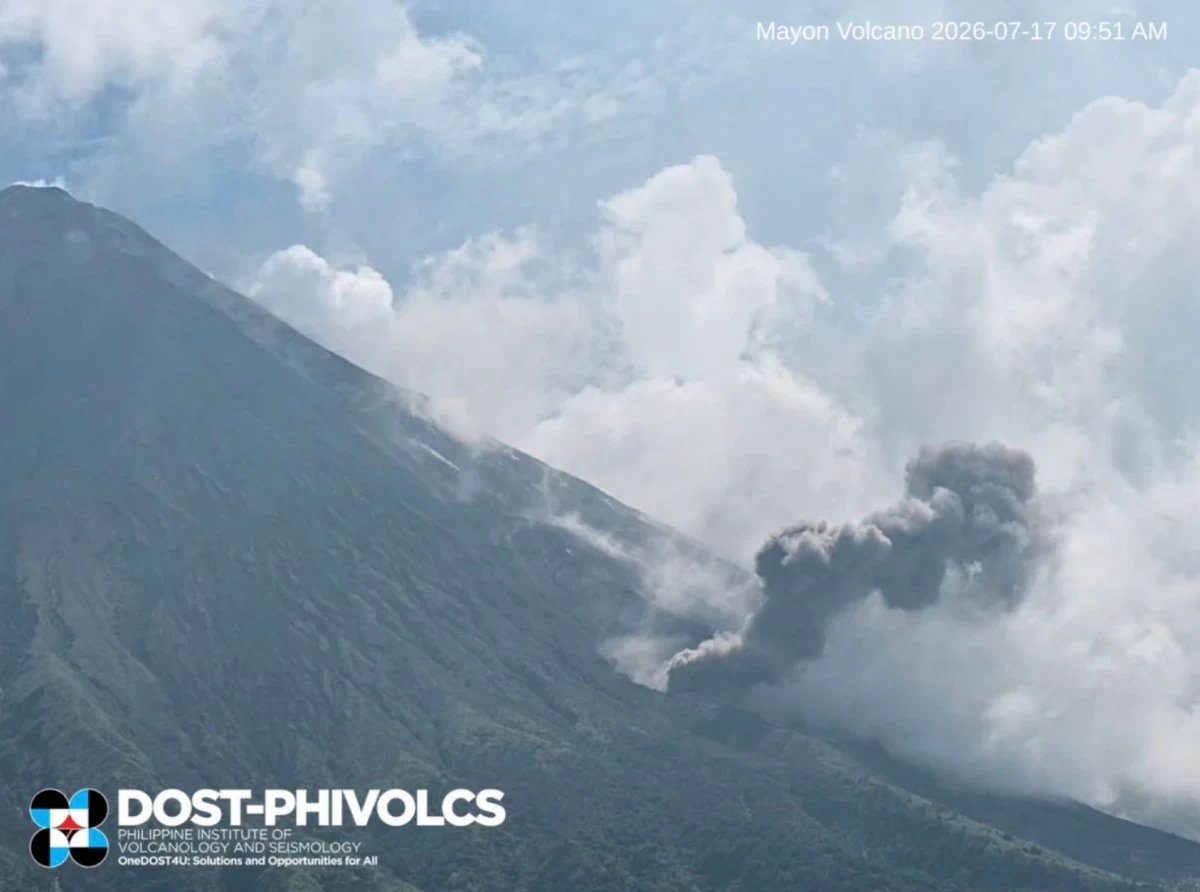
Ash rises from Mayon Volcano on Friday, July 17, as the front of a new lava flow advances and collapses along the Mi-isi Gully, generating continuous ash emission. The Philippine Institute of Volcanology and Seismology said weak winds may bring light ashfall to communities south and east of the volcano. Alert Level 3 remains in effect. (Photo courtesy of Phivolcs)
The Philippine Institute of Volcanology and Seismology (Phivolcs) warned on Friday, July 17, that communities south and east of Mayon Volcano may experience light ashfall as the active volcano continued to emit ash.
Phivolcs said the ash emission was caused by the continuing advance and collapse of the front of a new lava flow at the Mi-isi Gully on the volcano's southwestern flank.
Weak winds prevailing over the volcano may carry volcanic ash toward communities south and east of Mayon, the agency said.
Alert Level 3 remains in effect over the volcano, indicating a relatively high level of unrest and the possibility of a hazardous eruption.
In its latest 24-hour monitoring report, Phivolcs said Mayon continued to exhibit strombolian activity and lava effusion.
A strombolian activity refers to short explosive bursts that eject glowing volcanic material and produce brief lava fountains.
Phivolcs said lava flows extended about 3.8 kilometers along the Basud Gully, 3.2 kilometers along the Bonga Gully, and 2.1 kilometers along the Mi-isi Gully.
The agency also recorded 196 volcanic earthquakes, including 51 volcanic tremors lasting from five to 31 minutes.
It detected 251 rockfall events and 16 pyroclastic density current signals during the same monitoring period.
Sulfur dioxide emission remained elevated at an average of 4,814 tons per day based on measurements taken on July 16.
Phivolcs reminded the public that entry into the six-kilometer permanent danger zone remains prohibited due to the continuing threat of lava flows, rockfalls, pyroclastic density currents, ashfall, and other volcanic hazards.