






Manila Bulletin
 Philippines
National
Filipinos put AFP, PCG modernization first in protecting maritime rights, survey shows
Philippines
National
Filipinos put AFP, PCG modernization first in protecting maritime rights, survey shows
Philippines
National
Filipinos put AFP, PCG modernization first in protecting maritime rights, survey shows
Filipinos put AFP, PCG modernization first in protecting maritime rights, survey shows
Published Jul 15, 2026 03:14 pm


At A Glance
- Modernizing the Armed Forces of the Philippines (AFP) and PCG (Philippine Coast Guard) topped Filipinos' priorities for protecting the country's maritime rights, with 45 percent of respondents in an SWS survey choosing it as the government's foremost measure in defending the West Philippine Sea.
- The survey coincided with Defense Secretary Gilberto Teodoro Jr.'s push to raise defense spending to four percent of GDP from the current 1.3 percent to 1.4 percent, citing the need to strengthen the country's capability against external threats.
- Stratbase said Filipinos support both military modernization and stronger alliances as respondents also ranked closer defense cooperation with allies and like-minded countries among the government's top priorities in safeguarding Philippine maritime interests.
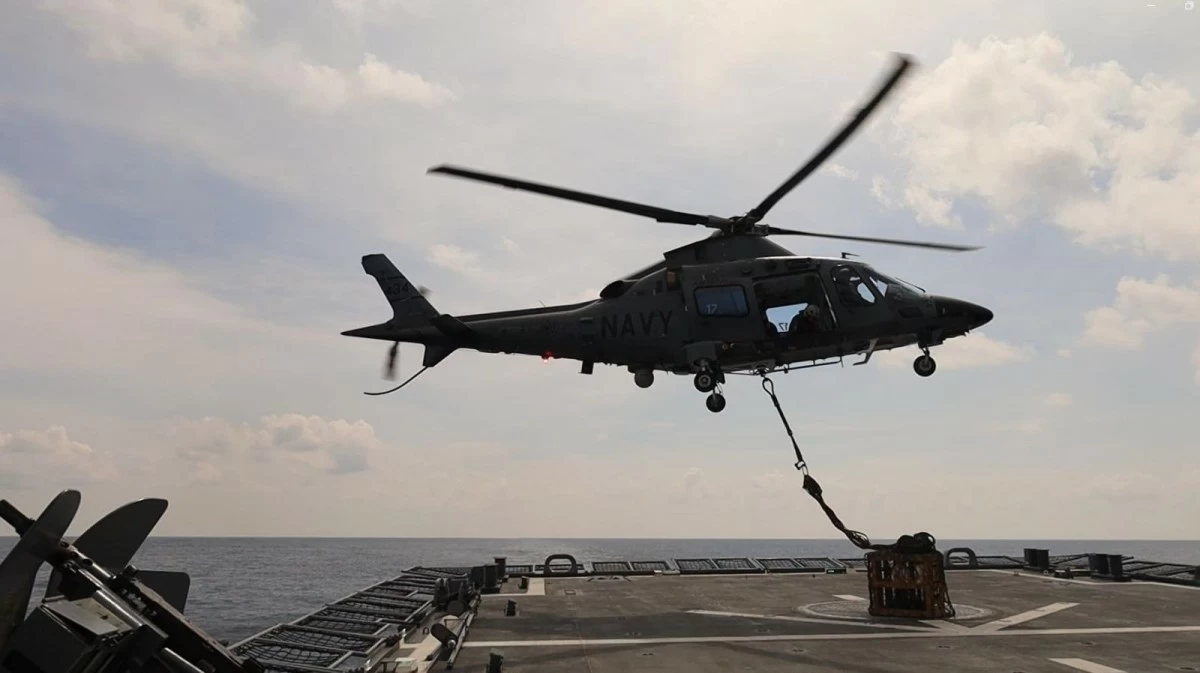
A Philippine Navy (PN) AW109 naval helicopter with tail number NH434 maneuvers to lay down a sling and net of external load during a Vertical Replenishment (VERTREP) operation involving the PN missile frigate BRP Antonio Luna (FFG15) and the United States Coast Guard Cutter Midgett (WMSL-757) in the vicinity of Bajo de Masinloc (Scarborough or Panatag Shoal) in the West Philippine Sea on May 30, 2026. (Photo: PN)
More Filipinos want the government to prioritize modernizing the Armed Forces of the Philippines (AFP) and the Philippine Coast Guard (PCG) over other security measures to protect the country's maritime rights, according to a Social Weather Stations (SWS) survey commissioned by the independent think tank Stratbase Group.
The Second Quarter 2026 survey found that 45 percent of Filipinos identified support for the AFP and PCG modernization programs as the government's top priority in defending the country's rights in the West Philippine Sea (WPS).
The survey asked respondents to identify their first and second preferred measures that the government should continue implementing to effectively defend the country's maritime rights.
Support for AFP and PCG modernization topped the first-choice responses across the country. It was selected by 47 percent of respondents in Luzon, 46 percent in the National Capital Region, 44 percent in the Visayas, and 39 percent in Mindanao.
Reinforcing alliances through maritime cooperative activities and military exercises with allies, friends and partners ranked second as a first-choice response with 33 percent. Another 22 percent preferred establishing defense and security agreements with like-minded countries.
The results were consistent with an earlier Pulse Asia survey commissioned by Stratbase in May, which found that 86 percent of Filipinos wanted the government to work with countries such as the United States, Japan, South Korea, Australia and Canada in defending the West Philippine Sea.
When respondents were asked to identify their second priority, reinforcing alliances emerged as the leading choice with 39 percent nationwide.
It drew 41 percent support in both the National Capital Region and the Visayas, 39 percent in Luzon and 37 percent in Mindanao.
Establishing defense and security agreements followed with 31 percent, while 30 percent selected continued modernization of the AFP and PCG as their second priority.
Support for modernization as a second choice was highest in Mindanao at 34 percent. It was followed by the Visayas with 30 percent, Luzon with 28 percent and the National Capital Region with 26 percent.
The poll was conducted from June 20 to 29, and used face-to-face interviews with 1,200 adult respondents nationwide. It had a margin of error of ±3 percent for national results and ±6 percent for Metro Manila, Balance Luzon, the Visayas and Mindanao at the 95 percent confidence level.
'Increase defense spending'
The survey coincided with the Department of National Defense (DND) Secretary Gilberto Teodoro Jr’s remarks that he was pushing to increase the country's defense spending to as much as four percent of the gross domestic product (GDP) to strengthen the country's capability against Chinese aggression and protect Philippine interests in the WPS.
At present, the country spends about 1.3 to 1.4 percent of GDP, based on estimates that include pensions and other military-related expenditures.
Stratbase Institute president Victor Andres “Dindo” Manhit said the results reflected growing public support for strengthening the country's own defense capability.
“The Filipino people understand that defending our maritime rights requires more than legal victories. It requires credible capabilities, resilient institutions, and sustained investment in the Armed Forces and the Philippine Coast Guard,” Manhit said on Wednesday, July 15.
“The survey shows that Filipinos recognize that our security begins with our ability to protect our sovereign rights and deter coercion in the West Philippine Sea,” he added.
Manhit said the results also showed that Filipinos viewed military modernization and stronger defense partnerships as complementary policies.
"Filipinos also recognize that credible defense is built on two pillars: a capable military and strong partnerships with like-minded countries. These are not competing approaches but complementary ones,” he said.
“As the security environment becomes more complex, the Philippines must continue investing in its own defense while deepening cooperation with allies who share our commitment to peace, stability, and international law,” he noted.
The findings also came days after the country marked the 10th anniversary of the 2016 arbitral ruling that invalidated China's sweeping claims in the South China Sea.
During a Stratbase conference commemorating the milestone, representatives from more than 30 foreign missions expressed support for the Philippines’ position in the WPS.
Ambassadors from Australia, Canada, the European Union, France, Germany, India, Japan, South Korea, New Zealand and the United Kingdom also signified their intention to deepen defense cooperation with Manila.