ADVERTISEMENT

Lenovo is building an Intelligent Command Center for FIFA World Cup 2026

An inside look at the technology giving FIFA a real-time operational picture of the most complex FIFA World Cup in history.

Published Jul 14, 2026 11:26 pm
This edition of FIFA World Cup will be unlike any tournament that has come before it. The tournament will feature 48 teams, 104 matches, 16 cities, and will span three countries. The logistical challenges of running an event at this scale are significant and require a fundamentally different approach from how major tournaments have been managed in the past. Lenovo is answering the call with its Intelligent Command Center (ICC).
What exactly is Lenovo’s Intelligent Command Center?
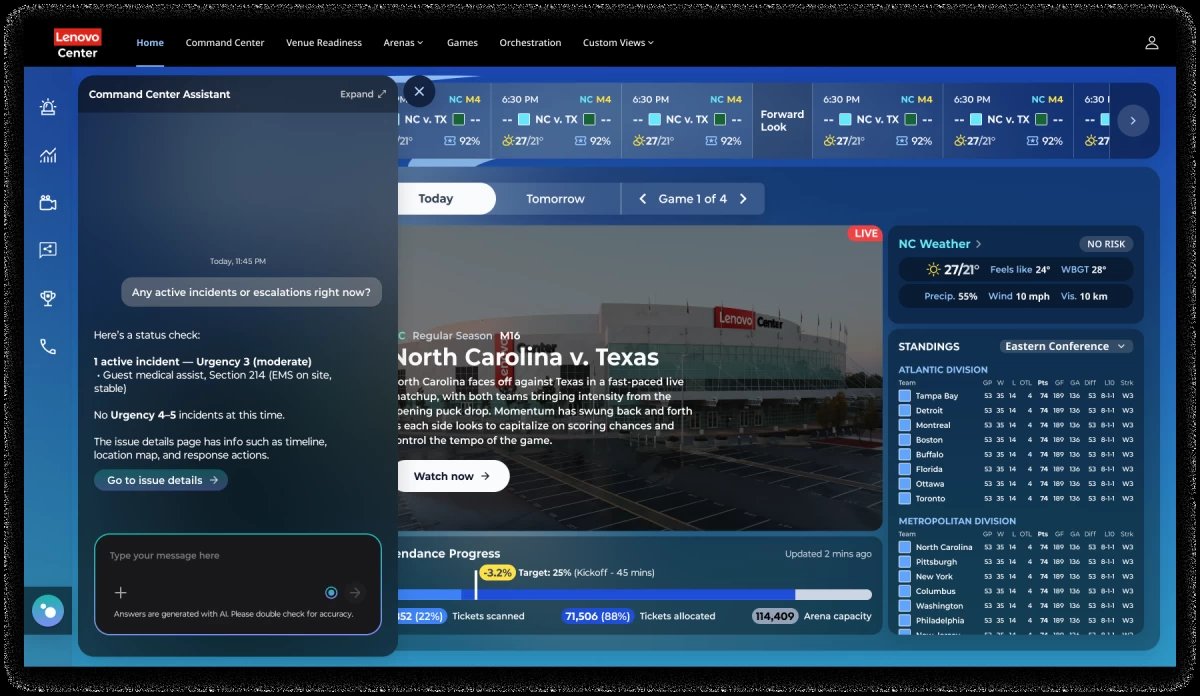
The ICC is a centralized, real-time operations platform that gives FIFA a holistic, live view of everything happening across the tournament. It aggregates data from multiple operational systems into a single environment, giving officials a shared source of truth from venue-level activity to tournament-wide trends.
While previous tournaments relied on teams consuming information from different systems with fragmented information, the ICC brings it all together in one place, in real-time.
Who is it built for?
The ICC is designed for FIFA operations teams and executives, who need a shared, live operational picture to coordinate and make decisions quickly. It is a fundamental feature of the Tournament Operations Center (TOC) in Miami, the venue from which FIFA oversees the entire tournament. Big screens will display real-time insights and alerts, and operational details will be made available to appropriate stakeholders directly into the palm of their hands on Lenovo tablets and devices.
When something happens the ICC helps ensure that the people who need to act are all looking at the same information, aiding a controlled and synchronized response.
How does this change tournament operations?
At a tournament spanning three countries and 16 stadiums, seamless coordination becomes more important than ever. Different functional areas can now update each other in real-time from across the continent, recurring issues can be shared in seconds, and informed decisions can be made faster.
Building on this, the ICC introduces a more connected way of working. While tournament operations have traditionally relied on siloed systems, the ICC brings these together into a live, unified view of operations. This enables FIFA officials to identify potential bottlenecks, risks, and disruptions earlier and respond more effectively as situations evolve.
What is Lenovo’s role?
Lenovo’s role is to design and build the ICC platform, ensuring its seamless execution across functionality, performance, and responsiveness. Lenovo enables the integration of data, dashboards, and decision-support tools that power the platform. Working in close partnership with FIFA’s operations teams, Lenovo ensures the platform reflects the agreed operational requirements and meets defined standards, enabling a consistent, reliable, and real-time view of tournament operations for all stakeholders when it matters most.
What else does the ICC provide?
Beyond real-time monitoring, the ICC supports collaboration across teams, scenario planning ahead of matches, and post-event analysis to help FIFA continuously improve operational execution across venues and throughout the tournament.

Related Tags

Lenovo FIFA 2026
ADVERTISEMENT
.most-popular .layout-ratio{ padding-bottom: 79.13%; } @media (min-width: 768px) and (max-width: 1024px) { .widget-title { font-size: 15px !important; } }

{{ articles_filter_1561_widget.title }}

.most-popular .layout-ratio{ padding-bottom: 79.13%; } @media (min-width: 768px) and (max-width: 1024px) { .widget-title { font-size: 15px !important; } }

{{ static_articles_1562_widget.title }}

.most-popular .layout-ratio{ padding-bottom: 79.13%; } @media (min-width: 768px) and (max-width: 1024px) { .widget-title { font-size: 15px !important; } }

{{ articles_filter_1563_widget.title }}

{{ articles_filter_1564_widget.title }}

.mb-article-details { position: relative; } .mb-article-details .article-body-preview, .mb-article-details .article-body-summary{ font-size: 17px; line-height: 30px; font-family: "Libre Caslon Text", serif; color: #000; } .mb-article-details .article-body-preview iframe , .mb-article-details .article-body-summary iframe{ width: 100%; margin: auto; } .read-more-background { background: linear-gradient(180deg, color(display-p3 1.000 1.000 1.000 / 0) 13.75%, color(display-p3 1.000 1.000 1.000 / 0.8) 30.79%, color(display-p3 1.000 1.000 1.000) 72.5%); position: absolute; height: 200px; width: 100%; bottom: 0; display: flex; justify-content: center; align-items: center; padding: 0; } .read-more-background a{ color: #000; } .read-more-btn { padding: 17px 45px; font-family: Inter; font-weight: 700; font-size: 18px; line-height: 16px; text-align: center; vertical-align: middle; border: 1px solid black; background-color: white; } .hidden { display: none; }
function initializeAllSwipers() { // Get all hidden inputs with cms_article_id document.querySelectorAll('[id^="cms_article_id_"]').forEach(function (input) { const cmsArticleId = input.value; const articleSelector = '#article-' + cmsArticleId + ' .body_images'; const swiperElement = document.querySelector(articleSelector); if (swiperElement && !swiperElement.classList.contains('swiper-initialized')) { new Swiper(articleSelector, { loop: true, pagination: false, navigation: { nextEl: '#article-' + cmsArticleId + ' .swiper-button-next', prevEl: '#article-' + cmsArticleId + ' .swiper-button-prev', }, }); } }); } setTimeout(initializeAllSwipers, 3000); const intersectionObserver = new IntersectionObserver( (entries) => { entries.forEach((entry) => { if (entry.isIntersecting) { const newUrl = entry.target.getAttribute("data-url"); if (newUrl) { history.pushState(null, null, newUrl); let article = entry.target; // Extract metadata const author = article.querySelector('.author-section').textContent.replace('By', '').trim(); const section = article.querySelector('.section-info ').textContent.replace(' ', ' '); const title = article.querySelector('.article-title h1').textContent; // Parse URL for Chartbeat path format const parsedUrl = new URL(newUrl, window.location.origin); const cleanUrl = parsedUrl.host + parsedUrl.pathname; // Update Chartbeat configuration if (typeof window._sf_async_config !== 'undefined') { window._sf_async_config.path = cleanUrl; window._sf_async_config.sections = section; window._sf_async_config.authors = author; } // Track virtual page view with Chartbeat if (typeof pSUPERFLY !== 'undefined' && typeof pSUPERFLY.virtualPage === 'function') { try { pSUPERFLY.virtualPage({ path: cleanUrl, title: title, sections: section, authors: author }); } catch (error) { console.error('ping error', error); } } // Optional: Update document title if (title && title !== document.title) { document.title = title; } } } }); }, { threshold: 0.1 } ); function showArticleBody(button) { const article = button.closest("article"); const summary = article.querySelector(".article-body-summary"); const body = article.querySelector(".article-body-preview"); const readMoreSection = article.querySelector(".read-more-background"); // Hide summary and read-more section summary.style.display = "none"; readMoreSection.style.display = "none"; // Show the full article body body.classList.remove("hidden"); } document.addEventListener("DOMContentLoaded", () => { let loadCount = 0; // Track how many times articles are loaded const offset = [1, 2, 3, 4, 5, 6, 7, 8, 9, 10]; // Offset values const currentUrl = window.location.pathname.substring(1); let isLoading = false; // Prevent multiple calls if (!currentUrl) { console.log("Current URL is invalid."); return; } const sentinel = document.getElementById("load-more-sentinel"); if (!sentinel) { console.log("Sentinel element not found."); return; } function isSentinelVisible() { const rect = sentinel.getBoundingClientRect(); return ( rect.top < window.innerHeight && rect.bottom >= 0 ); } function onScroll() { if (isLoading) return; if (isSentinelVisible()) { if (loadCount >= offset.length) { console.log("Maximum load attempts reached."); window.removeEventListener("scroll", onScroll); return; } isLoading = true; const currentOffset = offset[loadCount]; window.loadMoreItems().then(() => { let article = document.querySelector('#widget_1690 > div:nth-last-of-type(2) article'); intersectionObserver.observe(article) loadCount++; }).catch(error => { console.error("Error loading more items:", error); }).finally(() => { isLoading = false; }); } } window.addEventListener("scroll", onScroll); });

Sign up by email to receive news.