






Manila Bulletin
 Philippines
National
Earthquake swarm off Masbate reaches over 50 quakes since July 13
Philippines
National
Earthquake swarm off Masbate reaches over 50 quakes since July 13
Philippines
National
Earthquake swarm off Masbate reaches over 50 quakes since July 13
Earthquake swarm off Masbate reaches over 50 quakes since July 13
Published Jul 14, 2026 06:47 pm


At A Glance
- Phivolcs said an earthquake swarm is a series of earthquakes that occur close together in both location and time without a distinct mainshock followed by aftershocks.
- Such activity may continue for days or weeks and, in some cases, even longer.
Philippine Institute of Volcanology and Seismology (Phivolcs)
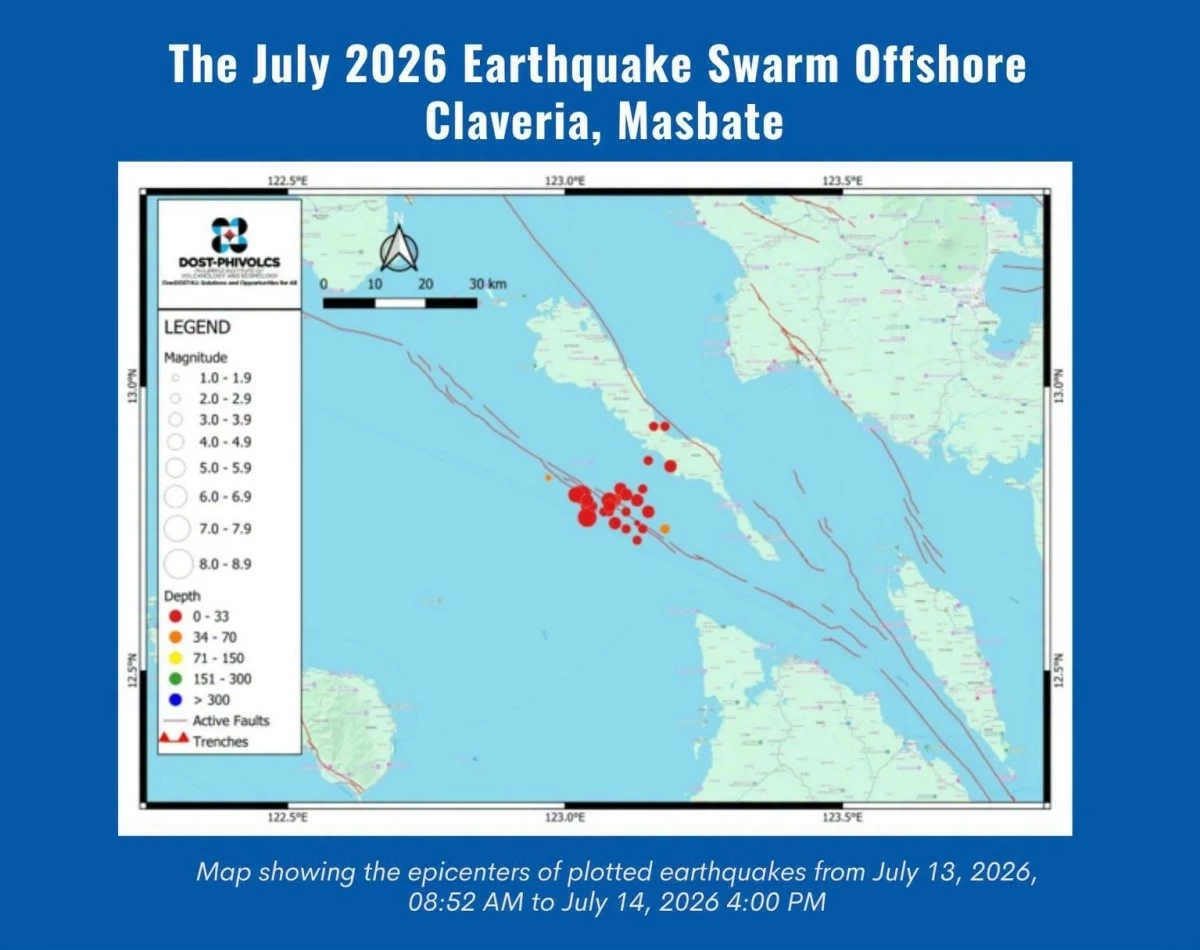
The Philippine Institute of Volcanology and Seismology (Phivolcs) has recorded 54 earthquakes off Claveria, Masbate, since an earthquake swarm began on Monday morning, July 13.
In an advisory issued on Tuesday, July 14, Phivolcs said the swarm started at 8:52 a.m. on July 13.
As of 4 p.m. Tuesday, its seismic network had detected 54 earthquakes.
Of the total, 28 earthquakes have been located, while five were felt by residents.
The strongest shaking reached Intensity V or “strong” on the Phivolcs Earthquake Intensity Scale.
The earthquakes ranged from magnitude 1.6 to 5.4 and occurred at depths of one to 45 kilometers.
Phivolcs said an earthquake swarm is a series of earthquakes that occur close together in both location and time without a distinct mainshock followed by aftershocks.
Such activity may continue for days or weeks and, in some cases, even longer.
It added that earthquake swarms may or may not be followed by a stronger earthquake.
Phivolcs advised residents to remain vigilant, review earthquake preparedness measures, identify the safest evacuation routes, prepare emergency supply kits, and observe the "Duck, Cover, and Hold" procedure during earthquakes.
For communities along the coast, Phivolcs reminded the public to watch for the natural warning signs of a possible local tsunami, including a strong and prolonged earthquake, unusual sea behavior such as the sudden retreat of seawater, and a loud roaring sound from the ocean.
Residents who notice any of these signs were urged to move immediately to higher ground and follow instructions from local government authorities.